
📖 Acts 16:35–40 (NKJV) 📚
35 And when it was day, the magistrates sent the officers, saying, “Let those men go.”
36 So the keeper of the prison reported these words to Paul, saying, “The magistrates have sent to let you go. Now therefore depart, and go in peace.”
37 But Paul said to them, “They have beaten us openly, uncondemned Romans, and have thrown us into prison. And now do they put us out secretly? No indeed! Let them come themselves and get us out.”
38 And the officers told these words to the magistrates, and they were afraid when they heard that they were Romans.
39 Then they came and pleaded with them and brought them out, and asked them to depart from the city.
40 So they went out of the prison and entered the house of Lydia; and when they had seen the brethren, they encouraged them and departed.

👣 Traces of Jesus’ Ministry 👣
🌅 Public injustice made right — Paul refused to leave secretly after being beaten unjustly (v.37). This reflects Jesus’ own trial and crucifixion, endured openly before all (John 18:20). Truth is not hidden in shadows but shines in the open.
⚖️ Boldness with authority — Paul’s insistence on justice shows the courage Jesus taught His disciples to have when standing before rulers (Matthew 10:18–20). Like Christ, Paul relied not on fear but on truth.
💔 Humbling of the powerful — The magistrates, once so bold in condemning, came trembling when confronted with their injustice (vv.38–39). This echoes Jesus’ parable where the exalted are humbled and the humble exalted (Luke 14:11).
🏠 Return to fellowship — Paul and Silas encouraged the brethren at Lydia’s house before departing (v.40). Jesus also strengthened His disciples after resurrection appearances, reminding them to carry on in faith (John 20:19–21).
🕊️ Peaceful departure — Though wronged, Paul and Silas left Philippi without vengeance (v.40). This reflects Jesus’ teaching in Matthew 5:39, to resist retaliation and instead walk in peace.

📜 From the Early Church 📜
🌅 Morning release — The timing of the magistrates’ orders at daybreak (v.35) highlights how justice in the early church often came not through the night of suffering, but with God’s mercies in the morning (Lamentations 3:23 echoed in practice).
⚖️ Roman citizenship as protection — Paul’s bold claim of Roman rights (v.37) shows how the early church navigated both faith and civic status. Citizenship was not boasted for pride, but used to protect the gospel mission.
😨 Fear of the authorities — The magistrates, who once beat Paul and Silas, trembled when they learned they had violated Roman law (vv.38–39). The early church often saw rulers who persecuted them become fearful when truth came to light.
🏠 The house church at Lydia’s — Paul and Silas returned to Lydia’s house (v.40), a reminder that the early church thrived not in temples or synagogues alone but in homes. Hospitality was the foundation of Christian fellowship and encouragement.
🕊️ Encouragement before departure — Before leaving Philippi, Paul and Silas strengthened the believers (v.40). This reflects the apostolic pattern: wherever the church was planted, it was left rooted in encouragement and teaching.
⏳ Historical & Cultural Background ⌛️
⚖️ Magistrates in Philippi — The “magistrates” (στρατηγοί, stratēgoi) were Roman officials overseeing law and order in the colony. Their authority was considerable, but they were still bound by Roman law, which protected citizens from unlawful punishment.
🇮🇹 Roman citizenship — Citizenship carried immense privileges in the Roman Empire. Roman citizens could not be beaten or imprisoned without a trial (Lex Valeria and Lex Porcia). Paul and Silas, as citizens, had been severely wronged, giving them grounds to protest.
👮 Officers (lictors) — The “officers” sent by the magistrates (v.35) were likely lictors, attendants who carried rods as symbols of authority. Ironically, these same rods had been used to beat Paul and Silas the day before.
🌅 Daybreak justice — Official Roman business was often conducted in the morning. The magistrates’ decision to quietly release Paul and Silas at dawn may reflect both routine practice and an attempt to avoid further public attention.
😨 Fear of reprisal — When the magistrates realized they had illegally punished Roman citizens, they feared the consequences. Roman officials who violated citizenship rights could face severe penalties, including loss of office or worse.
🏠 Lydia’s house church — Returning to Lydia’s home (v.40) shows again how the early Christian movement thrived through household gatherings. Homes became centers of worship, encouragement, and mission in cities across the empire.
🔍 Theological Themes

⚖️ Justice and Truth — Paul refused to leave secretly after being wronged (v.37). His stand shows that God cares about truth and justice, not only private faith.
😨 The Powerful Humbled — The magistrates who once condemned Paul and Silas were reduced to pleading with them (vv.38–39). God often overturns human pride, exalting the lowly and humbling the mighty.
🇮🇹 Faith and Citizenship — Paul’s appeal to Roman citizenship shows that believers may rightly use their earthly rights to advance God’s purposes. Our heavenly citizenship does not erase earthly responsibilities but reframes them for God’s glory.
🏠 Strengthening the Church — Paul and Silas visited Lydia’s house before leaving (v.40). Ministry is not just about public witness but also about building up the community of believers.
🕊️ Leaving in Peace — Though unjustly treated, Paul and Silas departed without vengeance. Their response reflects Christ’s teaching to seek peace, leaving the city stronger in faith rather than divided in strife.
🌅 Morning Mercy — The timing of their release at daybreak reflects God’s faithfulness: joy comes in the morning (Psalm 30:5). Even after a night of suffering, God brings new mercies at dawn.
🕎 Old Testament Connections 🏛️

⚖️ Justice for the Innocent — Paul’s protest against unlawful beating (v.37) echoes God’s law: “You shall not pervert justice” (Deuteronomy 16:19). The Lord always defends the rights of the innocent.
😨 The Mighty Fear — The magistrates trembling after their wrongdoing (vv.38–39) recalls Psalm 2:10–11: “Be wise, O kings… serve the Lord with fear, and rejoice with trembling.” Human rulers ultimately answer to God’s higher authority.
🏠 Gathering in Homes — Returning to Lydia’s house (v.40) reflects the Old Testament pattern of households serving the Lord, as Joshua declared: “As for me and my house, we will serve the Lord” (Joshua 24:15).
🌅 Deliverance at Dawn — Their release in the morning (v.35) connects to Psalm 30:5: “Weeping may endure for a night, but joy comes in the morning.” God’s mercy shines brightest after the darkest night.
🕊️ Encouragement of the Faithful — Paul and Silas encouraging the brethren before leaving (v.40) recalls how Moses encouraged Joshua before entering the land (Deuteronomy 31:7). God strengthens His people through faithful leaders.
🗝️ Key Word Studies 🔑
“Magistrates” (στρατηγοί, stratēgoi) ⚖️ — Strong’s G4755
Originally “generals” or “leaders of an army,” but in Roman colonies referred to chief officials who governed civic and legal matters. Their decisions carried weight, yet they feared Rome’s law when they realized their mistake.
“Officers” (ῥαβδοῦχοι, rhabdouchoi) 👮 — Strong’s G4465
Literally “rod-bearers” or lictors. These attendants carried rods as symbols of Roman authority and were the ones who executed beatings.
“Beaten” (δείραντες, deirantes) 💔 — Strong’s G1194
To flay, thrash, or whip. This word underscores the severity of the punishment inflicted on Paul and Silas.
“Uncondemned” (ἀκατακρίτους, akatakritous) ⚖️ — Strong’s G178
Without a proper trial or legal sentence. Paul emphasized their rights as Roman citizens had been completely disregarded.
“Afraid” (ἐφοβήθησαν, ephobēthēsan) 😨 — Strong’s G5399
To fear, be alarmed, or struck with awe. The magistrates’ fear reflects the gravity of violating Roman law.
“Encouraged” (παρεκάλεσαν, parekalesan) 🕊️ — Strong’s G3870
To exhort, comfort, or strengthen. Paul and Silas’ final act in Philippi was not bitterness but encouragement, building up the church in love before departing.
⁉️ Thoughtful Reflection Questions ⍰
- ⚖️ Paul stood for justice, insisting that the magistrates acknowledge their wrongdoing (v.37).
- How can I discern when God is calling me to quietly endure versus when He is calling me to boldly speak out?
- 😨 The magistrates who once held power trembled when confronted with truth (vv.38–39).
- How does this remind me that God, not human authority, has the final word?
- 🏠 Paul and Silas encouraged the believers at Lydia’s house before leaving (v.40).
- Who has God placed in my life that I can encourage and strengthen in their faith today?
- 🕊️ Though wronged, Paul and Silas left Philippi peacefully (v.40).
- What does it look like for me to walk away from hurtful situations with Christlike peace instead of bitterness?
- 🌅 Their release came at daybreak, after a long night of suffering (v.35).
- Where do I need to hold onto the hope that “joy comes in the morning” (Psalm 30:5)?
📚 References 📚
Free Online Sources:
- Blue Letter Bible — NKJV text, lexicon, and Strong’s Concordance. https://www.blueletterbible.org
- Bible Hub — Parallel translations and commentaries. https://biblehub.com
- NET Bible Notes — Textual and cultural insights. https://netbible.org
Image Credits (Created for This Post):
- “The message of release at daybreak.” — Ancient fresco style AI image created by ChatGPT for this study (Acts 16:35–40).
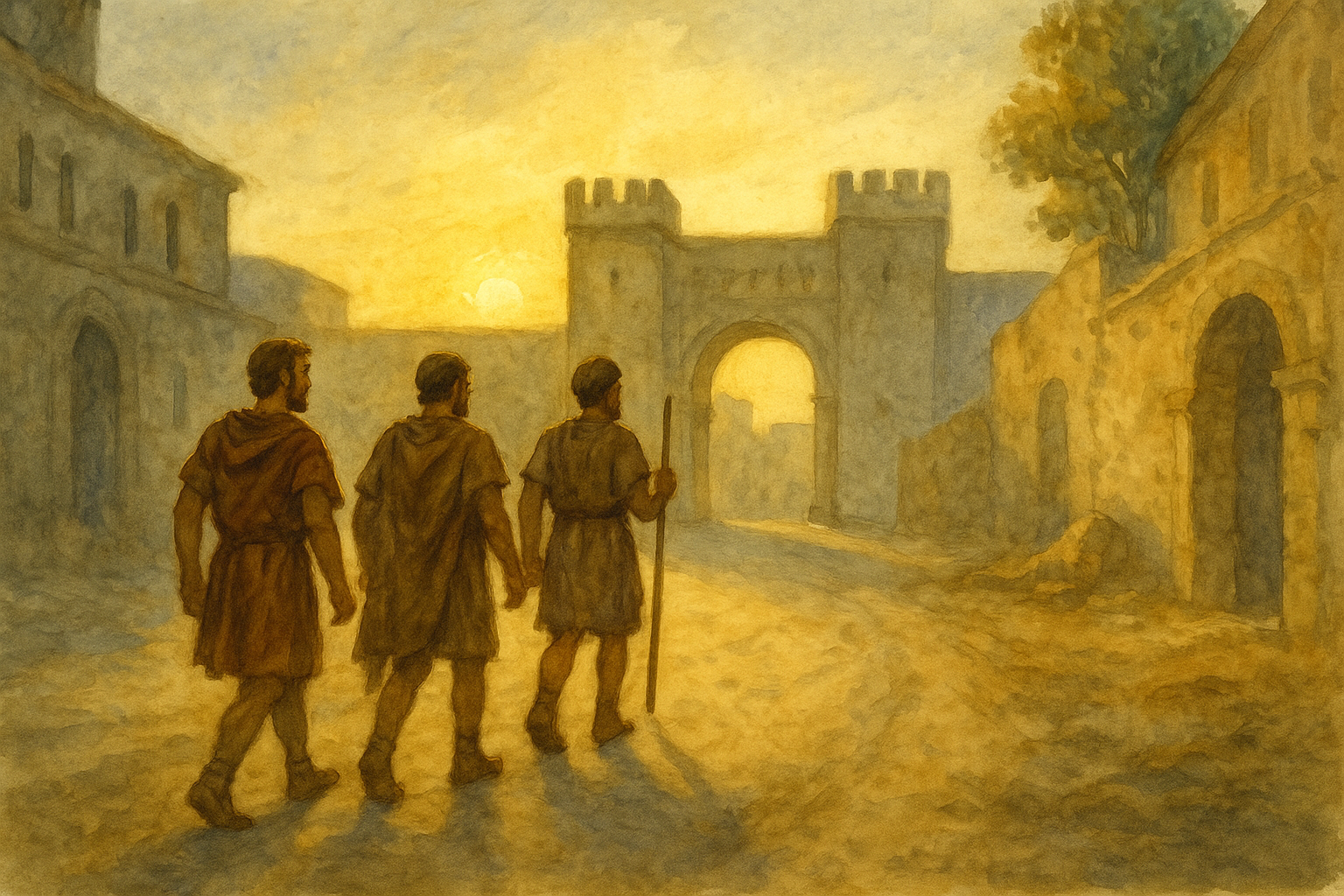
- “Depart, and go in peace.” — Watercolor style AI image created by ChatGPT for this study (Acts 16:35–40).
- “Paul’s bold declaration of Roman citizenship.” — Ancient fresco style AI image created by ChatGPT for this study (Acts 16:35–40).
- “Authorities trembling before the truth.” — Ancient fresco style AI image created by ChatGPT for this study (Acts 16:35–40).
- “The church strengthened in Lydia’s house.” — Ancient fresco style AI image created by ChatGPT for this study (Acts 16:35–40).
Artificial Intelligence Assistance:
ChatGPT. “🌸 Paul and Silas Released 🌻 — Acts 16:35–40.” OpenAI, 2025, https://chat.openai.com.
This post was prayerfully prepared in collaboration with ChatGPT 🤖, a research assistant designed to support deep, Christ-centered Bible study.
All Scripture is taken from the New King James Version (NKJV).
May this work bring glory to God and encouragement to the hearts of those who read it. 🕊️💕
Leave a Reply