
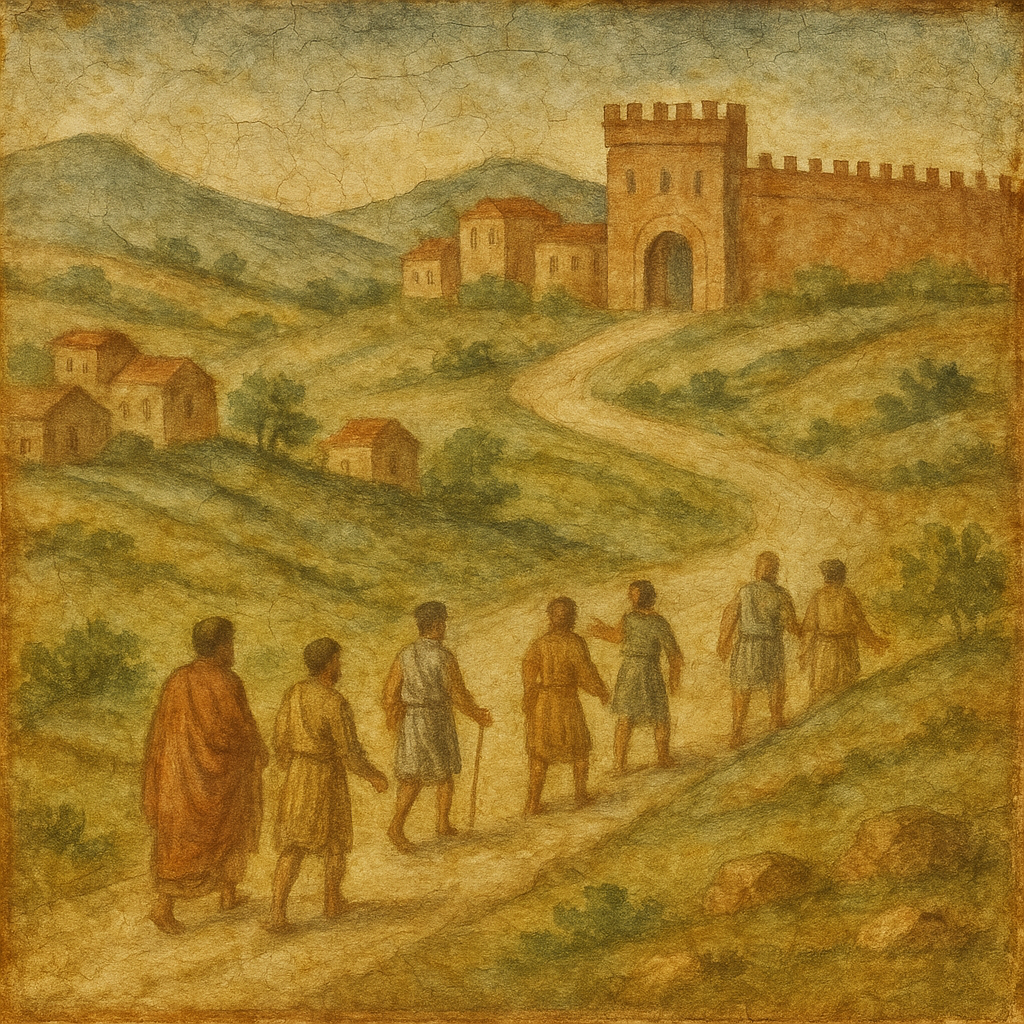
1 Now when they had passed through Amphipolis and Apollonia, they came to Thessalonica, where there was a synagogue of the Jews.
2 Then Paul, as his custom was, went in to them, and for three Sabbaths reasoned with them from the Scriptures,
3 explaining and demonstrating that the Christ had to suffer and rise again from the dead, and saying, “This Jesus whom I preach to you is the Christ.”
4 And some of them were persuaded; and a great multitude of the devout Greeks, and not a few of the leading women, joined Paul and Silas.
5 But the Jews who were not persuaded, becoming envious, took some of the evil men from the marketplace, and gathering a mob, set all the city in an uproar and attacked the house of Jason, and sought to bring them out to the people.
6 But when they did not find them, they dragged Jason and some brethren to the rulers of the city, crying out, “These who have turned the world upside down have come here too.
7 Jason has harbored them, and these are all acting contrary to the decrees of Caesar, saying there is another king—Jesus.”
8 And they troubled the crowd and the rulers of the city when they heard these things.
9 So when they had taken security from Jason and the rest, they let them go.

👣 Traces of Jesus’ Ministry 👣
📜 Reasoning from the Scriptures — Paul’s custom of entering the synagogue and teaching from the Scriptures (vv.2–3) echoes Jesus, who also taught in synagogues, reading and explaining the Word (Luke 4:16–21).
✝️ Christ Must Suffer and Rise — Paul emphasized the suffering and resurrection of the Christ (v.3). This directly continues Jesus’ own teaching after His resurrection: “Thus it is written, and thus it was necessary for the Christ to suffer and to rise from the dead the third day” (Luke 24:46).
🌍 Drawing Jews and Greeks — The message persuaded both Jews and devout Greeks (v.4). Jesus Himself reached across boundaries, bringing Samaritans, tax collectors, and Gentiles into His circle (John 4:39–42; Matthew 8:10).
👑 Another King—Jesus — The accusation that Paul and Silas proclaimed another king (v.7) recalls Jesus’ trial before Pilate, where He was charged with claiming kingship (John 18:33–37). The gospel’s claim to Christ’s kingship still confronts worldly powers.
🔥 Division over the Message — Just as some believed while others rejected Jesus (John 7:43), Paul’s preaching in Thessalonica caused both persuasion and envy, leading to uproar (vv.4–5). The ministry of Christ always brings decision.

📜 From the Early Church 📜
📖 Scripture-Centered Preaching — Paul’s ministry in Thessalonica was rooted in the Scriptures (vv.2–3). The early church modeled its preaching not on novelty, but on opening the Law and Prophets to reveal Christ.
⏳ Three Sabbaths — Paul’s short stay (about three weeks) shows how quickly the gospel could take root. Early believers treasured even brief teaching, clinging to the Word with hunger and zeal.
🌍 Multitudes Persuaded — Both Jews and Greeks, including prominent women, believed (v.4). The early church was remarkable for its diversity—breaking social, ethnic, and gender barriers that divided the ancient world.
🔥 Envy and Opposition — Opposition rose from those unwilling to believe (vv.5–6). The early church often faced hostility not just from rulers but from those envious of the gospel’s impact.
👑 Another King—Jesus — The charge of treason (v.7) was serious under Roman rule. The early church proclaimed Christ as Lord, knowing it could cost them reputation, security, or life itself.
🏠 The House of Jason — Like Lydia, Jason’s home became a center of gospel activity (vv.5–6). The early church often relied on household gatherings, showing the vital role of hospitality in the mission.

⏳ Historical & Cultural Background ⌛️
🏛️ Thessalonica — A bustling port city on the Via Egnatia, the major Roman road connecting east and west. Its location made it a strategic hub for trade, politics, and the spread of the gospel.
📖 Synagogues in the Diaspora — Thessalonica had a synagogue (v.1), unlike Philippi. Synagogues served as places for worship, teaching, and community life for Jews scattered through the Roman world. Paul’s custom of beginning there reflects the pattern of preaching “to the Jew first” (Romans 1:16).
⏳ Reasoning with the Scriptures — Jewish teaching often involved dialogue and explanation. Paul engaged in “reasoning” (dialegomai), which implied discussion and persuasive argument, not just preaching.
🌍 Leading Women — Prominent women of Thessalonica (v.4) were influential in both Jewish and Greek society. Inscriptions from Macedonia highlight women as benefactors of civic and religious life, which explains their notable presence among early converts.
🔥 Marketplace Mobs — The envious Jews gathered “evil men from the marketplace” (v.5). Marketplaces were social hubs where idle men lingered, easily stirred into violence. Ancient riots often began this way.
👑 Accusation of Treason — To say “another king—Jesus” (v.7) was dangerous under Roman rule. Caesar was the acknowledged ruler, and any rival claim could provoke charges of rebellion. This explains the alarm of the city rulers.
🏠 Security from Jason — Jason likely had to pay a bond to guarantee peace (v.9). This legal arrangement may have forced Paul to leave Thessalonica sooner than he wished, showing how the gospel often spread under pressure.

🔍 Theological Themes
📖 Christ Revealed in Scripture — Paul’s reasoning shows that the Old Testament points to Jesus’ suffering and resurrection (vv.2–3). The gospel is not detached from the Law and Prophets but is their fulfillment.
✝️ The Necessity of the Cross — Paul declared that the Christ had to suffer and rise (v.3). The cross was not an accident but God’s ordained plan for salvation.
🌍 The Gospel for All — Jews, Greeks, and leading women joined Paul and Silas (v.4). The gospel unites diverse people under one Lord, erasing cultural and social divisions.
🔥 The Cost of the Gospel — Envy, uproar, and false accusations followed Paul’s preaching (vv.5–7). Proclaiming Christ often stirs resistance because it challenges human pride and worldly power.
👑 Jesus as King — The charge that believers followed “another king—Jesus” (v.7) underscores the central Christian confession: Jesus is Lord. Allegiance to Him sometimes clashes with worldly rulers and systems.
🏠 Strength in Community — Jason’s home became a center of witness and also a place of risk (vv.5–6). The church grows in households where faith and hospitality intersect.
🕎 Old Testament Connections 🏛️
📖 Scripture as Witness — Paul reasoned from the Scriptures (vv.2–3), echoing passages like Isaiah 53 (the Suffering Servant) and Psalm 16:10 (the Holy One not seeing decay), both fulfilled in Jesus’ death and resurrection.
✝️ The Necessity of Suffering — The claim that “Christ had to suffer” (v.3) aligns with prophecies such as Zechariah 12:10 (“they will look on Me whom they pierced”) and Daniel 9:26 (the Anointed One cut off).
🌍 Light to the Nations — Devout Greeks and leading women believed (v.4). This fulfills Isaiah 49:6: “I will give You as a light to the Gentiles, that You should be My salvation to the ends of the earth.”
🔥 Jealousy of Opponents — The envy of some Jews (v.5) recalls Cain’s jealousy of Abel (Genesis 4:5–8) and Saul’s jealousy of David (1 Samuel 18:8–9). Jealousy repeatedly opposes God’s chosen servants.
👑 The Lord as King — The charge of “another king—Jesus” (v.7) echoes Old Testament promises of a coming King: “Yet I have set My King on My holy hill of Zion” (Psalm 2:6). The true King foretold has now come.
🏠 Household as Covenant Space — Jason’s house (vv.5–6) reflects the Old Testament pattern of households as places of covenant faith. Joshua declared, “As for me and my house, we will serve the Lord” (Joshua 24:15).
🗝️ Key Word Studies 🔑
“Reasoned” (διελέξατο, dieleksato) 📖 — Strong’s G1256
From dialegomai, meaning to discuss, argue, or dialogue. Paul’s preaching was interactive, aiming to persuade through explanation and reasoning.

“Explaining” (διανοίγων, dianoigōn) ✨ — Strong’s G1272
To open thoroughly, to make clear what was hidden. Used in Luke 24:32 when Jesus “opened the Scriptures” to the disciples on the Emmaus road.

“Demonstrating” (παρατιθέμενος, paratithemenos) 📜 — Strong’s G3908
To set forth, prove, or present evidence. Paul didn’t only explain but presented proofs that Jesus is the Christ.

“Persuaded” (ἐπείσθησαν, epeisthēsan) 💡 — Strong’s G3982
To be convinced, to believe with confidence. Faith here is shown as the result of conviction through the Spirit’s work in Paul’s reasoning.

“Envious” (ζηλώσαντες, zēlōsantes) 🔥 — Strong’s G2206
To be jealous, moved with envy. Often linked in Scripture with destructive rivalry (James 3:16).

“Uproar” (θορυβήσαντες, thorubēsantes) 📢 — Strong’s G2350
To stir into confusion, cause a commotion. Used to describe riots or public chaos, often arising against the gospel.

“Another King” (ἕτερον βασιλέα, heteron basilea) 👑 — Strong’s G2087 + G935
“Another” meaning different in kind; basileus meaning ruler or king. The charge placed Jesus as a rival to Caesar, showing the political weight of proclaiming Christ’s kingship.
⁉️ Thoughtful Reflection Questions ⍰
- 📖 Paul “reasoned with them from the Scriptures” (vv.2–3).
- How can I grow in my ability to share God’s Word clearly and persuasively with others?
- ✝️ Paul explained that Christ had to suffer and rise again (v.3).
- How does remembering the necessity of the cross shape my gratitude and daily walk with Jesus?
- 🌍 A diverse group of Jews, Greeks, and prominent women believed (v.4).
- In what ways can I embrace and encourage diversity within the body of Christ today?
- 🔥 Envy led to uproar and false accusations (vv.5–7).
- How do I respond when others resist or oppose God’s work in my life or community?
- 👑 The charge was raised: “There is another King—Jesus” (v.7).
- What does it mean in practice for me to live as one who serves King Jesus above all earthly rulers or systems?
- 🏠 Jason’s house became both a refuge and a place of risk (vv.5–6).
- How can I use my home, resources, or influence to support the spread of the gospel, even when it comes at personal cost?
📚 References 📚
Free Online Sources:
- Blue Letter Bible — NKJV text, lexicon, and Strong’s Concordance. https://www.blueletterbible.org
- Bible Hub — Parallel translations and commentaries. https://biblehub.com
- NET Bible Notes — Textual and cultural insights. https://netbible.org
Image Credits (Wordless, Created for This Post):
- “Journey into Thessalonica.” — Ancient fresco style AI image created by ChatGPT for this study (Acts 17:1–9).
- “Reasoning from the Scriptures.” — Ancient fresco style AI image created by ChatGPT for this study (Acts 17:1–9).
- “Hearts persuaded and joined to Christ.” — Ancient fresco style AI image created by ChatGPT for this study (Acts 17:1–9).
- “Envy stirring the city into uproar.” — Ancient fresco style AI image created by ChatGPT for this study (Acts 17:1–9).
- “Accusations before the rulers of the city.” — Ancient fresco style AI image created by ChatGPT for this study (Acts 17:1–9).
Artificial Intelligence Assistance:
ChatGPT. “🌸 Paul and Silas at Thessalonica 🌻 — Acts 17:1–9.” OpenAI, 2025, https://chat.openai.com.
This post was prayerfully prepared in collaboration with ChatGPT 🤖, a research assistant designed to support deep, Christ-centered Bible study.
All Scripture is taken from the New King James Version (NKJV).
May this work bring glory to God and encouragement to the hearts of those who read it. 🕊️💕
Leave a Reply