
📖 Acts 16:25–34 (NKJV) 📚
25 But at midnight Paul and Silas were praying and singing hymns to God, and the prisoners were listening to them.
26 Suddenly there was a great earthquake, so that the foundations of the prison were shaken; and immediately all the doors were opened and everyone’s chains were loosed.
27 And the keeper of the prison, awaking from sleep and seeing the prison doors open, supposing the prisoners had fled, drew his sword and was about to kill himself.
28 But Paul called with a loud voice, saying, “Do yourself no harm, for we are all here.”
29 Then he called for a light, ran in, and fell down trembling before Paul and Silas.
30 And he brought them out and said, “Sirs, what must I do to be saved?”
31 So they said, “Believe on the Lord Jesus Christ, and you will be saved, you and your household.”
32 Then they spoke the word of the Lord to him and to all who were in his house.
33 And he took them the same hour of the night and washed their stripes. And immediately he and all his family were baptized.
34 Now when he had brought them into his house, he set food before them; and he rejoiced, having believed in God with all his household.

👣 Traces of Jesus’ Ministry 👣
🎶 Songs in the night — Paul and Silas praying and singing in prison (v.25) echo Jesus Himself, who sang a hymn with His disciples before going out to Gethsemane (Matthew 26:30). Praise often rises strongest in the shadow of suffering.
🌊 Chains falling away — The earthquake that loosed every prisoner’s chains (v.26) reflects Jesus’ ministry of setting captives free (Luke 4:18). His power brings release not only spiritually but sometimes physically, in miraculous ways.
💔 Compassion over self-preservation — Paul’s cry to the jailer, “Do yourself no harm” (v.28), mirrors Jesus’ own mercy toward those who came to harm Him (Luke 22:51, healing the servant’s ear). Both show the heart of God to save rather than destroy.
✨ The way of salvation revealed — The jailer’s desperate question, “What must I do to be saved?” (v.30), echoes the same urgency Jesus inspired in those He met (Mark 10:17, the rich young ruler). The answer is simple and Christ-centered: “Believe on the Lord Jesus Christ” (v.31).
🏠 Household salvation — The jailer’s whole family believed and was baptized (vv.33–34), just as Jesus ministered not only to individuals but to whole households (John 4:53, the nobleman’s household). Salvation in Christ reaches families and communities, not only isolated souls.

📜 From the Early Church 📜
🎶 Worship as witness — The prisoners listened as Paul and Silas sang hymns at midnight (v.25). The early church understood that worship, even in suffering, was a testimony that could move the hearts of those watching.
🌍 God’s power in unlikely places — A Roman prison became the setting for one of the most dramatic conversions in Acts. The gospel did not need pulpits or synagogues; it reached people in marketplaces, riversides, and even jail cells.
⚡ Earthquake as divine intervention — Early Christians saw natural events not as accidents but as instruments of God’s purpose. Just as the earthquake opened prison doors, the Spirit opened human hearts to salvation.
👮 The jailer’s transformation — A man once hardened by duty and violence fell trembling before the gospel (v.29). The early church treasured these stories as proof that no one was beyond God’s reach — even Roman officials.
💦 Baptism without delay — The jailer and his family were baptized immediately, in the middle of the night (v.33). This reflects the early church’s urgency in responding to faith with the outward sign of new life in Christ.
🥖 Hospitality as fellowship — After his baptism, the jailer brought Paul and Silas into his home and fed them (v.34). Shared meals were central to the early church, turning ordinary tables into places of rejoicing and communion.

⏳ Historical & Cultural Background ⌛️
🎶 Midnight hymns in prison — Roman prisons were harsh, dark, and unsanitary. Prisoners usually groaned in misery; Paul and Silas singing hymns at midnight (v.25) would have been utterly countercultural and deeply striking to all who heard.
⚡ Earthquakes in Macedonia — The region around Philippi was prone to seismic activity, but Luke frames this earthquake as divinely timed: it struck at midnight, opened doors, and loosed chains (v.26). Ancient people often viewed such natural events as direct acts of the gods.
👮 The jailer’s responsibility — Roman jailers were personally accountable for their prisoners. If a prisoner escaped, the jailer could face execution (see Acts 12:19). This explains why the jailer drew his sword to end his life when he thought the prisoners had fled (v.27).
🏠 Household conversions — In Greco-Roman culture, households (oikos) included family members, servants, and sometimes tenants. When the head of a household converted, it often influenced the entire group, reflecting the communal nature of ancient life.
💦 Baptism at night — Baptisms usually occurred immediately after faith was professed, regardless of time or place (as with the Ethiopian eunuch in Acts 8:36). The jailer’s family being baptized the same hour of the night (v.33) fits this pattern of urgency.
🥖 Hospitality as honor — For the jailer to bring Paul and Silas into his home, wash their wounds, and feed them (v.34) was not only kindness but also a strong statement of loyalty and fellowship. In Roman culture, table fellowship sealed bonds of trust and friendship.

🔍 Theological Themes
🎶 Worship in Suffering — Paul and Silas turned a prison cell into a sanctuary (v.25). Their hymns show that joy and praise are not dependent on circumstances but on God’s unchanging presence.
⚡ God’s Power to Deliver — The earthquake that opened doors and broke chains (v.26) demonstrates God’s sovereign ability to intervene miraculously. He remains Lord over creation and human bondage alike.
💔 Life Preserved, Not Lost — Paul’s words to the jailer, “Do yourself no harm” (v.28), highlight the gospel’s value of life. Where despair led the jailer toward death, God’s grace led him toward salvation.
✨ Salvation by Faith in Christ — The jailer’s question, “What must I do to be saved?” (v.30), receives the timeless answer: “Believe on the Lord Jesus Christ, and you will be saved” (v.31). Salvation rests on Christ alone, not works or rituals.
💦 Immediate Obedience in Baptism — The jailer and his household were baptized without hesitation (v.33). Theological emphasis is placed on baptism as a natural, urgent response to faith.
🏠 Household Faith — The conversion of the jailer’s family (v.34) shows how the gospel transforms entire homes. The church grows through the spread of faith in households, binding families together in Christ.
🥖 Joy as Fruit of Faith — The jailer rejoiced with his whole household after believing (v.34). True salvation brings not only forgiveness but also deep joy that reshapes everyday life.

🕎 Old Testament Connections 🏛️
🎶 Songs in the Night — Job declared, “He gives songs in the night” (Job 35:10). Paul and Silas embody this truth as they worship in prison at midnight (v.25). God’s people have long turned to Him in dark hours for strength and song.
⚡ God Shakes the Earth — Earthquakes often signified God’s presence and power in the Old Testament: at Sinai (Exodus 19:18), at Elijah’s mountain encounter (1 Kings 19:11), and in the Psalms (Psalm 68:8). The quake in Philippi (v.26) reflects the same divine intervention.
💔 Preserving Life — Paul’s cry to the jailer, “Do yourself no harm” (v.28), recalls God’s command not to take life, for all people bear His image (Genesis 9:6). Where human despair reached for death, God’s mercy preserved life.
✨ Household Salvation — God promised Abraham that “in you all the families of the earth shall be blessed” (Genesis 12:3). The salvation of the jailer’s household (v.34) reflects this covenant promise extending through Christ to the nations.
💦 Washing and Renewal — The jailer washed Paul and Silas’ stripes, and then he and his household were washed in baptism (v.33). This imagery recalls Ezekiel 36:25: “I will sprinkle clean water on you, and you shall be clean.”
🥖 Joy After Deliverance — Just as Israel rejoiced after God’s mighty acts (Exodus 15:1–2, the Song of Moses), the jailer and his family rejoiced after their salvation (v.34). God’s deliverance always leads to joy-filled worship.
🗝️ Key Word Studies 🔑
“Praying” (προσευχόμενοι, proseuchomenoi) 🙏 — Strong’s G4336
To address God, to worship. Paul and Silas’ prayer (v.25) highlights communion with God even in hardship.
“Hymns” (ὕμνουν, hymnoun) 🎶 — Strong’s G5214
To sing a hymn of praise, often directed to God. Their hymns at midnight recall the Psalms, Israel’s ancient hymnal of faith and lament.
“Earthquake” (σεισμός, seismos) ⚡ — Strong’s G4578
A shaking, storm, or commotion. Used for literal earthquakes but also symbolically for divine upheaval. Here, God shakes open what men shut.
“Saved” (σωθῶ, sōthō) ✨ — Strong’s G4982
To save, deliver, preserve. The jailer’s cry (v.30) expresses both physical desperation and spiritual longing; Paul and Silas answer with Christ’s salvation.
“Believe” (πίστευσον, pisteuson) 💡 — Strong’s G4100
To trust in, rely upon, place full confidence. Salvation rests not in effort but in believing on Jesus Christ (v.31).
“Baptized” (ἐβαπτίσθη, ebaptisthē) 💦 — Strong’s G907
To immerse, dip, or wash. Immediate baptism (v.33) reflects the New Testament pattern of visible, obedient faith.
“Rejoiced” (ἠγαλλιάσατο, ēgalliásato) 🕊️ — Strong’s G21
To exult, leap with joy. The jailer’s joy (v.34) shows salvation is not only rescue from danger but the entrance into new, abundant life in Christ.
⁉️ Thoughtful Reflection Questions ⍰
- 🎶 Paul and Silas prayed and sang hymns at midnight in prison (v.25).
- How can I practice worship when I am in a “dark cell” of hardship or uncertainty?
- ⚡ God shook the prison and broke chains (v.26).
- What “chains” in my life do I long for Him to break, and do I trust His timing to do so?
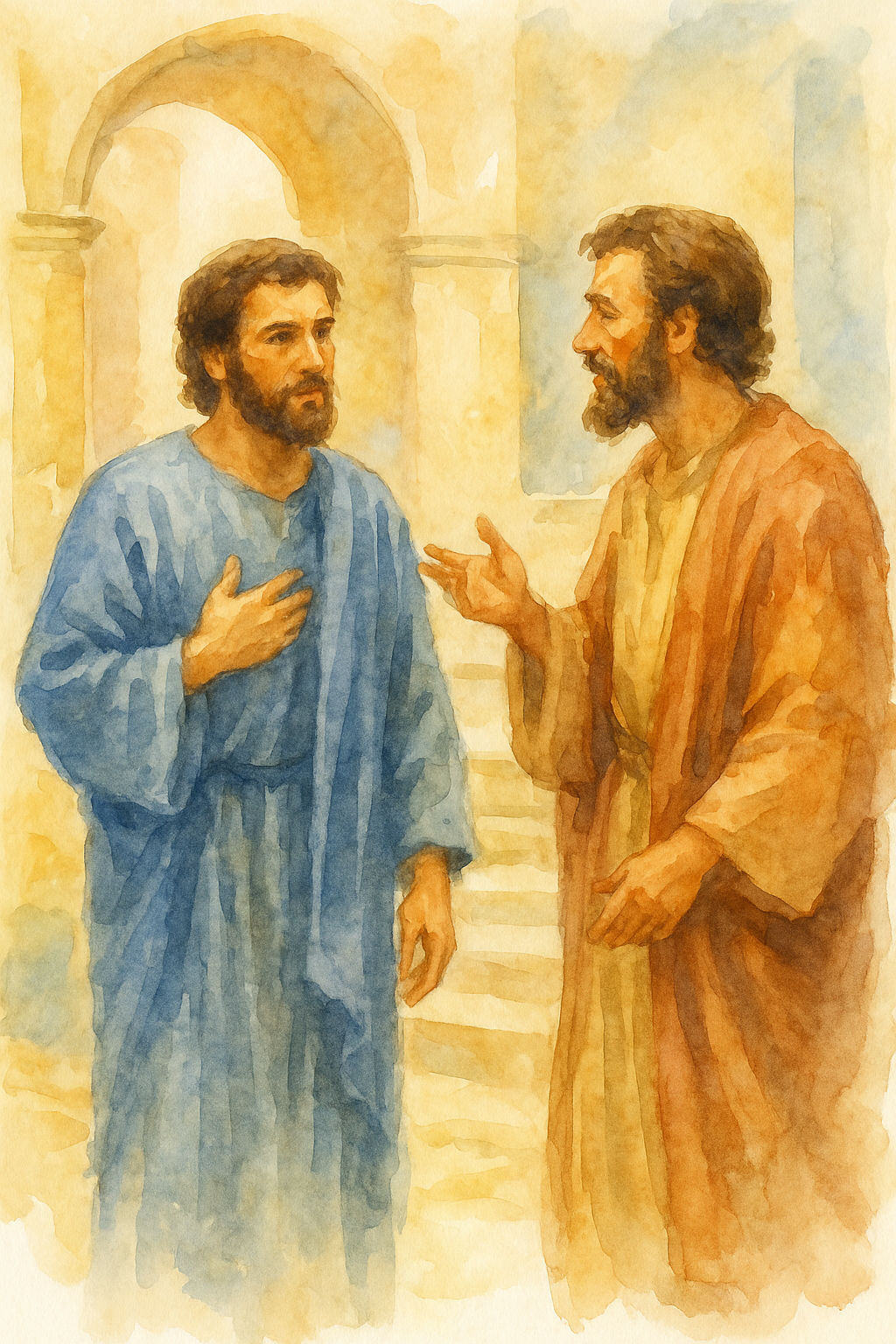
- 💔 Paul stopped the jailer from harming himself (v.28).
- How can I be attentive to those around me who may feel hopeless, and speak life and hope into their situations?
- ✨ The jailer asked, “What must I do to be saved?” (v.30).
- Have I fully embraced the simplicity of salvation by believing in Christ alone?
- 💦 The jailer and his household were baptized immediately (v.33).
- What steps of obedience might God be calling me to take without delay?
- 🕊️ The jailer rejoiced with his household after believing (v.34).
- How does my faith bring joy not only to me but also to those closest to me?
📚 References 📚
Free Online Sources:
- Blue Letter Bible — NKJV text, lexicon, and Strong’s Concordance. https://www.blueletterbible.org
- Bible Hub — Parallel translations and commentaries. https://biblehub.com
- NET Bible Notes — Textual and cultural insights. https://netbible.org
Image Credits (Wordless, Created for This Post):
- “Hymns rising in the midnight hour.” — Ancient fresco style AI image created by ChatGPT for this study (Acts 16:25–34).
- “The prison shaken, chains falling free.” — Ancient fresco style AI image created by ChatGPT for this study (Acts 16:25–34).
- “Despair at the edge of the sword.” — Ancient fresco style AI image created by ChatGPT for this study (Acts 16:25–34).
- “Hope spoken into the night.” — Ancient fresco style AI image created by ChatGPT for this study (Acts 16:25–34).
- “Rejoicing as a household believes and is baptized.” — Ancient fresco style AI image created by ChatGPT for this study (Acts 16:25–34).
Artificial Intelligence Assistance:
ChatGPT. “🌸 Paul and Silas in Prison 🌻 — Acts 16:25–34.” OpenAI, 2025, https://chat.openai.com.
This post was prayerfully prepared in collaboration with ChatGPT 🤖, a research assistant designed to support deep, Christ-centered Bible study.
All Scripture is taken from the New King James Version (NKJV).
May this work bring glory to God and encouragement to the hearts of those who read it. 🕊️💕
Leave a Reply