
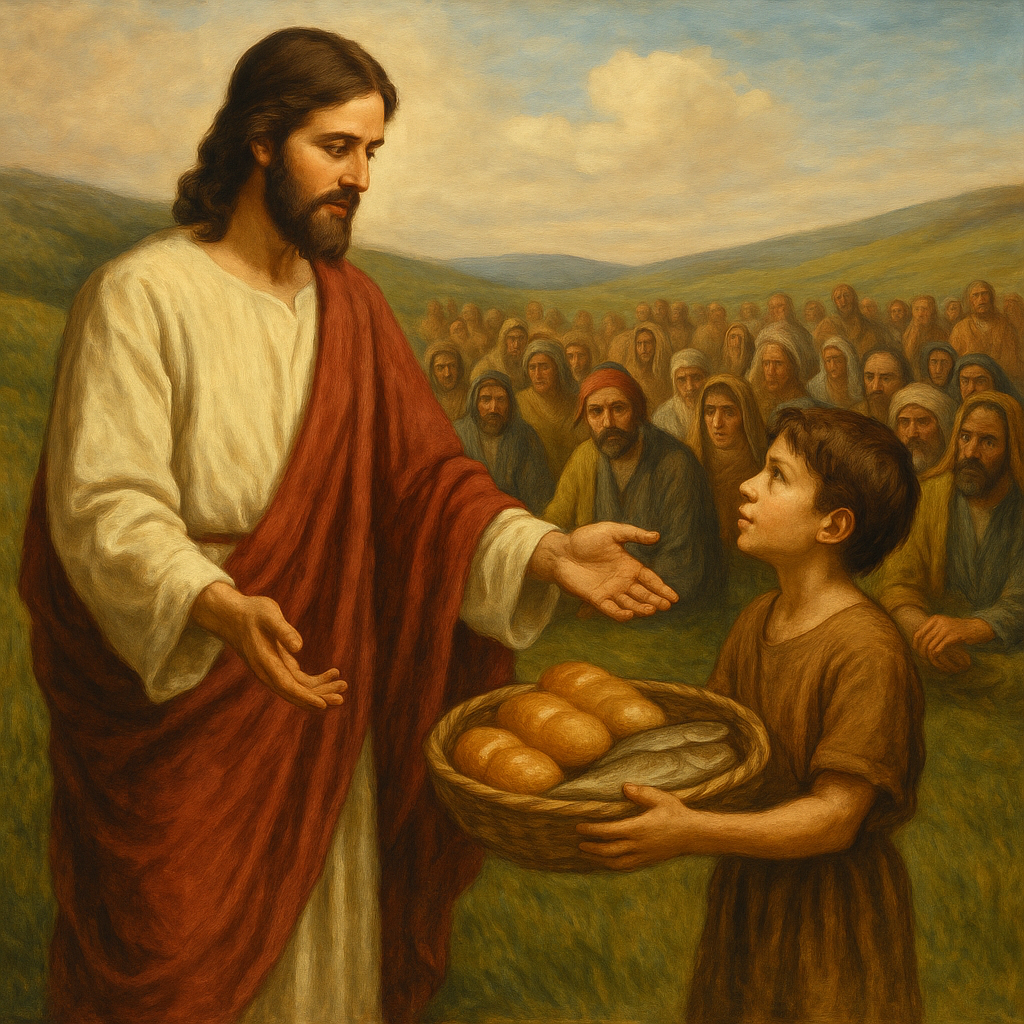
John 6:1–15 — The Feeding of the Five Thousand
✨ “Then Jesus took the loaves, and when He had given thanks He distributed them…” (John 6:11, NKJV)
Feeding the Five Thousand
(Matt. 14:13–21; Mark 6:30–44; Luke 9:10–17)
1 After these things Jesus went over the Sea of Galilee, which is the Sea of Tiberias.
2 Then a great multitude followed Him, because they saw His signs which He performed on those who were diseased.
3 And Jesus went up on the mountain, and there He sat with His disciples.
4 Now the Passover, a feast of the Jews, was near.
5 Then Jesus lifted up His eyes, and seeing a great multitude coming toward Him, He said to Philip, “Where shall we buy bread, that these may eat?”
6 But this He said to test him, for He Himself knew what He would do.
7 Philip answered Him, “Two hundred denarii worth of bread is not sufficient for them, that every one of them may have a little.”
8 One of His disciples, Andrew, Simon Peter’s brother, said to Him,
9 “There is a lad here who has five barley loaves and two small fish, but what are they among so many?”
10 Then Jesus said, “Make the people sit down.” Now there was much grass in the place. So the men sat down, in number about five thousand.
11 And Jesus took the loaves, and when He had given thanks He distributed them to the disciples, and the disciples to those sitting down; and likewise of the fish, as much as they wanted.
12 So when they were filled, He said to His disciples, “Gather up the fragments that remain, so that nothing is lost.”
13 Therefore they gathered them up, and filled twelve baskets with the fragments of the five barley loaves which were left over by those who had eaten.
14 Then those men, when they had seen the sign that Jesus did, said, “This is truly the Prophet who is to come into the world.”
15 Therefore when Jesus perceived that they were about to come and take Him by force to make Him king, He departed again to the mountain by Himself alone.
📋 Gospel Parallel Table — The Feeding of the Five Thousand

🧭 Harmony with the Gospels
The Feeding of the Five Thousand — A Unified Witness
The Feeding of the Five Thousand is the only miracle (aside from the Resurrection) recorded by Matthew, Mark, Luke, and John—which reveals just how foundational it was to the life and ministry of Jesus.
💡 Shared Truths Across All Four Gospels:
- The Setting: A large crowd follows Jesus into a remote or deserted place. Though each Gospel mentions slightly different geographical clues (Bethsaida, a mountain, or simply “a deserted place”), the shared picture is of Jesus intentionally stepping away from the crowds, only to have them follow Him because of His healing and teaching.
- Jesus’ Compassion: All accounts emphasize Jesus’ care—healing the sick (Matt., Luke, John), teaching the crowd (Mark, Luke), and ultimately providing for their hunger.
- 5 Loaves and 2 Fish: All four record this detail! John alone tells us it was a young boy who brought them—and specifies the bread as barley loaves, a poorer man’s staple.
- Disciples’ Doubt: In each account, the disciples worry there’s no way to feed such a crowd. John uniquely tells us Jesus already knew what He would do but asked Philip to test him.
- Jesus’ Method: He blesses and breaks the bread, then gives it to the disciples, who distribute it. This foreshadows the Lord’s Supper and teaches that spiritual provision flows through the hands of Christ and His followers.
- 12 Baskets Left Over: Each Gospel notes this—emphasizing that God provides not just enough, but more than enough. A number symbolizing completeness, possibly linking to the 12 tribes or 12 apostles.
🌟 Unique Emphases
| Gospel | Unique Elements |
|---|---|
| Matthew | Highlights the healing of the sick and notes that women and children were also present (not just the 5,000 men). |
| Mark | Describes Jesus seeing the people as sheep without a shepherd, a powerful Old Testament image of divine care and leadership (cf. Psalm 23). |
| Luke | Focuses on the Kingdom of God and healing those in need—showing the physical and spiritual aspects of Jesus’ mission together. |
| John | Only account to include the boy with the lunch, the Passover time setting, and the crowd’s desire to make Jesus king by force afterward—showing how they misunderstood His mission. |
Each Gospel writer gives us a part of the story, but together we see Jesus not just as a miracle-worker, but as the true Shepherd, Teacher, and Bread of Life—meeting needs in ways the world could never expect. 🌿
🕰️ Historical and Cultural Background
🌍 Geography & Setting
- Sea of Galilee / Sea of Tiberias: This body of water, also known as Lake Gennesaret, is in northern Israel and was central to much of Jesus’ ministry. “Sea of Tiberias” reflects the Roman name, showing John’s writing may have been aimed at a broader or later audience.
- Deserted or Mountainous Area: Jesus leads His disciples away to rest (Mark 6:31), but the crowds follow. The scene unfolds on a grassy hillside near Bethsaida (Luke 9:10), during springtime (John 6:4 says Passover was near), which explains the green grass.
🧾 Passover Context (John 6:4)
- This detail is so important. The Passover was a time when Jewish families remembered how God delivered them from Egypt with miraculous provision—including bread from heaven (manna) in the wilderness.
- By placing this miracle near Passover, John sets up a clear parallel: just as God fed His people through Moses, now Jesus feeds the multitudes—but with even greater authority.
- Later in John 6, Jesus will say: “My Father gives you the true bread from heaven” (John 6:32), pointing directly to Himself.
💰 The Cost of Bread
- Philip’s response—that 200 denarii wouldn’t be enough—reflects the enormous cost it would take to feed the crowd. A denarius was roughly one day’s wage, so 200 denarii = about 8 months’ pay!
- This wasn’t just a large group—it was an impossibly large group for any normal human solution.
🧒 The Boy’s Barley Loaves
- Barley was the grain of the poor (cf. Judges 7:13). This child’s lunch was ordinary, even humble—but Jesus uses the simple and small to accomplish the unimaginable.
- Fish, in the region, would have been dried or pickled—small portions, not large filets. The idea is: “Here is very little… but it is enough in the Lord’s hands.”
🧺 Twelve Baskets Left Over
- Twelve is a symbolic number in Jewish culture—12 tribes, 12 apostles, representing completeness and God’s covenantal people.
- The gathering of leftovers was also part of Jewish custom, not to waste food (cf. Ruth 2:14–16). But spiritually, it shows that God’s provision is abundant, not lacking.
👑 Crowd Reaction: “Make Him King”
- In John’s Gospel, after being fed, the people want to make Jesus king by force (John 6:15). This was a political desire—they saw Him as a miracle-worker who could overthrow Roman rule and restore national glory.
- But Jesus withdrew. His mission was not to reign with an earthly crown, but to give Himself as the true Bread of Life.
Jesus chose this moment carefully—meeting real physical needs while pointing toward deeper spiritual truths rooted in Israel’s history, hopes, and Scripture. 🌾
🗝️ Key Word Studies
1. “Signs” (v. 2)
Greek: σημεῖον (sēmeion)
Meaning: A mark, token, or miracle that points to something greater.
💡 Biblical Insight:
This isn’t just a “miracle” for show—it’s a sign meant to point people toward who Jesus truly is. John uses sēmeionoften to describe Jesus’ works (like the water to wine, healing, and now this). They were meant to awaken faith—not just meet needs.
2. “Test” (v. 6)
Greek: πειράζω (peirazō)
Meaning: To test, examine, or prove; not to tempt in an evil sense.
💡 Biblical Insight:
Jesus tests Philip not to shame him, but to help him grow in faith. Just like God “tested” Israel in the wilderness to teach dependence (Deut. 8:2), Jesus gently stretches the disciples to trust Him more deeply.
3. “Loaves” (v. 9)
Greek: ἄρτος (artos)
Meaning: Bread; a general term used for loaves, often made of barley or wheat.
💡 Biblical Insight:
Bread was the basic sustenance of life. Jesus later uses this same word when He says, “I am the Bread of Life” (John 6:35). This physical loaf pointed forward to a greater spiritual reality: He is the nourishment our souls need.
4. “Barley” (v. 9)
Hebrew (Old Testament): שְׂעוֹרָה (se’orah)
Meaning: A coarse grain; common food for the poor or animals.
💡 Biblical Insight:
Barley was what the poor could afford (see 2 Kings 4:42–44). The boy’s simple meal—barley bread and small fish—reminds us that God does not need extravagance to do something miraculous. He uses the humble and willing.
5. “Gather up” (v. 12)
Greek: συναγάγετε (synagagete)
Meaning: To collect, gather together.
💡 Biblical Insight:
The same root gives us the word synagogue—a gathering place. Jesus didn’t just feed people; He made sure nothing was wasted. This points to His value of even the smallest fragment—and perhaps even hints at gathering souls as well as leftovers.
6. “Prophet” (v. 14)
Greek: ὁ προφήτης (ho prophētēs)
Meaning: The Prophet foretold in Deuteronomy 18:15—“The LORD your God will raise up for you a Prophet like me from your midst.”
💡 Biblical Insight:
The crowd saw Jesus’ sign and immediately thought of Moses, who fed their ancestors with manna. They believed Jesus might be the Prophet Moses promised—though many still misunderstood what kind of “deliverer” He was.
These rich words lead us right to the heart of the passage—Jesus wasn’t just feeding people. He was revealing His identity as the One greater than Moses, the Bread that satisfies, and the fulfillment of Israel’s deepest hopes. 🍞✨
🔍 Theological Themes
1. Jesus as the All-Sufficient Provider
This miracle shows that Jesus meets every need, even when the situation seems impossible. The disciples had no idea how to feed the crowd—but Jesus did.
💬 “He Himself knew what He would do” (v. 6).
This reminds us: Jesus is never caught off guard. His provision is timely, abundant, and intentional.
📖 Philippians 4:19 – “And my God shall supply all your need according to His riches in glory by Christ Jesus.”
2. A Foreshadowing of the Lord’s Supper
Jesus takes, gives thanks, breaks, and distributes—just like He will at the Last Supper (Luke 22:19).
This meal on a hillside is a preview of something greater: the spiritual feast of salvation through His body and blood.
📖 John 6:35 – “I am the bread of life. He who comes to Me shall never hunger.”
3. God Uses the Small and Humble
The miracle begins with a small boy’s lunch. What others saw as insignificant, Jesus saw as enough.
This shows the Kingdom principle that God values the small, the faithful, and the overlooked. No gift is too small when placed in the hands of Christ.
📖 1 Corinthians 1:27 – “God has chosen the foolish things of the world to put to shame the wise…”
4. Jesus as the Greater Moses
By providing miraculous bread during Passover season, Jesus echoes Moses and the manna in the wilderness.
But unlike Moses, Jesus doesn’t ask God for bread—He creates it Himself, (He does not ask the Father to multiply the food. He thanks, then distributes—and the miracle happens through Him) in that He is God in the flesh.
📖 Deuteronomy 18:15 – “The Lord your God will raise up for you a Prophet like me…”
📖 John 6:32 – “Moses did not give you the bread from heaven, but My Father gives you the true bread from heaven.”
5. Misunderstanding of Jesus’ Mission
The crowd wants to make Jesus king by force (v. 15). They are focused on politics and miracles—not repentance and salvation.
Jesus withdraws, because His Kingdom is not of this world. He came not to rule with a sword, but to lay down His life.
📖 John 18:36 – “My kingdom is not of this world…”
6. Jesus Wastes Nothing
After feeding the crowd, He says, “Gather up the fragments that remain, so that nothing is lost” (v. 12).
This speaks to His care—not just over food, but over people. Jesus sees value in what others discard. There are no throwaways in His Kingdom.
These themes come together to show us that this miracle wasn’t just a meal—it was a message about the Messiah: who He is, what He gives, and what He came to do.
🔗 Old Testament Connections
This miracle wasn’t random—it echoed Israel’s history, fulfilled prophecy, and revealed that Jesus is the long-awaited Redeemer. Let’s trace the connections:
🍞 1. Manna in the Wilderness (Exodus 16)
📖 Exodus 16:4 – “Behold, I will rain bread from heaven for you…”
In the wilderness, God miraculously provided manna to feed the Israelites. It was daily bread—sufficient for each day. Jesus feeding the crowd near Passover directly parallels this provision.
💡 In John 6:31, the people even say: “Our fathers ate the manna in the desert…”
But Jesus replies: “My Father gives you the true bread from heaven.” (v. 32)
Parallel:
- Moses: Manna from heaven → daily physical provision
- Jesus: Bread of Life → eternal spiritual provision
🌿 2. Psalm 23 — “The Lord is My Shepherd”
📖 Psalm 23:1–2 – “He makes me lie down in green pastures… He prepares a table before me…”
Mark’s Gospel (6:34) says Jesus saw the crowd and had compassion on them, like sheep without a shepherd.
John notes that there was much grass in the place (John 6:10)—likely during springtime near Passover.
This points to Jesus as the Good Shepherd—leading, feeding, and caring for His people with both tender mercy and abundant provision.
🐟 3. Elisha Feeds a Hundred (2 Kings 4:42–44)
📖 “Give it to the people that they may eat… for thus says the Lord: ‘They shall eat and have some left over.’”
– 2 Kings 4:43–44
The prophet Elisha multiplies barley loaves to feed 100 men—and there are leftovers! This miracle would have been well-known to Jewish readers.
But Jesus feeds 5,000+—a vastly greater miracle, revealing that He is greater than even the prophets.
🏞️ 4. Deuteronomy 18:15 — “The Prophet”
📖 “The LORD your God will raise up for you a Prophet like me from your midst…”
In John 6:14, the people say, “This is truly the Prophet who is to come into the world.”
They are referring to this passage—expecting a second Moses.
And just as Moses:
- Led the people through the wilderness
- Provided bread (manna)
- Delivered God’s law
—Jesus feeds the multitude in a deserted place, brings the true Bread, and fulfills the Law.
👑 5. Misunderstanding the Messiah (Various Prophecies)
The people wanted to make Jesus king by force (John 6:15), thinking of the Messiah as a political ruler (see Isaiah 9:6–7, Jeremiah 23:5).
But Jesus withdrew—because His Kingdom was not of this world (John 18:36). This points to a deeper fulfillment:
He came to rule hearts, not thrones. 👑
These Old Testament echoes aren’t just poetic—they are proof that Jesus is the fulfillment of all that came before. He is the greater Moses, the better bread, the Shepherd of Psalm 23, and the long-promised Prophet of Deuteronomy.
🌾💛✨Thoughtful Reflection Questions✨💛🌾
- What do I tend to do when I feel there isn’t “enough” (time, energy, resources)?
- Do I try to fix it myself like Philip and Andrew—or do I bring it to Jesus first?
- Is there something small in my life—like the boy’s lunch—that I’m tempted to dismiss as too ordinary to be useful?
- What could Jesus do if I truly offered it into His hands?
- Do I sometimes want Jesus to be the kind of “king” I’ve imagined—fixing my problems without changing my heart?
- How is His Kingdom different from what I naturally expect?
- How do I respond to God’s provision?
- Am I quick to give thanks like Jesus did… or do I overlook the miracles hiding in the everyday?
- What leftovers in my life—blessings, time, talents—might Jesus be asking me to gather and not waste?
- What have I set aside that He may still want to use?
- How does this story deepen my understanding of who Jesus truly is?
- Not just a provider—but the Bread of Life, the Shepherd, the Prophet, the Lord.
✅ References (with Free Access Links Where Available)
The Holy Bible. New King James Version, Thomas Nelson, 1982.
Strong, James. Strong’s Exhaustive Concordance of the Bible. Hendrickson Publishers, 2007.
Nelson’s Illustrated Bible Dictionary. Edited by Ronald F. Youngblood, F. F. Bruce, and R. K. Harrison, Thomas Nelson, 1986.
- Not available for free online; requires purchase or library access.Christianbook Listing
Tenney, Merrill C. John: The Gospel of Belief. Eerdmans, 1997.
- Not available for free online; can be purchased at:Amazon
Barclay, William. The Gospel of John, Volume 1. Westminster John Knox Press, 2001.
Easton, Matthew George. Easton’s Bible Dictionary. Thomas Nelson, 1897.
- Blue Letter Bible – Easton’s Dictionary (Fully Searchable)
- Bible Study Tools – Easton’s Dictionary
- Internet Archive – Original Scanned Book
Artificial Intelligence Assistance
ChatGPT. “Day 22 — The Study of Jesus, with Bonnie Moore: John 6:1–15 — The Feeding of the Five Thousand.” OpenAI, 2025, https://chat.openai.com.
This post was prayerfully prepared in collaboration with ChatGPT, a research assistant designed to support deep, Christ-centered Bible study. All Scripture is taken from the New King James Version (NKJV), and supporting references include Strong’s Concordance, cultural background texts, and trusted harmony of the Gospels materials. May this work bring glory to God and encouragement to the hearts of those who read it. 🕊️
Leave a Reply