
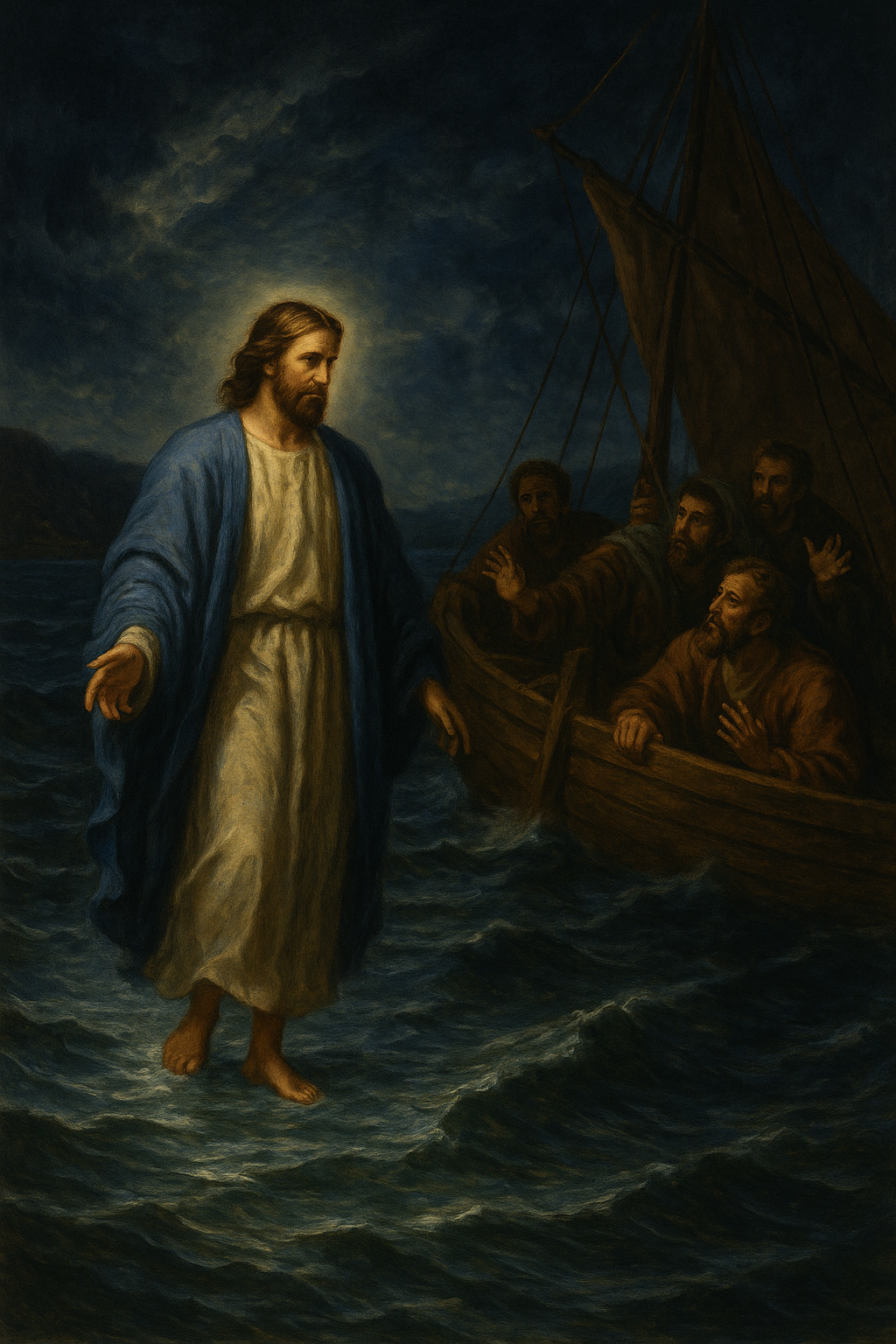
John 6:16–21 — Jesus Walks on Water
✨ “It is I; do not be afraid.” (John 6:20, NKJV)
📖 Scripture Reading (NKJV)
John 6:16–21
16 Now when evening came, His disciples went down to the sea,
17 got into the boat, and went over the sea toward Capernaum. And it was already dark, and Jesus had not come to them.
18 Then the sea arose because a great wind was blowing.
19 So when they had rowed about three or four miles, they saw Jesus walking on the sea and drawing near the boat; and they were afraid.
21 Then they willingly received Him into the boat, and immediately the boat was at the land where they were going.
📋 Gospel Parallel Table — Jesus Walks on Water

🌟 Notes:
- Matthew is the only Gospel that includes Peter walking on the water, showing both his faith and his faltering.
- John is the briefest account—yet it contains the beautiful line: “Immediately the boat was at the land where they were going”—a possible hint of divine transportation or simply a testimony to the peace that followed Christ’s presence.
- 📚 Commentary Insights:
- Craig Keener (The Gospel of John) notes this could imply a miraculous arrival, though John does not explain it directly.
- Matthew Henry’s Commentary (public domain) reflects:“They were at their wits’ end, but the presence of Christ calmed their fears… and the ship was at land—a double deliverance.”
- Many scholars and pastors (especially in traditional teaching circles) have taken it either:
- In all three, Jesus comes in the storm and says: “It is I; do not be afraid.”
🧭 Harmony with the Gospels
This event is one of the most dramatic and symbolic miracles in the Gospels. When all three accounts are read together, we see a story not just about Jesus’ power over nature—but about His presence in the storms of life, the testing of faith, and the deepening of discipleship.
🔁
Shared Themes Across the Gospels
🌊 1. The Disciples in the Dark
- All three Gospels say it was evening, and they were alone on the sea.
- Jesus had stayed behind to pray (Matt. 14:23, Mark 6:46).
- The sea became rough, with strong wind and waves—a picture of trial, fear, and isolation.
👣 2. Jesus Comes Walking on the Water
- He approaches in the fourth watch of the night (Matt. 14:25)—between 3:00–6:00 AM. The darkest hour.
- He is above the chaos, walking on what threatens to drown them.
- His presence reveals that He is Lord over all creation—not just the healer on land, but the Master of the deep.
😨 3. The Disciples’ Fear
- All are afraid—thinking He’s a ghost (Matt. and Mark), or simply frightened by the sight (John).
- Yet Jesus answers with the same gentle command:“It is I; do not be afraid.”In Greek, this could also read: “I AM; do not fear.” (ἐγώ εἰμι · μὴ φοβεῖσθε)
🌟 Unique Contributions
| Gospel | Unique Emphasis |
|---|---|
| Matthew | Only Gospel that includes Peter walking on water. This adds a layer about faith, doubt, and rescue. Peter starts strong, but sinks when he focuses on the wind—yet Jesus immediately lifts him. |
| Mark | Says Jesus saw them straining from the mountain, showing He was never out of touch with their suffering. Also notes they were “astounded” because they hadn’t understood the loaves—connecting this trial to the miracle of provision earlier that day. |
| John | Doesn’t mention Peter or calming the storm, but highlights that the boat immediately reached shore once Jesus was welcomed in. The focus is on His presence being enough to bring peace and completion. |
🕯️ Harmony Summary
The storm, the sea, and the fear all dissolve the moment Jesus reveals Himself. Each Gospel writer shows a different side of the same truth:
He is always aware, always able, and always near—even when we cannot see Him at first.
The same Lord who feeds the hungry multitude also meets His disciples in the dark.
🕰️ Historical and Cultural Background
🌊 The Sea of Galilee
- Also called the Lake of Gennesaret or the Sea of Tiberias (John 6:1).
- It’s about 13 miles long and 8 miles wide, surrounded by hills.
- Sudden violent windstorms are common—caused by cool air rushing down from the hills around the lake, especially in the evening.
🪶 Cultural Note:
Jewish people in the 1st century had a deep respect and fear of the sea. It was often associated with chaos, danger, and death (see Psalm 46:3; Isaiah 57:20). So Jesus walking calmly on it showed power over the uncontrollable.
🚣 Boating in the 1st Century
- Fishing boats were small—about 27 feet long and 7 feet wide, fitting around 12–15 men.
- The disciples were rowing hard into the wind, likely exhausting themselves in the dark.
- John says they had rowed 3–4 miles—so they were in the middle of the lake, and still had far to go.
🙏 Jesus on the Mountain
- Matthew and Mark say Jesus had gone up the mountain to pray.
- This echoes Moses on the mountain interceding for Israel (Exodus 32–34), and shows us Jesus’ pattern: before and after ministry, He sought solitude with the Father.
- While the disciples struggled, Jesus saw them (Mark 6:48)—even in the dark and distance. His eye was never off them.
👻 Fear of Ghosts
- In ancient Jewish belief, the night was associated with unclean spirits, and the idea of ghostly apparitions was part of folk fear.
- When the disciples saw Jesus walking on water, they panicked, thinking He was a spirit.
- His words, “It is I; do not be afraid,” directly addressed both their physical fear and their spiritual anxiety.
🧭 Capernaum: Their Intended Destination
- Capernaum was a key base of Jesus’ ministry.
- The disciples had started across the sea without Jesus, expecting to meet Him later (or assuming He would stay behind).
- Their return to Capernaum—with Jesus now in the boat—reminds us that true arrival happens only when Jesus is with us.
Jesus walking on the sea wasn’t just about getting from point A to point B. It was a revelation of His divine identity, wrapped in an act of rescue and peace during a moment of real danger.
🗝️ Key Word Studies
1. “Sea” (v. 16–17, 19)
Greek: θάλασσα (thalassa)
Meaning: The sea or a large body of water; often symbolic of chaos or danger in Jewish literature.
💡 Biblical Significance:
- The sea represents unpredictable forces, often hostile or untamed (see Psalm 107:23–29).
- Jesus walking on the sea demonstrates His complete authority over what people feared most.
📖 Job 9:8 – “[God] alone spreads out the heavens, and treads on the waves of the sea.”
Jesus fulfills this image.
2. “Afraid” (v. 19)
Greek: ἐφοβήθησαν (ephobēthēsan)
Meaning: To fear, be terrified, or deeply alarmed.
💡 Contextual Insight:
- This is not just a startled feeling—it’s gut-level fear, the kind associated with supernatural or life-threatening situations.
- Their fear wasn’t just of the storm—it was of the unknown presence walking on the waves.
3. “It is I” (v. 20)
Greek: ἐγώ εἰμι (egō eimi)
Literal Translation: I AM.
💡 Theological Insight:
- This phrase is used repeatedly in John’s Gospel (e.g., “I am the bread of life,” “I am the light of the world”).
- It intentionally echoes Exodus 3:14, when God told Moses: “I AM who I AM.”
- Jesus is not merely identifying Himself—He is declaring His divinity.
📖 John 8:58 – “Before Abraham was, I AM.”
4. “Do not be afraid” (v. 20)
Greek: μὴ φοβεῖσθε (mē phobeisthe)
Meaning: A command—“stop being afraid.”
💡 Biblical Theme:
- This phrase appears throughout Scripture whenever God or His messengers draw near.
- It is not a scolding, but a comforting command—God reminding His people they are safe in His presence.
📖 Isaiah 41:10 – “Fear not, for I am with you…”
5. “Immediately” (v. 21)
Greek: εὐθέως (eutheōs)
Meaning: Instantly, without delay.
💡 Spiritual Connection:
- This word implies a divine intervention, not just coincidence.
- The moment Jesus was received into the boat, they arrived—physically or experientially—at their destination.
Each of these words adds weight to what’s happening:
Jesus isn’t just calming a storm—He is revealing Himself as God, comforting His followers, and bringing them safely through fear and chaos.
🔍 Theological Themes
✨ 1. Jesus Is Lord Over Creation
When Jesus walks on the sea, He’s doing what only God is described as doing in Scripture.
📖 Job 9:8 – “[He] alone spreads out the heavens, and treads on the waves of the sea.”
This act is not just a miracle—it’s a revelation of divinity. He isn’t subject to nature; nature submits to Him.
Jesus doesn’t need to calm the sea to prove His power—He simply walks on it. It’s a glimpse into His divine authority.
✨ 2. His Presence Brings Peace in the Storm
The disciples were straining, afraid, and in the dark. But the moment Jesus drew near and spoke:
“It is I; do not be afraid.”
—fear began to fade. Peace came not when the storm stopped, but when Jesus entered the moment.
This reminds us: Jesus may not always remove the storm first—but He always brings peace in the middle of it.
📖 Philippians 4:7 – “And the peace of God… will guard your hearts and minds through Christ Jesus.”
✨ 3. Jesus Knows Our Struggles—Even From Afar
In Mark’s account, we learn Jesus saw the disciples straining at the oars—from the mountain.
Even when we can’t see Him, He sees us. He watches over His people and comes to them in the right moment—not too early, not too late.
📖 Psalm 121:4 – “Behold, He who keeps Israel shall neither slumber nor sleep.”
✨ 4. “I AM” — The Identity of Jesus
When Jesus says, “It is I,” the Greek (egō eimi) points back to God’s own self-disclosure in Exodus 3:14—“I AM WHO I AM.”
He is not just calming fears—He is declaring:
👉 “The One who is with you in this boat is the same I AM who parted the Red Sea.”
It’s a moment of divine self-revelation.
✨ 5. Faith Is Receiving Jesus Fully
John’s Gospel doesn’t describe Peter’s attempt to walk on water, or the calming of the storm. Instead, it centers on this:
“Then they willingly received Him into the boat…” (v. 21)
This act of receiving Jesus led to completion—their arrival, their calm, their understanding.
The lesson is simple and powerful:
👉 When you receive Jesus fully, He gets you where you’re meant to go.
🔗 Old Testament Connections
🌊 1. God Walks on the Waters
📖 Job 9:8 – “[God] alone spreads out the heavens, and treads on the waves of the sea.”
In this poetic passage, Job describes God’s power over nature. When Jesus walks on the sea in John 6, He is doing exactly what only God was ever said to do. It’s a quiet but stunning revelation:
👉 Jesus is God in the flesh, fulfilling what Job had described long ago.
🌒 2. God Brings His People Through the Sea
📖 Exodus 14:21–22 – “The Lord caused the sea to go back… and the waters were a wall… so the children of Israel went into the midst of the sea on the dry ground.”
The Red Sea crossing was the most famous moment of divine rescue in Jewish history. The disciples—crossing the water at night, surrounded by fear—mirror this journey.
But now, the Redeemer is not parting the sea… He is walking on top of it.
🗺️ 3. Psalm 77:19 — “Your Path Was in the Sea”
📖 Psalm 77:19 – “Your way was in the sea, Your path in the great waters, and Your footsteps were not known.”
This beautiful verse describes a God whose ways are mysterious, but always saving. It reads almost like a prophecy of Jesus walking on the water.
He is present even when unseen, moving across what terrifies us, guiding us in the dark.
🔥 4. The Burning Bush: “I AM”
📖 Exodus 3:14 – “And God said to Moses, ‘I AM WHO I AM.’”
Jesus’ words—“It is I” (ἐγώ εἰμι)—echo this holy name. He doesn’t just say “It’s me”—He says “I AM.”
He is identifying Himself as the eternal, self-existent God who spoke from the bush and delivered Israel.
🛟 5. Psalm 107:28–30 — Deliverance from the Sea
📖 Psalm 107:28–30 – “Then they cry out to the Lord in their trouble… He calms the storm… and brings them to their desired haven.”
This psalm tells of sailors caught in a storm—who cry out, are rescued, and arrive safely. The pattern matches John 6 exactly:
- Storm
- Cry
- Rescue
- Peace
- Arrival
Jesus fulfills this psalm in real time on the Sea of Galilee. 🙌
All these Old Testament links testify that this moment was not random, but perfectly prophetic. The disciples were witnessing what the Scriptures had foretold—and we, reading it now, get to see the fulfillment with eyes of faith.
✨ Thoughtful Reflection Questions
- 🌒 Have I ever felt like I was rowing alone in the dark?
- What did I do in that moment—and can I look back now and see how Jesus was near, even when I didn’t recognize Him?
- 🌊 What “seas” in my life feel uncontrollable or frightening right now?
- How might Jesus be calling me to trust Him above those waves?
- 👣 Jesus walked on what scared them most.
- What fear in my life could be transformed into peace if I truly believed Jesus is Lord over it?
- 🤍 Jesus said, “It is I; do not be afraid.”
- What would change if I heard Him saying that directly to me, right now, in my own storm?
- 🛶 The disciples willingly received Him into the boat.
- Is there any part of my life or heart where I’ve hesitated to invite Jesus in fully? What’s keeping me from doing so?
- ✨ “Immediately, they were at the shore.”
- Do I believe that peace, rest, and arrival are possible—not because I’m strong, but because He is with me?
✅ References
The Holy Bible. New King James Version, Thomas Nelson, 1982.
📖 Word Studies
Strong, James. Strong’s Exhaustive Concordance of the Bible. Hendrickson Publishers, 2007.
- Blue Letter Bible – Strong’s Concordance Search
- θάλασσα (thalassa) – G2281View on Blue Letter Bible
- ἐφοβήθησαν (ephobēthēsan) – G5399View on Blue Letter Bible
- ἐγώ εἰμι (egō eimi) – G1473 + G1510View on Blue Letter Bible
- μὴ φοβεῖσθε (mē phobeisthe) – G5399 (imperative)View on Blue Letter Bible
- εὐθέως (eutheōs) – G2112View on Blue Letter Bible
🕰️ Cultural and Historical Background
Walton, John H., et al. The IVP Bible Background Commentary: New Testament. InterVarsity Press, 2014.
- Not freely available online; available for purchase or library access. IVP Product Page
Keener, Craig S. The Gospel of John: A Commentary. Vol. 1, Baker Academic, 2003.
- Not freely available online; academic commentary. Publisher Listing – Baker Academic
🔗 Old Testament Connections
- Job 9:8 – God treads on the sea
- Exodus 14:21–22 – Israel walks through the sea
- Psalm 77:19 – “Your path was in the sea”
- Exodus 3:14 – “I AM WHO I AM”
- Psalm 107:28–30 – He calms the storm
📚 Gospel Harmony & Theological Sources
Tenney, Merrill C. John: The Gospel of Belief. Eerdmans, 1997.
Barclay, William. The Gospel of John, Volume 1. Westminster John Knox Press, 2001.
Easton, Matthew George. Easton’s Bible Dictionary. Thomas Nelson, 1897.
- Blue Letter Bible – Easton’s Dictionary
- Bible Study Tools – Easton’s
- Internet Archive – Original Scanned Book
🤖 Artificial Intelligence Assistance
ChatGPT. “Day 23 — The Study of Jesus, with Bonnie Moore: John 6:16–21 — Jesus Walks on Water.” OpenAI, 2025, https://chat.openai.com.
This post was prayerfully prepared in collaboration with ChatGPT, a research assistant designed to support deep, Christ-centered Bible study. All Scripture is taken from the New King James Version (NKJV), and supporting references include Strong’s Concordance, cultural background texts, and trusted harmony of the Gospels materials. May this work bring glory to God and encouragement to the hearts of those who read it. 🕊️
Leave a Reply