
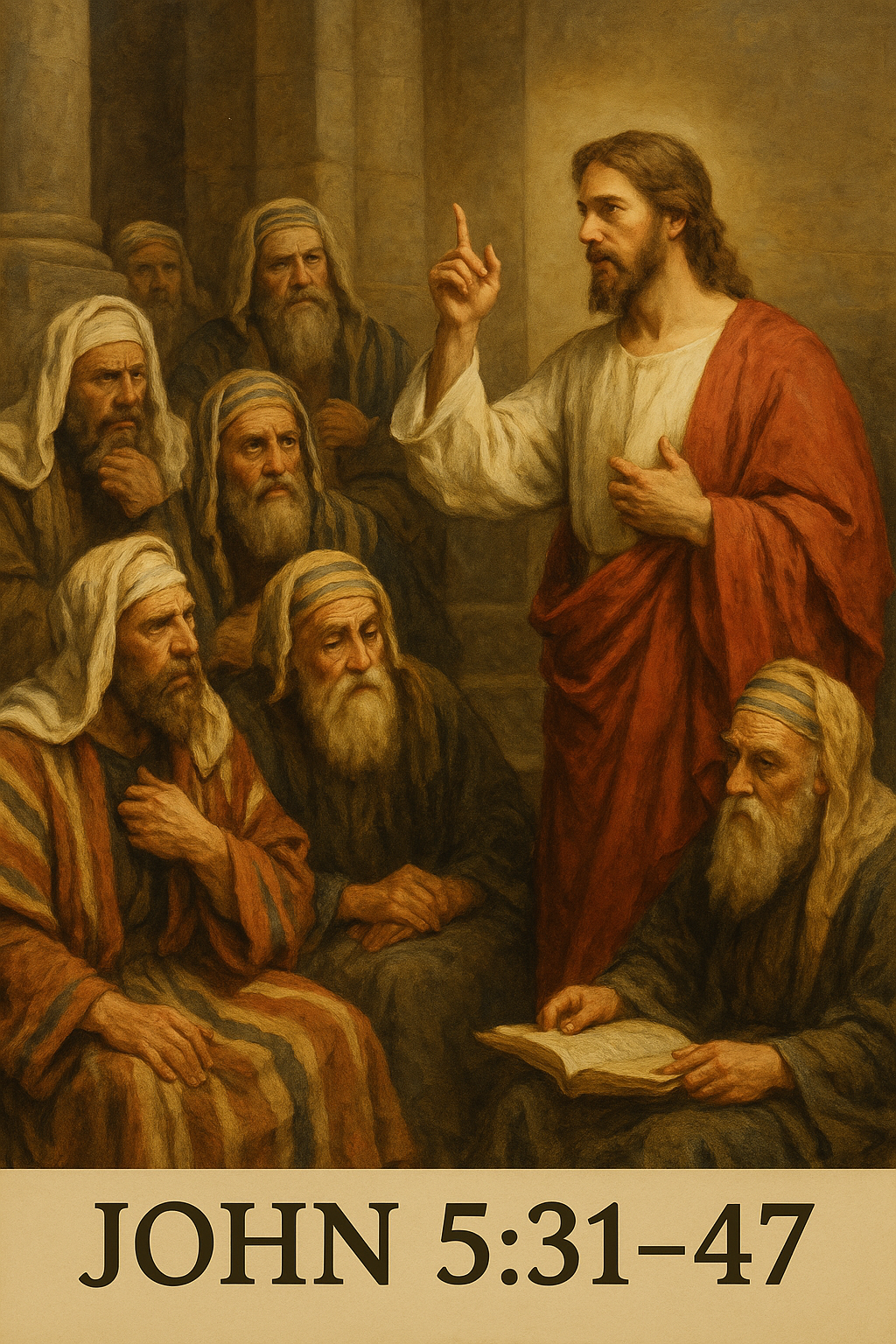
In John 5:31–47, Jesus talks about the different ways people can know He’s truly sent by God—through John the Baptist, His miracles, the words of the Father, the Scriptures, and even Moses. But the religious leaders still wouldn’t believe Him. This part of the Bible reminds us to ask if we’re really listening to God or just holding on to what we want to believe. ✨📖
📖 John 5:31–47 (NKJV)
31 “If I bear witness of Myself, My witness is not true.
32 There is another who bears witness of Me, and I know that the witness which He witnesses of Me is true.
33 You have sent to John, and he has borne witness to the truth.
34 Yet I do not receive testimony from man, but I say these things that you may be saved.
35 He was the burning and shining lamp, and you were willing for a time to rejoice in his light.
36 But I have a greater witness than John’s; for the works which the Father has given Me to finish—the very works that I do—bear witness of Me, that the Father has sent Me.
37 And the Father Himself, who sent Me, has testified of Me. You have neither heard His voice at any time, nor seen His form.
38 But you do not have His word abiding in you, because whom He sent, Him you do not believe.
39 You search the Scriptures, for in them you think you have eternal life; and these are they which testify of Me.
40 But you are not willing to come to Me that you may have life.
41 I do not receive honor from men.
42 But I know you, that you do not have the love of God in you.
43 I have come in My Father’s name, and you do not receive Me; if another comes in his own name, him you will receive.
44 How can you believe, who receive honor from one another, and do not seek the honor that comes from the only God?
45 Do not think that I shall accuse you to the Father; there is one who accuses you—Moses, in whom you trust.
46 For if you believed Moses, you would believe Me; for he wrote about Me.
47 But if you do not believe his writings, how will you believe My words?”
📋 Gospel Parallels
🔍 Thematic Echoes (though not direct parallels):
- John the Baptist as witness 🕊️
- Matthew 3:11–12, I indeed baptize you with water unto repentance, but He who is coming after me is mightier than I, whose sandals I am not worthy to carry. He will baptize you with the Holy Spirit and fire. His winnowing fan is in His hand, and He will thoroughly clean out His threshing floor, and gather His wheat into the barn; but He will burn up the chaff with unquenchable fire.”
- Mark 1:7–8, And he preached, saying, “There comes One after me who is mightier than I, whose sandal strap I am not worthy to stoop down and loose. I indeed baptized you with water, but He will baptize you with the Holy Spirit.”
- Luke 3:15–17 Now as the people were in expectation, and all reasoned in their hearts about John, whether he was the Christ or not, John answered, saying to all, “I indeed baptize you with water; but One mightier than I is coming, whose sandal strap I am not worthy to loose. He will baptize you with the Holy Spirit and fire. His winnowing fan is in His hand, and He will thoroughly clean out His threshing floor, and gather the wheat into His barn; but the chaff He will burn with unquenchable fire.”
Miracles as testimony
- Matthew 11:4–5 (Jesus tells John’s disciples to consider the miracles) Jesus answered and said to them, “Go and tell John the things which you hear and see: The blind see and the lame walk; the lepers are cleansed and the deaf hear; the dead are raised up and the poor have the gospel preached to them.
- Luke 7:22 — Jesus answered and said to them, “Go and tell John the things you have seen and heard: that the blind see, the lame walk, the lepers are cleansed, the deaf hear, the dead are raised, the poor have the gospel preached to them.
Search the Scriptures 📖
- Luke 24:27 — And beginning at Moses and all the Prophets, He expounded to them in all the Scriptures the things concerning Himself.
🧭 Harmony with the Gospels
Though no other Gospel includes this full dialogue, the themes Jesus expresses here are echoed throughout the ministry accounts in Matthew, Mark, and Luke.
🔦 1. The Witness of John the Baptist
“You have sent to John, and he has borne witness to the truth.” — John 5:33
💬 Echoed in:
Matthew 3:11 – “He who is coming after me is mightier than I…”
Mark 1:7 – “There comes One after me who is mightier than I…”
Luke 3:16 – John speaks of the One who will baptize with the Holy Spirit and fire.
🕊️ All three Synoptics preserve the public witness John gave about Jesus as the coming One, aligning with what Jesus reminds them of here in John 5.
✨ 2. The Witness of Jesus’ Works
“The works which the Father has given Me… bear witness of Me.” — John 5:36
💬 Echoed in:
- Matthew 11:4–5 – Jesus tells John’s disciples to report the miracles: “The blind see and the lame walk…”
- Luke 7:22 – Identical list of miracles as evidence of His identity.
🔍 Jesus’ miracles are not just acts of compassion — they are signs that testify of His divine mission.
📜 3. The Witness of the Scriptures (Moses and the Prophets)
“These are they which testify of Me.” — John 5:39“If you believed Moses, you would believe Me…” — John 5:46
💬 Echoed in:
- Luke 24:27 – “Beginning at Moses… He expounded… the things concerning Himself.”
- Luke 24:44 – Jesus says the Law, Prophets, and Psalms all speak of Him.
📚 Jesus boldly proclaims that the entire Old Testament bears witness to His identity — and if they truly understood Moses, they would recognize Him.
🌟 Summary:
John’s Gospel uniquely packages these four witnesses together:
- John the Baptist 🔥
- Jesus’ Miracles ✨
- The Father’s Voice (at His baptism) 💧
- The Scriptures (especially Moses) 📜
Together, they form a heavenly testimony — and still today, they call us to believe.

⚖️ 1. Legal Requirement for Multiple Witnesses
In Jewish law, a person’s testimony about themselves wasn’t valid in court.
Deuteronomy 19:15 (One witness shall not rise against a man concerning any iniquity or any sin that he commits; by the mouth of two or three witnesses the matter shall be established.)
💬 So when Jesus says, “If I bear witness of Myself, My witness is not true” (v. 31), He is not denying His own truthfulness, but rather appealing to the legal structure His audience trusted. He’s playing by their rules — and then going above and beyond by giving them four witnesses!
🔥 2. John the Baptist’s Role as a Public Prophet
John was a nationally recognized prophet in Israel. Many believed him to be sent by God — even if they didn’t understand the full scope of his mission.
“He was the burning and shining lamp…” (v. 35)
In Jewish tradition, a prophet was often referred to as a lamp — someone who brought light and
⚖️ 1. Legal Requirement for Multiple Witnesses
In Jewish law, a person’s testimony about themselves wasn’t valid in court.
Deuteronomy 19:15 (One witness shall not rise against a man concerning any iniquity or any sin that he commits; by the mouth of two or three witnesses the matter shall be established.)
💬 So when Jesus says, “If I bear witness of Myself, My witness is not true” (v. 31), He is not denying His own truthfulness, but rather appealing to the legal structure His audience trusted. He’s playing by their rules — and then going above and beyond by giving them four witnesses!
🔥 2. John the Baptist’s Role as a Public Prophet
John was a nationally recognized prophet in Israel. Many believed him to be sent by God — even if they didn’t understand the full scope of his mission.
“He was the burning and shining lamp…” (v. 35)
In Jewish tradition, a prophet was often referred to as a lamp — someone who brought light and clarity to God’s people. Jesus honors John’s role, even as He points to the greater light of His own identity. 🌟
✡️ 3. “You Search the Scriptures…” — The Devotion of the Pharisees
The religious leaders were known for their meticulous study of the Torah and the writings of Moses.
- They believed that eternal life was tied to knowing the Scriptures, but many missed the point — the Scriptures were meant to lead them to Jesus.
- This was a painful rebuke: “You search the Scriptures… and they testify of Me” (v. 39), yet “you are not willing to come to Me” (v. 40).
📚 Their study was diligent — but without heart, it became information without transformation.
🧑⚖️ 4. Jesus Naming Moses as Their Accuser
This was stunning. The Jewish leaders revered Moses and trusted in the Law. But Jesus says:
“Do not think that I shall accuse you… Moses… in whom you trust” (v. 45)
🧨 This would have been deeply offensive — because He’s saying that Moses’ writings were not only being misunderstood, but that they would stand against them in the final judgment if they rejected the One Moses wrote about.
This backdrop shows how radical and revealing Jesus’ words were in that moment — and why this discourse caused such controversy among the religious leaders.
An Aside About Moses and Old Testament Foreshadowing
✨ “Do not think that I shall accuse you to the Father…”
Jesus, as Judge (v. 27), could have rightfully stood as their accuser — yet He tells them:
- “It won’t even be Me who brings the charge…”
- Instead, someone they revere will rise as their accuser.
🕊️ Tone: It’s not a relief — it’s a REBUKE. The very one they claim as their spiritual foundation will be the one to expose their unbelief.
✨ “There is one who accuses you—Moses…”
To the Jewish mind:
- Moses was the ultimate prophet (Deuteronomy 34:10)
- He was the giver of the Law, the intercessor, the friend of God
But Jesus flips that reverence into confrontation:
“You trust Moses? Then listen to him — because he wrote about Me.”
🔍 Where Did Moses Write About Jesus?
Here are a few key Old Testament passages where Moses foreshadowed or directly spoke of the coming Christ:
📖 1. Deuteronomy 18:15
“The Lord your God will raise up for you a Prophet like me from your midst… Him you shall hear.”
Jesus is this promised Prophet — one who speaks God’s words and leads His people.
Peter quotes this passage in Acts 3:22–23 and applies it directly to Jesus.
📖 2. Genesis 3:15
The first prophecy of a Savior:
“He shall bruise your head, and you shall bruise His heel.”
Jesus is the seed of the woman who would crush the serpent’s head — this was written by Moses in Genesis.
📖 3. Genesis 22 — The Sacrifice of Isaac
- Isaac’s near-sacrifice on Mount Moriah points to the Father offering His Son.
- God provided a ram in Isaac’s place — a substitute, foreshadowing Christ.
📖 4. Exodus 12 — The Passover Lamb
Moses records the instructions for the blood of a spotless lamb to save Israel from death.“When I see the blood, I will pass over you…”Jesus is the true Passover Lamb (1 Corinthians 5:7).
📖 5. Numbers 21:8–9 — The Bronze Serpent
When the people were dying from snake bites, God told Moses to raise a bronze serpent on a pole — whoever looked at it would live. Jesus refers to this in John 3:14:“As Moses lifted up the serpent… even so must the Son of Man be lifted up…”
🧨 The Implication of John 5:45–47:
Jesus says: “If you believed Moses, you would believe Me…”
This is a devastating indictment:
- You don’t really believe the Scriptures you claim to revere
- You missed the whole point of Moses’ writings
- And now, those very writings stand as your accuser
It shows us how Scripture without surrender can lead to blindness.
🗝️ Key Word Studies
1. **“Bear witness” (Greek: μαρτυρέω — martyreō) — vv. 31–33, 36–37
This verb appears multiple times in this passage and means:
- To testify, as in a courtroom
- To affirm the truth of what one has seen, heard, or experienced
- It’s where we get our word martyr — one who bears witness even unto death
Jesus appeals to multiple witnesses (John, miracles, the Father, Scripture), but not because He needs validation — He is showing the legal sufficiency of His identity.
2. **“Receive” (Greek: λαμβάνω — lambanō) — vv. 34, 41, 43
This word means:
- To take hold of, accept, or welcome
- In context, it speaks of receiving truth, testimony, or a person’s authority
Jesus says, “I do not receive testimony from man,” and later, “you do not receive Me.”
The religious leaders were willing to accept men (v. 43), but rejected the One sent by God.
3. **“Honor” (Greek: δόξα — doxa) — v. 41, 44
This word is often translated as glory, but also means:
- Praise, approval, or human recognition
Jesus contrasts man’s praise with the glory that comes from God. He calls out the tendency to seek applause from others while ignoring divine approval.
4. **“Abide” (Greek: μένω — menō) — v. 38
“To dwell,” “to remain,” “to continue in”
“You do not have His word abiding in you…”
This implies the living presence of God’s Word shaping the heart, not just intellectual knowledge.
5. **“Testify” (Greek: μαρτυρία — martyria) — v. 39
Closely related to martyreō, this noun form means:
- A legal testimony, a record of truth
- In Scripture, it’s often used to describe the witness that leads to belief
The Scriptures themselves bear witness of Christ — but only for those with eyes to see.
🔍 Theological Themes
✨ 1. God’s Witnesses Are Abundant and Clear
Jesus appeals to four powerful witnesses:
- 🕊️ John the Baptist — a prophet who prepared the way
- ✨ His own miracles — signs of divine authority
- ☁️ The Father Himself — who testified at His baptism (John 1:32–34; Matthew 3:17)
- 📜 The Scriptures — especially Moses, who foreshadowed Christ
🔎 This reveals God’s abundant provision of truth — belief in Jesus is not a blind leap, but a response to reliable testimony.
✨ 2. Jesus Does Not Seek Human Approval
“I do not receive honor from men…” (v. 41)
Jesus modeled complete dependence on the Father’s will — not the praise or acceptance of people. He speaks with boldness because He’s not looking for applause — only obedience to truth.
💛 This challenges us to ask: Do I live for the approval of others or the honor that comes from God alone?
✨ 3. Scripture Points to Christ — Always
“These are they which testify of Me.” (v. 39)
Jesus declares that all of Scripture ultimately leads to Him.
- The Bible is not just a rulebook or history — it is a revelation of the Redeemer.
- If we read Scripture but do not come to Jesus, we miss the entire point.
📖 Luke 24:27 confirms this: “Beginning at Moses… He expounded the things concerning Himself.”
✨ 4. Unbelief is Not Intellectual — It’s Moral and Spiritual
“You are not willing to come to Me…” (v. 40)
“You do not have the love of God in you…” (v. 42)
Jesus exposes the true root of unbelief — not ignorance, but pride, self-glory, and resistance to surrender.
They searched the Scriptures but not with hearts open to God.
⚠️ This reminds us that belief isn’t just about the mind — it’s about the heart’s posture toward God.
✨ 5. Moses Accuses Those Who Reject Christ
“If you believed Moses, you would believe Me…” (v. 46)
Jesus claims full alignment with Moses — not contradiction. The law and prophets were shadows pointing to the Messiah.
Those who trusted Moses but rejected Jesus were not honoring Moses at all.
This is a sobering truth: even devotion to Scripture can become idolatrous if it’s separated from the One to whom it points.
✨ Thoughtful Reflection Questions
- Jesus points to multiple witnesses: John the Baptist, His works, the Father, and the Scriptures.
- 🔍 Which of these has spoken most clearly to you in your walk of faith? Are you listening still?
- He says, “You search the Scriptures… and these are they which testify of Me.”
- 📖 When I open God’s Word, am I truly seeking Jesus? Or am I ever tempted to study out of habit, pride, or pressure?
- Jesus rebukes the religious leaders for seeking honor from one another instead of from God.
- 💭 Do I find myself caring too much about the approval of others — even in spiritual things? How can I turn my heart fully toward seeking the honor that comes from God alone?
- Jesus says, “You are not willing to come to Me that you may have life.”
- 🌱 Are there places in my heart where I still resist surrender — where I need to come to Him more fully today?
- He says Moses himself will stand as a witness.
- 🔔 Do I see the whole Bible — from Genesis to Revelation — as one story pointing to Jesus? How does that truth change how I read and respond to Scripture?
References
Scripture
The Holy Bible: New King James Version. Thomas Nelson, 1982.
Word Studies
Strong, James. Strong’s Exhaustive Concordance of the Bible. Nashville: Thomas Nelson, 1990.
- Martyreō (μαρτυρέω) – G3140
- Lambanō (λαμβάνω) – G2983
- Doxa (δόξα) – G1391
- Menō (μένω) – G3306
- Martyria (μαρτυρία) – G3141
Cultural and Historical Background
Walton, John H., et al. The IVP Bible Background Commentary: New Testament. InterVarsity Press, 2014.
Keener, Craig S. The Gospel of John: A Commentary. Vol. 1, Baker Academic, 2003.
Old Testament Connections
- Genesis 3:15 – The promise of a Redeemer
- Genesis 22 – The substitute sacrifice (Isaac)
- Exodus 12 – The Passover Lamb
- Deuteronomy 18:15–19 – The promised Prophet like Moses
- Deuteronomy 19:15 – Two or three witnesses
- Psalm 40:7–8 – The scroll that speaks of Christ
- Numbers 21:8–9 – The bronze serpent lifted up
New Testament Connections & Commentary
Ladd, George Eldon. The Presence of the Future: The Eschatology of Biblical Realism. Eerdmans, 1974.
Wright, N. T. Jesus and the Victory of God. Fortress Press, 1996.
Artificial Intelligence Assistance
ChatGPT. “Day 21 — The Study of Jesus, with Bonnie Moore: John 5:31–47 – ‘The Witnesses to Jesus.’” OpenAI, 2025, https://chat.openai.com.
This post was prayerfully prepared in collaboration with ChatGPT, a research assistant designed to support deep, Christ-centered Bible study. All Scripture is taken from the New King James Version (NKJV), and supporting references include Strong’s Concordance, cultural background texts, and trusted harmony of the Gospels materials. May this work bring glory to God and encouragem
Leave a Reply