
💧 A Miracle, A Message, A Messiah ✨
Acts 3 (NKJV)
1 Now Peter and John went up together to the temple at the hour of prayer, the ninth hour.
2 And a certain man lame from his mother’s womb was carried, whom they laid daily at the gate of the temple which is called Beautiful, to ask alms from those who entered the temple;
3 who, seeing Peter and John about to go into the temple, asked for alms.
4 And fixing his eyes on him, with John, Peter said, “Look at us.”
5 So he gave them his attention, expecting to receive something from them.
6 Then Peter said, “Silver and gold I do not have, but what I do have I give you: In the name of Jesus Christ of Nazareth, rise up and walk.”

7 And he took him by the right hand and lifted him up, and immediately his feet and ankle bones received strength.
8 So he, leaping up, stood and walked and entered the temple with them—walking, leaping, and praising God.
9 And all the people saw him walking and praising God.
10 Then they knew that it was he who sat begging alms at the Beautiful Gate of the temple; and they were filled with wonder and amazement at what had happened to him.
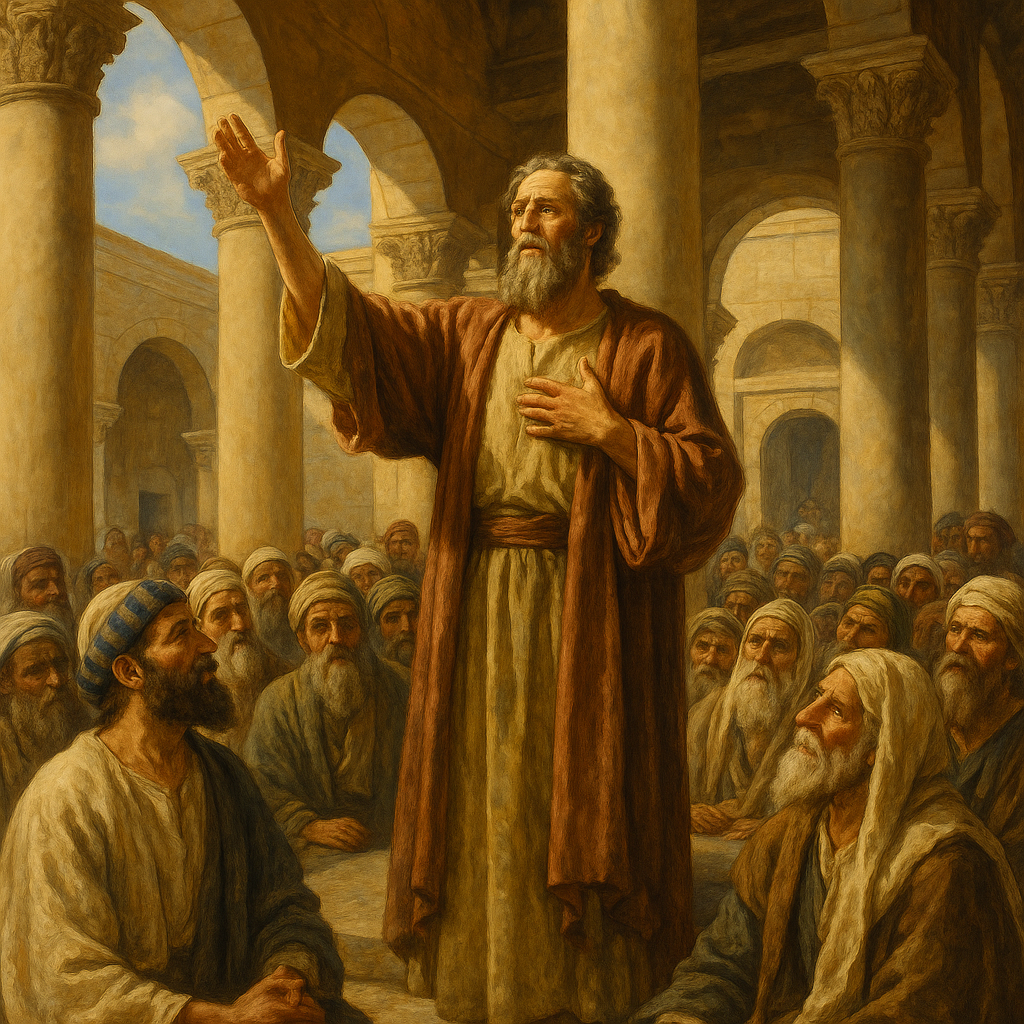
Preaching in Solomon’s Portico.
11 Now as the lame man who was healed held on to Peter and John, all the people ran together to them in the porch which is called Solomon’s, greatly amazed.
12 So when Peter saw it, he responded to the people: “Men of Israel, why do you marvel at this? Or why look so intently at us, as though by our own power or godliness we had made this man walk?
13 The God of Abraham, Isaac, and Jacob, the God of our fathers, glorified His Servant Jesus, whom you delivered up and denied in the presence of Pilate, when he was determined to let Him go.
14 But you denied the Holy One and the Just, and asked for a murderer to be granted to you,
15 and killed the Prince of life, whom God raised from the dead, of which we are witnesses.
16 And His name, through faith in His name, has made this man strong, whom you see and know. Yes, the faith which comes through Him has given him this perfect soundness in the presence of you all.
17 “Yet now, brethren, I know that you did it in ignorance, as did also your rulers.
18 But those things which God foretold by the mouth of all His prophets, that the Christ would suffer, He has thus fulfilled.
19 Repent therefore and be converted, that your sins may be blotted out, so that times of refreshing may come from the presence of the Lord,
20 and that He may send Jesus Christ, who was preached to you before,
21 whom heaven must receive until the times of restoration of all things, which God has spoken by the mouth of all His holy prophets since the world began.
22 For Moses truly said to the fathers, The LORD your God will raise up for you a Prophet like me from your brethren. Him you shall hear in all things, whatever He says to you.
23 And it shall be that every soul who will not hear that Prophet shall be utterly destroyed from among the people.’
24 Yes, and all the prophets, from Samuel and those who follow, as many as have spoken, have also foretold these days.
25 You are sons of the prophets, and of the covenant which God made with our fathers, saying to Abraham, And in your seed all the families of the earth shall be blessed.’
26 To you first, God, having raised up His Servant Jesus, sent Him to bless you, in turning away every one of you from your iniquities.”
👣 Traces of Jesus’ Ministry
From the first step at the temple gate to Peter’s final words in Solomon’s porch, this chapter breathes with the presence of Jesus.
1. Healing in the Name of Jesus (v. 6)
Peter says, “In the name of Jesus Christ of Nazareth, rise up and walk.”
- This is exactly how Jesus healed — with command and authority, never ritual.
- Peter is careful to emphasize: this miracle is not his doing, but through Jesus alone.
- It’s an echo of Jesus’ own words in John 14:12:
- “He who believes in Me, the works that I do he will do also; and greater works than these he will do…”
2. Compassion for the Broken (v. 2–7)
The man had been lame from birth. He was a fixture — overlooked, pitied, but never healed.
- Jesus was always moved by the suffering of the forgotten (Mark 1:40–41).
- The apostles had learned that miracles weren’t for show — they were for restoration, for lifting people up in body and soul.

3. Worship as a Response to Healing (v. 8–9)
After being healed, the man leaped and praised God in the temple.
- This mirrors the response of many Jesus healed (Luke 17:15, the grateful leper; Mark 5:19, the man delivered from demons).
- Jesus’ ministry always pointed people back to worship and thanksgiving, not just physical change.
4. Bold Preaching with Scripture and Truth (v. 12–26)
Peter’s sermon is steeped in the teachings of Jesus:
- He gives all glory to God (v. 13)
- He proclaims Jesus as the Servant, Holy One, Prince of Life, raised from the dead — all titles Jesus used or fulfilled.
- He calls for repentance and promises refreshing and restoration (v. 19–21).
This is exactly what Jesus taught His disciples to do:
“That repentance and remission of sins should be preached in His name to all nations, beginning at Jerusalem.” (Luke 24:47)
5. Moses and the Prophets Testify of Christ (v. 22–26)
Peter ends with Moses’ words from Deuteronomy 18:15, pointing to Jesus as the prophet they must hear.
- This connects directly to Luke 24:27, where Jesus, “beginning at Moses and all the Prophets… expounded to them in all the Scriptures the things concerning Himself.”
6. A Name That Still Heals
Jesus may not be physically present, but His name is. His power continues through faith.
“And His name, through faith in His name, has made this man strong…” (v. 16)
Peter learned this not just by teaching, but by watching Jesus — and now he walks as Jesus walked (1 John 2:6).
📜 From the Early Church
Acts 3 gives us our first close-up look at the early church in action outside the upper room — a public setting, a bold miracle, and a Gospel message rooted in the Old Testament. Here’s what we see:
1. The Church Moved Toward the Hurting
Peter and John didn’t pass the lame man by — they stopped. Looked. Spoke.
They didn’t give him silver or gold, but they gave something greater: healing in the name of Jesus.
The early church followed Jesus’ lead — always moving toward need, not away from it.
2. Ministry Was Done Openly and Humbly
They healed the man at the temple gate, not in secret. But Peter immediately said:
“Why look so intently at us, as though by our own power or godliness we had made this man walk?” (v. 12)
The early Christians were visible but humble — letting God get all the glory. ✨
3. They Used Every Opportunity to Preach Jesus
When the crowd gathered in amazement, Peter didn’t entertain them — he evangelized.
He boldly told them:
- They had denied and killed the Holy One.
- God had raised Him up.
- There was still time to repent and be restored.
The early church didn’t shy away from the hard truth — but they always delivered it with a call to hope. 💛
4. They Continued in the Temple and in Public
Even after persecution began in later chapters, we see the apostles frequenting the temple (v. 1, 11).
The early church didn’t run from the heart of Jewish life — they entered it with boldness and clarity, proclaiming Jesus as the fulfillment of all they’d hoped for.
5. The Power of God Was Not Just in Healing — But in Teaching
Though the miracle drew attention, the real work was in the sermon.
The man was healed physically.
But the people were called to be healed spiritually: “that your sins may be blotted out, so that times of refreshing may come from the presence of the Lord” (v. 19).
This shows us that in the early church, truth and compassion walked hand in hand.
🕰️ Historical and Cultural Background
Acts 3 takes place in Jerusalem, near the heart of Jewish worship: the temple. This wasn’t just any day — it was the ninth hour (3:00 p.m.), the traditional hour of prayer, when faithful Jews gathered for evening sacrifice and worship.
📍 The Beautiful Gate (v. 2)
- Though the exact gate is debated, many scholars believe this was the Nicanor Gate — a massive, ornately decorated bronze gate between the Court of the Women and the Court of Israel.
- It was likely a main entrance — well-traveled and visible. A strategic place for a beggar, but also for a miracle.
- The name “Beautiful” may have referred to its appearance, but this day, its name took on spiritual meaning — because something truly beautiful happened there. 💛
🧍♂️ A Man Lame from Birth
- Disabilities carried deep social and religious stigma in that time. Many believed that a person’s suffering was due to sin (see John 9:1–3).
- This man was over 40 years old (Acts 4:22) — never able to walk, always dependent on others, unable to enter deeper parts of the temple.
- His healing not only gave him legs — it gave him dignity, inclusion, and joy.
👥 Jewish Expectations of the Messiah
- Peter’s message in Solomon’s Portico was aimed at devout Jews — those who still hoped for the fulfillment of God’s promises to Israel.
- Many believed the Messiah would be a political leader or deliverer. Peter instead presents Jesus as:
- The Servant (Isaiah 52–53)
- The Holy One and Just (Messianic language)
- The Prophet like Moses (Deut. 18:15)
- He tells them: You missed Him — but God still offers you grace. This was bold. And it cut to the heart.
⛲ Solomon’s Porch (v. 11)
- This was a long covered colonnade on the east side of the temple, near the Court of the Gentiles.
- Jesus Himself had walked and taught there (John 10:23), and now His apostles stand in that same place, proclaiming His name.
- It became a key location for early Christian preaching (see Acts 5:12). A place of continuity and confrontation.
🔥 A Bold Shift in the Temple’s Purpose
- In this one chapter, the temple becomes not only a place of Jewish sacrifice — but a platform for the Gospel.
- The apostles weren’t trying to start a revolution… but the Spirit was.
🗝️ Key Word Studies
1. “Alms” (v. 2–3)
🔤 Greek: eleēmosynē (ἐλεημοσύνη, Strong’s G1654)
👉 Meaning: Mercy, compassion expressed through giving to the poor.
💡 This wasn’t just about coins — it was about kindness. The man at the gate wasn’t only asking for money, but for mercy.
🤲 True giving is an act of the heart — not just the hand.
2. “In the name of Jesus Christ” (v. 6)
🔤 Greek: onoma (ὄνομα, Strong’s G3686)
👉 Meaning: Name, authority, reputation, character.
🕊️ Peter wasn’t invoking a magic word — he was acting under the full power and identity of Jesus.
✝️ In the Bible, doing something “in His name” means doing it by His will, His power, and for His glory.
3. “Immediately his feet and ankle bones received strength” (v. 7)
🔤 Greek: stereōō (στηρίζω, Strong’s G4732)
👉 Meaning: To make firm, stable, to strengthen.
💥 This wasn’t gradual healing — it was instant and complete. His body did what it had never done before.
🙌 Jesus’ name doesn’t just patch us — it makes us whole.
4. “Leaping up… walking and praising God” (v. 8)
🔤 Greek: hallomai (ἅλλομαι, Strong’s G242)
👉 Meaning: To leap, spring up, jump with joy.
🦶 The same word is used in Isaiah 35:6: “Then shall the lame man leap like a deer…” — a messianic prophecy!
💃 This was a fulfillment of prophecy right in the temple courts!
5. “Astonishment” and “Amazement” (v. 10–11)
🔤 Greek: thambos (θάμβος, Strong’s G2285) & ekstasis (ἔκστασις, Strong’s G1611)
👉 Meaning: Wonder, awe, overwhelming shock.
🌟 The people were not just surprised — they were undone. The word ekstasis is where we get “ecstatic.”
🤯 When God moves, it often stuns us into praise.
6. “Faith in His name” (v. 16)
🔤 Greek: pistis (πίστις, Strong’s G4102)
👉 Meaning: Trust, conviction, full confidence.
🙏 This healing didn’t come from Peter’s ability — but from faith placed firmly in Jesus.
💖 Faith isn’t a feeling — it’s a firm grip on the One who saves.
7. “Times of refreshing” (v. 19)
🔤 Greek: anapsyxis (ἀνάψυξις, Strong’s G403)
👉 Meaning: A cooling, recovery of breath, spiritual rest.
💨 This word only appears here in the New Testament — it’s the idea of relief after weariness.
🌬️ Repentance brings spiritual renewal — not dread, but fresh air for the soul.
🔍 Theological Themes
1. ✝️ Jesus Is Still Working — Through His Name and His People
Even though Jesus had ascended, His power hadn’t gone anywhere.
- The apostles say clearly: “Why look at us?” (v. 12)
- The miracle happened in Jesus’ name, by faith in Him (v. 16)🕊️ This teaches us that the church is not about personalities — it’s about the living Christ continuing His mission.
🔥 The church is powerful only when it lifts His name, not its own.
2. 💧 Healing Points to Something Greater: Salvation
The lame man was healed physically, but the people were being invited into spiritual healing.
Peter’s sermon leads to this call:
“Repent therefore and be converted, that your sins may be blotted out…” (v. 19)
🌿 This reminds us that miracles are not the goal — restoration with God is.
🌬️ Healing brings awe, but repentance brings refreshing.
3. 🕊️ Repentance Is the Gateway to Refreshing
The phrase “times of refreshing” (v. 19) is so gentle and hopeful.
Peter doesn’t shame them — he invites them. They had denied the Holy One… but God still longed to restore them.
💛 Repentance is not punishment — it is returning to the presence of God.
It’s not too late to come back.
4. 📜 Jesus Is the Fulfillment of the Prophets
Peter walks them through Moses, Samuel, and the covenant with Abraham.
- Jesus is the promised Prophet like Moses (v. 22–23)
- He’s the Servant foretold by Isaiah (v. 13)
- He’s the Seed through whom all families are blessed (v. 25)📖 Peter preaches the Old Testament as one big arrow — pointing to Jesus. 🔭
🪶 The early church didn’t abandon Scripture — it revealed its meaning.
5. 🤲 God’s Mercy Is Deep and Available
Peter acknowledges their ignorance (v. 17) — not to excuse them, but to offer them grace.
“To you first, God, having raised up His Servant Jesus, sent Him to bless you…” (v. 26)
That blessing? 💫 Turning away from iniquity. What a gentle, yet powerful truth.
✨ God doesn’t just forgive. He turns us back toward Him — that’s the true blessing.
This chapter reminds us that the early church didn’t just know Jesus — they proclaimed Him, obeyed Him, and let His power flow through them in love. 💒
🔗 Old Testament Connections
1. 📜 Deuteronomy 18:15–19 — The Prophet Like Moses
“The Lord your God will raise up for you a Prophet like me from your midst… Him you shall hear.”
Peter quotes this directly in verses 22–23, identifying Jesus as that promised Prophet — the one who would speak God’s words, just like Moses did.
🕯️ Moses led Israel out of bondage.
✝️ Jesus leads us out of sin.
⚠️ And just like Moses warned, those who will not listen will be cut off.
2. 🦁 Isaiah’s Servant Songs — Especially Isaiah 52–53
Peter calls Jesus “His Servant Jesus” (v. 13), a powerful phrase echoing Isaiah’s suffering Servant:
“Behold, My Servant shall deal prudently… He was despised and rejected by men.” (Isaiah 52:13; 53:3)
- Jesus was delivered up (v. 13)
- Denied by the people (v. 13–14)
- Put to death (v. 15)
- Raised and glorified by God (v. 15–16)
✨ The same Servant Isaiah saw… Peter had walked with.
3. 🌱 Genesis 12:3 — The Blessing Through Abraham’s Seed
“In your seed all the families of the earth shall be blessed.”
Peter references this in v. 25 — Jesus is the true Seed, the one who brings blessing not just to Israel, but to the world.
💫 The promise given to Abraham now lives in the church.
4. 📣 Joel’s Pattern of Repentance and Mercy
Though not quoted directly here (as it was in Acts 2), the heart of Joel’s message is echoed:
“Repent… and times of refreshing will come.” (Acts 3:19)
“Return to Me… for He is gracious and merciful.” (Joel 2:13)
📖 Peter is continuing what the prophets always said: Return. Be healed. Be His again. 💛
5. 📖 Psalm 118:22 — The Stone Rejected by Builders
While not directly quoted in this chapter, Peter alludes to this theme when he says:
“You denied the Holy One and the Just, and asked for a murderer…” (v. 14)
He is preparing the church to understand that Jesus, though rejected, is now the cornerstone.
(He’ll quote it more fully in Acts 4:11!) 🪨
📖 New Testament Connections
1. ✝️ Luke 24:44–47 — Jesus Taught the Apostles to Preach This Way
Peter’s sermon in Acts 3 shows how well he understood what Jesus had taught after the resurrection:
“That all things must be fulfilled… and that repentance and remission of sins should be preached in His name to all nations, beginning at Jerusalem.”
That’s exactly what Peter does here:
- Uses Scripture 📜
- Points to the cross ✝️
- Calls for repentance 💧
🗣️ This is the first of many sermons that follow this pattern in Acts — and in Paul’s letters too.
2. 🕊️ Galatians 3:16 — The Seed is Christ
“He does not say, ‘And to seeds,’ as of many, but as of one… ‘And to your Seed,’ who is Christ.”
Paul makes the same point Peter does in Acts 3:25 — that Jesus is the fulfillment of the promise to Abraham.
🌍 Through Him, all families of the earth are blessed.
3. 📖 Hebrews 1:1–2 — God Speaks Through His Son
Peter declares Jesus to be the Prophet Moses foretold — the one we must hear and obey (Acts 3:22).
The Hebrew writer says:
“God… has in these last days spoken to us by His Son…”
📣 Jesus is the final Word — the one to listen to above all.
4. 💖 1 Peter 2:24 — “By His Stripes You Were Healed”
Peter, the same man preaching in Acts 3, would later write of Christ:
“He Himself bore our sins… by whose stripes you were healed.”
His understanding of spiritual healing goes beyond physical miracles — it’s about being restored to wholeness with God. 🕊️
5. 📜 Acts 4:11–12 — The Rejected Stone and Salvation in No Other
Though it follows immediately after Acts 3, Peter’s words in Acts 4 build directly from this sermon:
“This is the ‘stone which was rejected’… nor is there salvation in any other.”
It all begins at the Beautiful Gate — but the message spreads everywhere.
✨ Thoughtful Reflection Questions
- 🧎♀️ Where in my life do I feel “lame” — stuck, powerless, or broken?
- Am I looking for silver and gold… when Jesus is offering something better?
- ✝️ Have I truly responded to the name of Jesus with faith and repentance?
- Have I let Him lift me up — not just to walk, but to leap and praise God?
- 📖 Do I recognize Jesus in the Scriptures like Peter did — as the Servant, the Prophet, the promised Messiah?
- How can I let God’s Word shape my understanding more fully?
- 🌬️ Have I experienced the “times of refreshing” that come from being made right with God?
- Or am I still carrying things He’s already willing to blot out?
- 🔥 How can I be more like Peter — bold, loving, and clear — when I speak about Jesus to others?
- Who around me might be waiting for someone to lift their eyes and offer hope?
✅ References
Free Online Sources (linked):
- Blue Letter Bible — For Strong’s Concordance, Greek word studies, cross-references, and commentaries.
- Bible Hub — For parallel translations, interlinear Greek, and commentaries.
- NET Bible Notes — For scholarly translation notes and manuscript references.
- GotQuestions.org — For general understanding of Acts and doctrinal summaries.
📚 Paid Print or Digital Books Used in This Post:
- Jackson, Wayne. The Acts of the Apostles: From Jerusalem to Rome. Christian Courier Publications.Available for purchase here.
- Shelly, Rubel. What the Bible Says About the Church. Nashville, TN: 20th Century Christian, 1985.(Check ABEBooks or Amazon for rare copies.)
🤖✨ Artificial Intelligence Assistance
ChatGPT. “✨From the Beautiful Gate to Solomon’s Porch: A Miracle, A Message, A Messiah✨ — Acts 3:1–26.” OpenAI, 2025, https://chat.openai.com.
This post was prayerfully prepared in collaboration with ChatGPT 🤖, a research assistant designed to support deep, Christ-centered Bible study.
All Scripture is taken from the New King James Version (NKJV), and supporting references include Strong’s Concordance, cultural background texts, and trusted Gospel study materials.
May this work bring glory to God and encouragement to the hearts of those who read it. 🕊️💕
Leave a Reply