
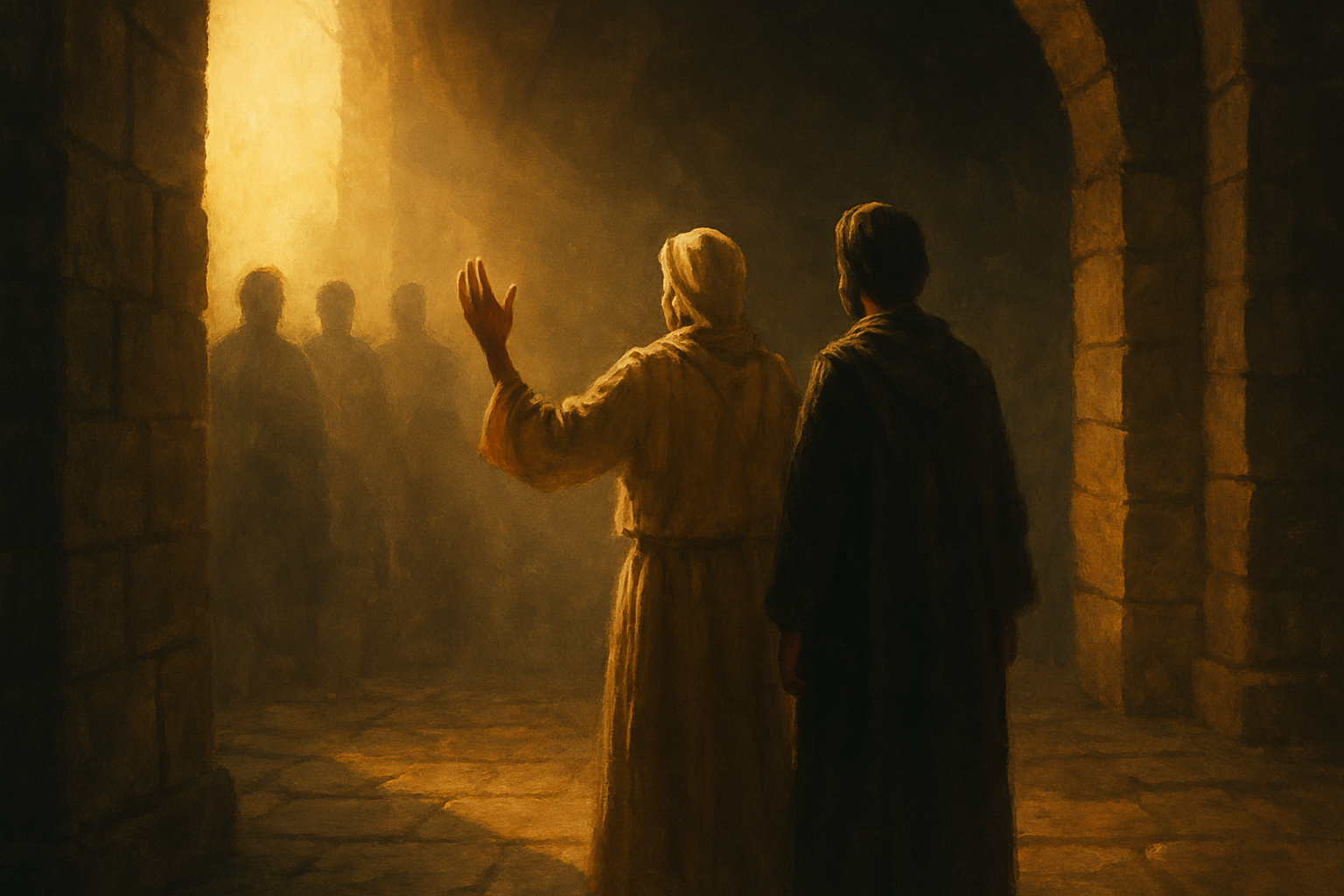
🌿 Peter and John Are Arrested for Teaching in Jesus’ Name
📖 Scripture Reading (NKJV)
Acts 4:1–12
1 Now as they spoke to the people, the priests, the captain of the temple, and the Sadducees came upon them,
2 being greatly disturbed that they taught the people and preached in Jesus the resurrection from the dead.
3 And they laid hands on them, and put them in custody until the next day, for it was already evening.
4 However, many of those who heard the word believed; and the number of the men came to be about five thousand.
5 And it came to pass, on the next day, that their rulers, elders, and scribes,
6 as well as Annas the high priest, Caiaphas, John, and Alexander, and as many as were of the family of the high priest, were gathered together at Jerusalem.
7 And when they had set them in the midst, they asked, “By what power or by what name have you done this?”
8 Then Peter, filled with the Holy Spirit, said to them, “Rulers of the people and elders of Israel:
9 If we this day are judged for a good deed done to a helpless man, by what means he has been made well,
10 let it be known to you all, and to all the people of Israel, that by the name of Jesus Christ of Nazareth, whom you crucified, whom God raised from the dead, by Him this man stands here before you whole.
11 This is the ‘stone which was rejected by you builders, which has become the chief cornerstone.’
12 Nor is there salvation in any other, for there is no other name under heaven given among men by which we must be saved.”
👣 Traces of Jesus’ Ministry
Peter and John, boldly proclaiming truth despite persecution, are walking in the very footsteps of Jesus — not only in word, but in how they are treated.
- Teaching that Disturbs the Authorities-Just as Jesus often drew the ire of religious leaders, Peter and John now face similar hostility. The priests, temple captain, and Sadducees are “greatly disturbed” (v. 2), echoing how the Pharisees and Sadducees reacted to Jesus’ public teaching and authority (Luke 20:1–2; John 11:47–48).
- Resurrection Preaching-Peter and John are specifically targeted for “preaching in Jesus the resurrection from the dead” (v. 2). This continues the central message of Jesus Himself, who foretold His resurrection (John 2:19–21; Matthew 16:21) and was confirmed by it. ✝️🌅
- Spirit-Filled Boldness-In verse 8, Peter is “filled with the Holy Spirit” — just as Jesus promised His followers would be when brought before rulers and councils (Luke 12:11–12). This moment is a direct fulfillment of that teaching. 🔥🕊️
- The Cornerstone-Quoting Psalm 118:22, Peter refers to Jesus as “the stone which was rejected by you builders, which has become the chief cornerstone” (v. 11). Jesus used this same verse to describe Himself during His ministry (Matthew 21:42). Peter, having heard it from the Lord’s own lips, now proclaims it boldly. 🪨👷♂️➡️👑
- The Exclusive Power of His Name-Peter declares that “there is no other name under heaven given among men by which we must be saved” (v. 12). This builds directly on Jesus’ own words in John 14:6 — “I am the way, the truth, and the life. No one comes to the Father except through Me.”
In every phrase, Peter is honoring and continuing the very ministry of Jesus — and now, through persecution and proclamation, the legacy of the Gospel presses forward. 💧🌍
📜 From the Early Church
How the Church Was Formed — and How It Should Remain Today 🌿
Acts 4:1–12 shows a defining moment in the early church’s formation — a time when faith and courage became essential to its very identity. ✨
- Boldness under Pressure-Peter and John are arrested not for disrupting public order or causing harm — but for healing a man and proclaiming Jesus (v. 9–10). This reflects the early church’s commitment to truth over comfort and courage over conformity. Even when the stakes were high, they didn’t soften their message. This kind of boldness became the backbone of the church’s witness. 🗣️🔥
- Growth Despite Opposition-Though opposition rises, so does faith: “many of those who heard the word believed; and the number… came to be about five thousand” (v. 4). The early church didn’t just survive adversity — it thrived in it. Faith spreads when it’s lived visibly, even (and especially) in hardship. 🌱⛓️
- A Gospel of Healing and Salvation-The miracle in Acts 3 that led to this trial is central here. Peter emphasizes the kindness of the act (“a good deed done to a helpless man”) and the saving power of Jesus that made it possible (v. 9–10). The early church continually emphasized that the message of Christ wasn’t just spiritual — it was practical, loving, and healing. 🧎♂️💖
- Christ at the Center-At the heart of the church’s mission is one message: “Nor is there salvation in any other…” (v. 12). The early church had no gimmicks. It pointed only to Jesus — crucified, risen, and reigning. This clarity is what kept the message pure and the mission focused. ✝️👑
These verses show that the early church wasn’t simply built on structure — it was built on faith, boldness, compassion, and truth. And this is still how the church should be today. 💛
🕰️ Historical and Cultural Background
A Clash of Powers: The Church, the Temple, and the Name of Jesus
In Acts 4:1–12, we witness the first recorded opposition to the apostles after Pentecost — a pivotal moment that signals how the message of Jesus would be received by the religious establishment. Here’s some context to help us understand why this confrontation was so tense:
- Who Were the Sadducees?
- The Sadducees were the wealthy, priestly elite who held influence over the temple system and denied any belief in the resurrection (Matthew 22:23). Because Peter and John were preaching Jesus’ resurrection (v. 2), the Sadducees felt both theologically challenged and politically threatened. 🧎♂️⛔✝️
- The Captain of the Temple
- The “captain of the temple” (v. 1) was second in authority only to the high priest. He led the temple police and had power to arrest those who disrupted temple order. The fact that he personally came with the Sadducees shows how seriously they viewed this preaching.
- Evening Arrest, Morning Trial
- Jewish law discouraged evening trials. Since it was already late (v. 3), Peter and John were held overnight — echoing how Jesus, too, was held and questioned by night and morning (Luke 22:66). 🕯️🌒
- The Council: Sanhedrin Power Structure
- Verses 5–6 describe the rulers, elders, scribes, and high priestly family members gathering. This was the Sanhedrin, the Jewish ruling council — the same body that had condemned Jesus (Matthew 26:57–66). Peter and John were now facing the very powers that executed their Lord. 😔💔
- A Public Challenge in the Temple Courts
- Preaching was often done publicly in the temple courtyards. This bold miracle and message in Acts 3–4 wasn’t hidden — it was done right in front of thousands. That’s why the authorities felt pressure to respond quickly and decisively. 🏛️👀
These historical details reveal how significant and courageous this moment was. Peter and John weren’t just preaching — they were declaring Jesus as Messiah and Savior in the very place where He had been condemned. And they did it without fear. 🔥🕊️
🗝️ Key Word Studies
- “Greatly disturbed” (v. 2) — diaponeomai (διαπονέομαι)➤ Strong’s G1278: To be thoroughly annoyed or troubled; to be worked up with indignation.💢😤 This wasn’t mild concern — the leaders were deeply agitated that Peter and John were proclaiming resurrection through Jesus. Their power and doctrine were being challenged.
- “Resurrection” (v. 2) — anastasis (ἀνάστασις)➤ Strong’s G386: A rising again; a return to life after death.✝️🌅 This word was the theological battleground. The Sadducees denied it — but the apostles preached it boldly as the very hope of salvation.
- “Being greatly disturbed that they taught…” (v. 2) — Notice the sequence: teaching led to disturbance.📚🗣️ Truth still has this effect. When we teach plainly about Jesus, it often stirs hearts — for better or worse.
- “Filled with the Holy Spirit” (v. 8) — plēthō (πληθώ)➤ Strong’s G4130: To be fully furnished or empowered; completely imbued.🔥🕊️ Peter didn’t act out of personal courage — he was saturated with divine boldness, just as Jesus had promised in Luke 12:12.
- “Name” (v. 10, 12) — onoma (ὄνομα)➤ Strong’s G3686: Name, character, authority, or reputation.🙏👑 The name of Jesus wasn’t just a label — it represented His power, presence, and saving authority. There is no other name that saves.
- “Saved” (v. 12) — sōzō (σῴζω)➤ Strong’s G4982: To save, rescue, heal, preserve.💖🚑 More than escape from sin, sōzō includes healing and wholeness. This makes perfect sense in the context of the healed man and the salvation offered to all. (See Romans 10:13.)
- “Cornerstone” (v. 11) — kephalē gōnias (κεφαλὴ γωνίας)➤ Strong’s G2776 & G1137: The head or chief stone in a corner; the foundation alignment stone.🧱📐 Jesus is the keystone of the faith — the one whom the builders (leaders) rejected, but God made central to everything.
🔍 Theological Themes
- 💡 Boldness Through the Holy Spirit
- Peter’s transformation is striking. The same man who denied Jesus now boldly preaches Him before the Sanhedrin (v. 8–10). Why? He was filled with the Holy Spirit. The early church’s power didn’t come from influence or eloquence — it came from divine indwelling.
- ➤ See also: Luke 12:11–12, Acts 1:8
- ✝️ Jesus as the Only Way to Salvation
- Verse 12 delivers one of the clearest theological declarations in the entire New Testament: “Nor is there salvation in any other…” There are no substitutes, no alternatives — only Jesus.
- ➤ This message is exclusive, but not harsh — it’s an open door for everyone to enter by the one true name.➤ See also: John 14:6, 1 Timothy 2:5
- 🧱 Rejected but Chosen — The Cornerstone Image
- The quote from Psalm 118:22 about the rejected stone becoming the cornerstone is both prophetic and foundational. The builders (the religious elite) rejected Jesus, but God exalted Him.
- ➤ This imagery paints Jesus as the structural anchor of faith — not just a decoration, but the essential alignment point.
- ➤ See also: Isaiah 28:16, 1 Peter 2:6–7
- 👑 Apostolic Authority in Jesus’ Name
- Everything Peter and John say or do is “in the name of Jesus.” This points to their God-given authority, not personal status. They were untrained fishermen — yet they spoke with power because their authority was borrowed from heaven.
- ➤ See also: Acts 3:6, Acts 16:18
- 🚪 Opposition Opens Doors
- Being arrested and questioned didn’t hinder the Gospel — it amplified it. God often uses pressure points to make the message louder, not quieter. The faith of the early church grew not in safety, but in resistance.
- ➤ See also: Philippians 1:12–14, 2 Corinthians 4:7–10
🔗 Old Testament Connections
- 🧱 Psalm 118:22 — “The Stone Which the Builders Rejected”
- ➤ This prophecy is directly quoted by Peter in verse 11. In its original context, it likely referred to Israel being rejected by nations but chosen by God.
- ➤ In the New Testament, this verse is applied specifically to Jesus, who was rejected by the Jewish leaders but exalted by God as the cornerstone of the spiritual temple — the Church.📖 Psalm 118:22–23 | Fulfilled: Matthew 21:42, Mark 12:10, Luke 20:17, 1 Peter 2:7
- 🌿 Isaiah 28:16 — “Behold, I lay in Zion a Sure Foundation”
- ➤ This prophetic word about a chosen and precious cornerstone is also fulfilled in Christ. Peter references it indirectly, establishing Jesus as the sure foundation of salvation and truth.
- ➤ See also: 1 Peter 2:6📖 Isaiah 28:16 — “…Whoever believes will not act hastily.”
- 🔥 Joel 2:28–32 — Spirit-Filled Boldness
- ➤ Though not quoted here, the courage of Peter and John continues the Spirit-led proclamation foretold by Joel. This boldness is not natural — it’s a result of the outpoured Spirit begun in Acts 2.
- ➤ “Your sons and your daughters shall prophesy…” — and your apostles will speak without fear!📖 Joel 2:28–32 → Acts 2:16–18, and seen again in Acts 4:31
- 💖 Isaiah 53 — Rejected Yet Risen
- ➤ Though not directly cited here, the themes of rejection, suffering, and exaltation are deeply connected to the suffering servant of Isaiah 53. Jesus, despised and rejected by men, is now proclaimed as the only name that saves.
📖 New Testament Connections
- 🕊️ Luke 12:11–12 — Promise of the Spirit’s Words
- ➤ Jesus told His disciples not to worry about what to say when brought before authorities — the Holy Spirit would speak through them.
- ➤ This is fulfilled here in Peter’s boldness before the Sanhedrin: “Then Peter, filled with the Holy Spirit…” (Acts 4:8).📖 Luke 12:11–12 | Fulfilled: Acts 4:8–10
- ✝️ John 14:6 — “I am the Way…”
- ➤ Peter’s declaration in Acts 4:12 — “Nor is there salvation in any other…” — echoes Jesus’ words: “No one comes to the Father except through Me.”
- ➤ The exclusivity of Christ is consistent throughout the New Testament and gently affirmed with unwavering boldness here.📖 John 14:6, 1 Timothy 2:5
- 🧱 1 Peter 2:4–7 — The Living Stone
- ➤ Peter later expands this imagery in his epistle, calling Jesus the chief cornerstone, chosen by God and precious.
- ➤ Believers are living stones being built into a spiritual house — rooted in the same truth Peter proclaimed in Acts 4.📖 1 Peter 2:4–7
- 📢 Matthew 10:18–20 — Testimony Before Rulers
- ➤ Jesus warned and prepared His followers that they would be delivered up to councils, and that their testimony would be a witness to them.
- ➤ Peter and John now walk out this prophecy, becoming a testimony not only in words but in courage and clarity.📖 Matthew 10:18–20 | Fulfilled: Acts 4:5–12
- 🔥 Acts 1:8 — “You Shall Be Witnesses to Me”
- ➤ This moment in Acts 4 is a direct living out of Jesus’ commission. Peter and John are witnesses of the resurrection, boldly proclaiming the name of Jesus to the ends of the earth — beginning in Jerusalem.
✨ Thoughtful Reflection Questions
- How does Peter’s boldness in front of the Sanhedrin inspire me in my own faith?
- ➤ Do I trust the Holy Spirit to give me words when I feel afraid or unprepared?
- What role does the name of Jesus play in my daily life?
- ➤ Am I praying, speaking, and acting in His name with reverence and confidence?
- Peter said there is “no other name under heaven given among men by which we must be saved.”
- ➤ How does this truth shape my understanding of salvation?
- ➤ What does it mean for how I share my faith with others?
- When I encounter opposition for doing what is right or sharing God’s Word, how do I respond?
- ➤ Do I shrink back — or stand firm like Peter and John?
- Have I ever felt “unlearned” or “ordinary,” like Peter and John were perceived — and yet still been used by God?
- ➤ What does this teach me about the kind of people God chooses to use for His glory?
📚 References
📚 Free Online Sources (linked):
- Blue Letter Bible. “Acts 4 (NKJV).” https://www.blueletterbible.org/nkjv/act/4/1/
- Bible Hub. “Acts 4 Commentary, Greek Interlinear, and Tools.” https://biblehub.com/acts/4.htm
- NET Bible Notes. “Acts 4 Translation and Footnotes.” https://netbible.org/bible/Acts+4
- GotQuestions.org. “What was the Sanhedrin?” https://www.gotquestions.org/sanhedrin.html
Paid Print or Digital Books Used in This Post:
- Jackson, Wayne. The Acts of the Apostles: From Jerusalem to Rome. Christian Courier Publications.➤ Available for purchase at: https://store.christiancourier.com/products/acts-of-apostles
- Shelly, Rubel. What the Bible Says About the Church. Nashville, TN: 20th Century Christian, 1985.➤ Out of print; occasionally available secondhand via Amazon or used bookstores.
🤖✨ Artificial Intelligence Assistance
ChatGPT. “✨ Bold in the Face of Opposition — Acts 4:1–12.” OpenAI, 2025, https://chat.openai.com.
This post was prayerfully prepared in collaboration with ChatGPT 🤖, a research assistant designed to support deep, Christ-centered Bible study. All Scripture is taken from the New King James Version (NKJV), and supporting references include Strong’s Concordance, cultural background texts, and trusted Gospel study materials. May this work bring glory to God and encouragement to the hearts of those who read it. 🕊️💕
Leave a Reply