
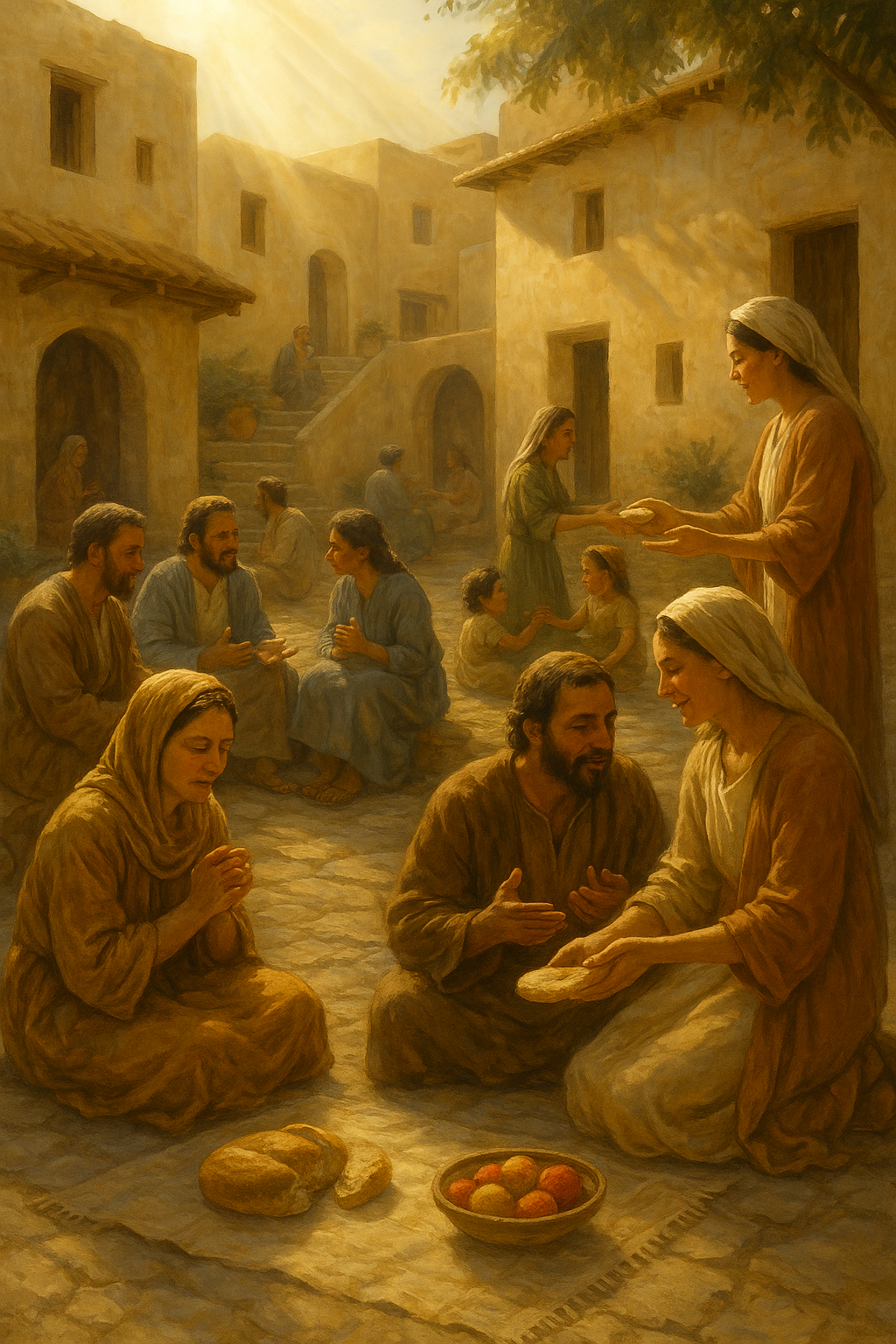
🌼 How the First Converts Became the Early Church
40 And with many other words he testified and exhorted them, saying, “Be saved from this perverse generation.”
41 Then those who gladly received his word were baptized; and that day about three thousand souls were added to them.
42 And they continued steadfastly in the apostles’ doctrine and fellowship, in the breaking of bread, and in prayers.
43 Then fear came upon every soul, and many wonders and signs were done through the apostles.
44 Now all who believed were together, and had all things in common,
45 and sold their possessions and goods, and divided them among all, as anyone had need.
46 So continuing daily with one accord in the temple, and breaking bread from house to house, they ate their food with gladness and simplicity of heart,
47 praising God and having favor with all the people. And the Lord added to the church daily those who were being saved.
👣 Traces of Jesus’ Ministry
Even though Jesus had ascended, His presence and teachings shaped every part of how the early church lived:
- “They gladly received His word” (v. 41) — This reflects Jesus’ own words in John 18:37: “Everyone who is of the truth hears My voice.” The sheep still knew the Shepherd. 🐑
- Baptism followed belief immediately, just as Jesus had commanded in the Great Commission (Matthew 28:19–20). 💧
- The new believers “continued steadfastly” in the apostles’ doctrine — which was, in truth, the teaching of Jesus passed on. 📖
- The breaking of bread and prayers mirror what Jesus modeled at the Last Supper (Luke 22:19) and during His ministry.
- Signs and wonders (v. 43) echo Jesus’ miracles — now carried on through the apostles by the power of the Spirit He sent. ✨
- And then we read: “Fear came upon every soul” — not terror, but a deep and holy awe.This kind of “fear” (phobos, G5401) is the stunned reverence that comes from realizing God is truly among us.Just as people trembled with awe when Jesus healed the sick, forgave sins, and raised the dead, the early believers recognized His presence still moved powerfully in their midst. 🕊️This fear was sacred — not the kind that drives away, but the kind that humbles the heart and deepens belief.
- All things in common (v. 44) reflects Jesus’ deep teachings on generosity, humility, and serving one another (Luke 12:33, John 13:14–15). 💛
- Their joy and simplicity of heart (v. 46) carry the tone of the Sermon on the Mount — pure, peaceful, and heavenly-minded.
- And as always, “The Lord added to the church daily” (v. 47) — because it’s Jesus who gives the increase (cf. 1 Corinthians 3:6). 🌱
📜 From the Early Church
Acts 2:40–47 gives us the first portrait of life in the Lord’s church — simple, joyful, and Spirit-filled.
- Those who gladly received the word were baptized — and they didn’t hesitate. Around 3,000 souls were added in a single day. This wasn’t a slow build; it was a Spirit-fueled beginning. 🔥
- The new believers immediately began “continuing steadfastly” (v. 42) — a phrase that means ongoing devotion and commitment. Their faith wasn’t just emotional—it was enduring. They held fast to:
- The apostles’ doctrine — rooted in the words of Christ
- Fellowship — true community, not just casual friendship
- Breaking of bread — likely both shared meals and the Lord’s Supper
- Prayers — daily spiritual connection with God 🙏
- The church became a spiritual family. They:
- Shared everything (v. 44–45) — sacrificial generosity flowed naturally. No one was left in need.
- Worshiped together daily (v. 46) — both in the temple and from house to house, blending reverence and warmth.
- Ate with gladness and simplicity of heart — their joy was real, humble, and unforced. 🌼
- They had favor with all the people — the surrounding community noticed something beautiful and good.
- Most importantly: “The Lord added to the church daily those who were being saved.”The early church didn’t grow through programs or persuasion — it grew because the message was true, the Spirit was working, and the people lived in a way that reflected Jesus. 🕊️
🕰️ Historical and Cultural Background
The events of Acts 2:40–47 unfolded in Jerusalem, during the Feast of Pentecost — one of the major Jewish pilgrimage festivals. Jews from all over the Roman world had gathered in the city to celebrate, making it a perfect time for the Gospel to be proclaimed to a diverse and devout audience. 🌍
After Peter’s sermon and the miraculous outpouring of the Spirit, about 3,000 people responded in obedience to the Gospel. This created an instant, large community of baptized believers — something entirely new.
Culturally, this was significant for several reasons:
- Most of the new converts were Jews who had a strong background in the Old Testament but now had to re-center their faith in Jesus as the Messiah. This was both exhilarating and disorienting. ✡️➡️✝️
- Many of these converts were likely pilgrims from other regions (see Acts 2:9–11) who had planned only a short stay in Jerusalem. But after baptism, many chose to remain in the city to learn, worship, and grow together. This helps explain why believers began sharing all things in common — so that no one would be left in need during this transitional time. 🏠💞
- The temple in Jerusalem remained a central gathering place for worship and teaching (v. 46), but their daily spiritual life expanded to include house-to-house fellowship, meals, and breaking of bread. This set the stage for a church that was both corporate and intimate — large in number, yet deeply personal.
- Their radical generosity would have stood out against the cultural norms of Roman society, which prized hierarchy, wealth, and power. In contrast, the early church modeled humility, equality, and sacrificial love — the very heart of Christ.
- The early Christians gained favor with the people (v. 47), showing that their kindness, unity, and joy were visibly attractive — even to those not yet converted.
This was not merely a religious movement. It was the birth of a new way of life, rooted in the teachings of Jesus and lived out in real, everyday acts of faith, love, and community. 🌾
🗝️ Key Word Studies
- “Be saved” (v. 40) — sōzō (Greek: σῴζω, Strong’s G4982)👉 To rescue, deliver, heal, or make whole.Peter wasn’t just talking about escaping punishment — he was offering complete spiritual restoration through Christ. This same word is used in Luke 8:36, describing a man freed from demons: “He who had been demon-possessed was healed (sōzō).”In Christ, salvation is not just removal of guilt, but the restoration of the soul. 🕊️
- “Continued steadfastly” (v. 42) — proskartereō (Greek: προσκαρτερέω, Strong’s G4342)👉 To persist in, to remain devoted to, to be constantly diligent.This wasn’t a one-time emotional high — it was daily, determined faithfulness. Used in Romans 12:12: “continuing steadfastly in prayer.”These believers were anchored, not casual.
- “Fellowship” (v. 42) — koinōnia (Greek: κοινωνία, Strong’s G2842)👉 Sharing, participation, communion, close bond. This word doesn’t just mean “being around each other.” It means life woven together, shared burdens and blessings.Philippians 1:5 — “your fellowship in the gospel from the first day.”
- “Fear” (v. 43) — phobos (Greek: φόβος, Strong’s G5401)👉 Reverence, awe, holy trembling in the presence of divine power. Not dread — but soul-deep respect and wonder.Acts 5:11 — after Ananias and Sapphira, “great fear came upon all the church.”
- “Gladness” (v. 46) — agalliasis (Greek: ἀγαλλίασις, Strong’s G20)👉 Exultation, extreme joy, overflowing gladness. This joy wasn’t surface-level. It was Spirit-sourced and deeply felt.Used in Luke 1:44 — “the babe leaped in my womb for joy.”
- “Simplicity of heart” (v. 46) — aphelotēs (Greek: ἀφελότητι, Strong’s G858)👉 Sincerity, singleness, a heart free from duplicity. These early believers weren’t putting on a show. Their hearts were uncluttered and genuine — pure in love and intent.
- “Added” (v. 47) — prostithēmi (Greek: προστίθημι, Strong’s G4369)👉 To place beside, to join, to increase. The Lord Himself was building His church, soul by soul — not just numerically, but in relationship and belonging.
🔍 Theological Themes
- Salvation Is Both Immediate and Ongoing
- In verse 41, those who gladly received the word were baptized that day. But verse 47 says the Lord was adding “daily those who were being saved.”🔁 This shows that salvation isn’t just a moment — it’s a new way of life. It begins in obedience and continues in fellowship, worship, learning, and growth.
- The Church Is God’s Design
- The church wasn’t man-made. Verse 47 says “the Lord added to the church.” The believers didn’t create a club — they were added by God into a spiritual body, unified by faith and purpose. 1 Corinthians 12:18 — “But now God has set the members, each one of them, in the body just as He pleased.”
- The Christian Life Is Devoted and Daily
- Verse 42 uses the phrase “continued steadfastly,” showing that the early church was not casual or occasional in their faith.They were devoted to:
- Learning from the apostles (doctrine)
- Living in fellowship
- Remembering Christ through breaking bread
- Praying togetherChristianity was a daily rhythm, not a weekly obligation.
- Verse 42 uses the phrase “continued steadfastly,” showing that the early church was not casual or occasional in their faith.They were devoted to:
- Worship Is Both Communal and Joyful
- Their time together wasn’t rigid or joyless. They met in the temple and homes, worshipped with gladness, and were filled with simplicity of heart. Worship wasn’t performance — it was overflowing love and gratitude.
- Psalm 100:2 — “Serve the Lord with gladness; come before His presence with singing.”
- Unity and Generosity Are Signs of God’s Presence
- Their willingness to share all things in common (vv. 44–45) wasn’t forced — it was the natural result of the Spirit’s work in their hearts.
- Where God is truly working, self fades and love increases. This theme of generous unity is echoed throughout Acts and the epistles.
- God Is the One Who Gives the Growth
- The church grew not through strategy, marketing, or programs — but because the Lord added those who were being saved.
- He is the one who convicts hearts, draws souls, and builds His church.1 Corinthians 3:6 — “I planted, Apollos watered, but God gave the increase.”
🔗 Old Testament Connections
- A Called-Out People
- The early church was the beginning of a new spiritual Israel — a people called out by God to be His own. “You shall be to Me a kingdom of priests and a holy nation.” (Exodus 19:6)
- Just as Israel was formed after their deliverance from Egypt, so the church was formed after salvation through Christ.T he parallel is striking: deliverance, covenant, teaching, worship, and fellowship.
- Daily Devotion and Sacrifice
- The early church “continued daily” in the temple and at home. The Old Testament pattern of daily offerings, prayers, and songs is echoed here — but now fulfilled spiritually. “Let my prayer be set before You as incense, the lifting up of my hands as the evening sacrifice.” (Psalm 141:2)
- The people became living sacrifices (Romans 12:1), fulfilling the heart of Old Testament worship.
- A Community of Gladness and Unity
- Psalm 133:1 says, “Behold, how good and how pleasant it is for brethren to dwell together in unity!”
- The joyful, generous fellowship in Acts 2 is a fulfillment of that vision — not just blood relatives dwelling together, but spiritual family in Christ.
- God’s Dwelling Among His People
- In the tabernacle and the temple, God promised to dwell among His people. Now, through the Spirit, He truly did — not in buildings, but in the hearts of believers.“I will dwell in them and walk among them. I will be their God, and they shall be My people.” (Leviticus 26:12; echoed in 2 Corinthians 6:16)
- Provisions for the Poor and Needy
- The sharing of resources (Acts 2:44–45) reflects Old Testament commands for the care of the poor and vulnerable:“If there is among you a poor man… you shall open your hand wide to him.” (Deuteronomy 15:7–8)
- The church was now putting that generous spirit into action — not out of obligation, but out of love.
📖 New Testament Connections
- Romans 12:4–5 — One Body in Christ“For as we have many members in one body… so we, being many, are one body in Christ, and individually members of one another.”The unity and shared life of the early church in Acts 2 is fully developed in Paul’s teachings — especially in Romans and 1 Corinthians. The idea of belonging to one another is not just poetic — it’s foundational. 💛
- 1 Corinthians 1:10 & 12:25 — No Divisions, Same CarePaul pleads for the church to have “no divisions,” echoing the early unity found in Acts.“That there should be no schism in the body, but that the members should have the same care for one another.”The Acts 2 believers were living this out — sharing resources, praying together, and caring for needs with love.
- Galatians 6:2 — Bear One Another’s BurdensThe church in Acts did just that. Those with more shared with those in need.“Bear one another’s burdens, and so fulfill the law of Christ.”This wasn’t mere financial help — it was the kind of spiritual and emotional lifting we all need. 🌾
- Philippians 2:1–4 — Like-Minded, Lowly in HeartPaul urges believers to have the same mind and love — looking not only to their own interests but also to others’.The early church embodied this attitude of joyful humility and service.“Fulfill my joy by being like-minded… in lowliness of mind let each esteem others better than himself.”
- Hebrews 10:24–25 — Encouraging One Another DailyThe daily gatherings, prayers, and meals in Acts 2 reflect what the Hebrew writer would later urge:“Not forsaking the assembling of ourselves together… but exhorting one another.”Encouragement and shared spiritual growth are core to the Christian life — never just Sunday-only.
- 1 Peter 1:22 — Love One Another FerventlyPeter himself, who preached that Pentecost sermon, would later write:“Love one another fervently with a pure heart.”He had seen it — firsthand — in the hearts of those who were “glad and generous,” worshiping together in simplicity.
✨ Thoughtful Reflection Questions
- 💧 Have I responded to the Gospel like the first converts did — with readiness, joy, and obedience?
- If not, what might be holding me back?
- 🌼 Does my daily life reflect the gladness and simplicity of heart found in the early church?
- What could I let go of to make more space for God?
- 💞 Am I devoted to fellowship, prayer, and the teaching of Christ — or have I drifted into isolation or routine?
- How can I re-center my walk with the Lord and with His people?
- 🕊️ Do I trust that God is still adding to His church daily — and do I see my role in that growth?
- Who might need encouragement, invitation, or love from me today?
📚 References
Free Online Sources (linked):
- Blue Letter Bible — Greek word studies, interlinear tools, and commentaries.
- Bible Hub — Parallel translations, Strong’s Concordance, and verse-by-verse breakdowns.
- NET Bible Notes — Extensive translator’s notes and study helps.
- GotQuestions.org — Accessible answers to common theological questions (used carefully).
- Christian Courier Articles — Church of Christ perspective on New Testament doctrine and church life.
📚 Paid Print or Digital Books Used in This Post:
- Jackson, Wayne. The Bible and Baptism: A Study of Baptism in the New Testament. Stockton, CA: Christian Courier Publications. Available here
- Winkler, Wendell. Acts: A Handbook on the Book of Acts. Montgomery, AL: Winkler Publications.[Available through Gospel Advocate or used bookstores online]
- Shelly, Rubel. What the Bible Says About the Church. Nashville, TN: 20th Century Christian, 1985.(Out of print; may be available via used book sellers or Church of Christ libraries)
🤖✨ Artificial Intelligence Assistance
ChatGPT. “✨ A Vital Church Grows 🌼 How the First Converts Became the Early Church — Acts 2:40–47.” OpenAI, 2025, https://chat.openai.com.
This post was prayerfully prepared in collaboration with ChatGPT 🤖, a research assistant designed to support deep, Christ-centered Bible study.
All Scripture is taken from the New King James Version (NKJV), and supporting references include Strong’s Concordance, cultural background texts, and trusted Gospel study materials.
May this work bring glory to God and encouragement to the hearts of those who read it. 🕊️💕
Leave a Reply