
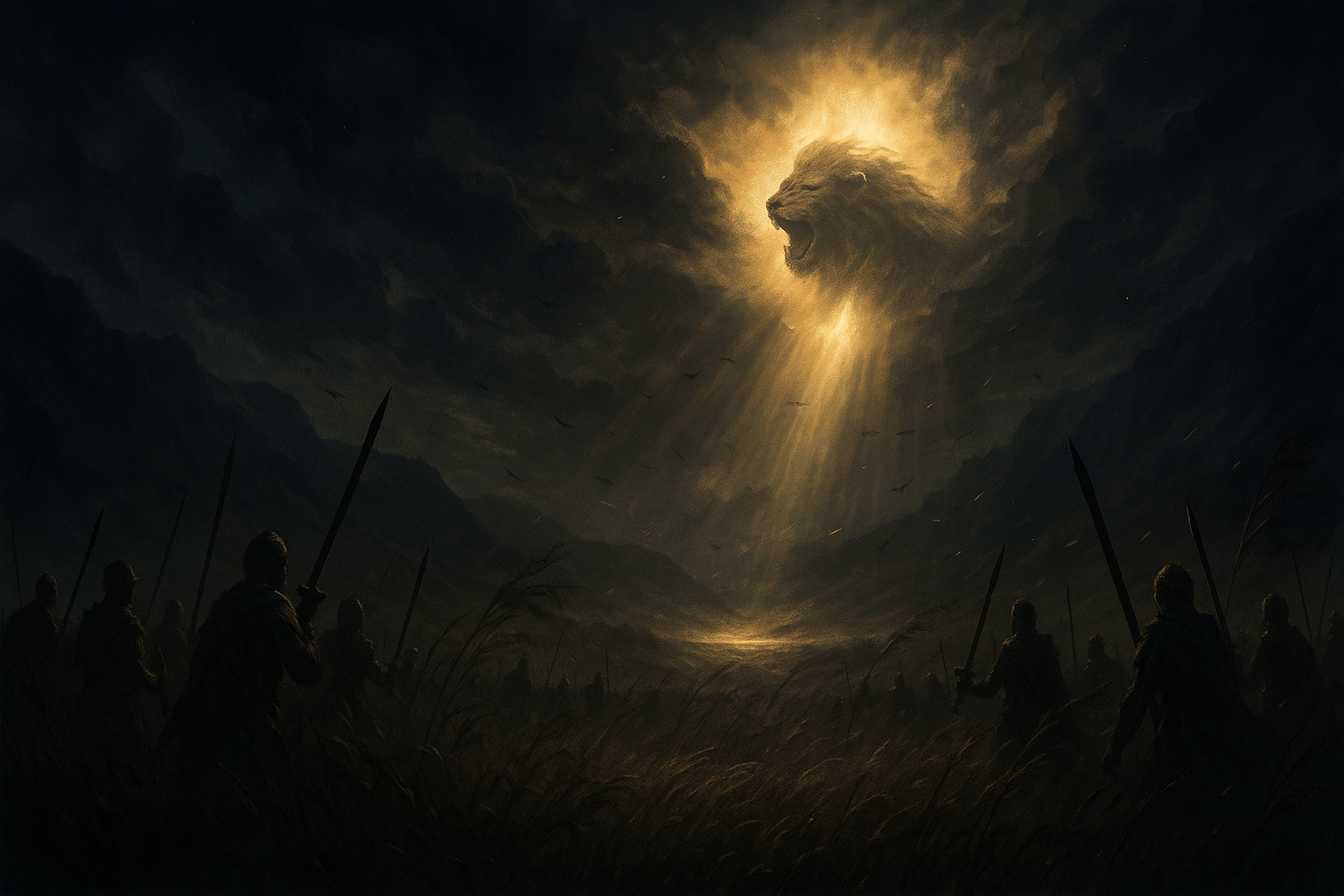
🔥 “Multitudes in the Valley of Decision”
🌿 A prophetic call to battle, but a promise of protection for Zion
📖 Joel 3:9–17 (NKJV)
9 Proclaim this among the nations:
“Prepare for war! Wake up the mighty men,
Let all the men of war draw near,
Let them come up.
10 Beat your plowshares into swords
And your pruning hooks into spears;
Let the weak say, ‘I am strong.’ ”
11 Assemble and come, all you nations,
And gather together all around.
Cause Your mighty ones to go down there, O Lord.
12 “Let the nations be wakened, and come up to the Valley of Jehoshaphat;
For there I will sit to judge all the surrounding nations.
13 Put in the sickle, for the harvest is ripe.
Come, go down;
For the winepress is full,
The vats overflow—
For their wickedness is great.”
14 Multitudes, multitudes in the valley of decision!
For the day of the Lord is near in the valley of decision.
15 The sun and moon will grow dark,
And the stars will diminish their brightness.
16 The Lord also will roar from Zion,
And utter His voice from Jerusalem;
The heavens and earth will shake;
But the Lord will be a shelter for His people,
And the strength of the children of Israel.
17 “So you shall know that I am the Lord your God,
Dwelling in Zion My holy mountain.
Then Jerusalem shall be holy,
And no aliens shall ever pass through her again.”
🕰️ Historical and Cultural Background
This dramatic section of Joel paints a picture of God summoning the nations for judgment—a stark reversal from the hopeful restoration in the previous verses. The setting Joel envisions is the Valley of Jehoshaphat, a symbolic name meaning “Yahweh judges.” While not linked to a specific geographical valley, it represents a divine courtroom where God Himself presides as Judge over the nations.
At the time Joel was likely written (traditionally thought to be pre-exilic or early post-exilic-see definitions below), Judah had experienced waves of invasion, destruction, and humiliation. Neighboring nations such as Tyre, Sidon, Philistia, Edom, and Egypt had not only mocked Judah’s distress but often participated in harming them. Joel foretells that a day will come when God calls those same nations to account.
📜 Pre-Exilic
“Pre-exilic” means before the Babylonian exile.
These are the times before Jerusalem fell, when Israel and Judah still existed as kingdoms (though often unfaithful).
📖 Books or prophets in this period often warned of coming judgment due to sin and idolatry.
- ⏳ Timeline: Roughly before 586 B.C.
- 🗣️ Example prophets: Isaiah, Amos, Micah, Hosea, Habakkuk, possibly Joel (though scholars debate this)

🕊️ Post-Exilic
“Post-exilic” means after the return from Babylonian captivity.
This was the time of restoration and rebuilding, especially the rebuilding of the temple under leaders like Zerubbabel, Ezra, and Nehemiah.
📖 Books in this period often encouraged faithfulness and reminded people of God’s promises.
- ⏳ Timeline: Begins after 538 B.C. (when the first returnees came back under Cyrus the Great)
- 🗣️ Example prophets: Haggai, Zechariah, Malachi, parts of Daniel, and possibly Joel (depending on dating)
Culturally, the passage uses agricultural metaphors to deliver a terrifying image:
- Plowshares turned into swords and pruning hooks into spears reflect a reversal of Isaiah 2:4 and Micah 4:3, where peace is prophesied. Here, the call is to war, not peace.
- The winepress and ripe harvest echo the imagery of divine judgment also found in Revelation 14:14–20. These were familiar images in an agrarian society, symbolizing the overflowing sin of the nations and God’s readiness to act.
Lastly, the tone is apocalyptic—cosmic signs, a roaring voice from Zion, and the darkening of the sun, moon, and stars serve to show God’s total authority over both heaven and earth. For the nations, this day brings dread. For God’s people, however, it brings refuge and reassurance. God is not absent in calamity—He is their shelter and strength.
🗝️ Key Word Studies
1. Prepare for war (v. 9)
- Hebrew: qādash (קָדַשׁ) — Strong’s H6942
- Meaning: To consecrate, sanctify, dedicate, prepare.
- 🕊️ Insight: This is surprising! The same word often used for setting apart something holy is here used to describe preparing for war. It hints at how seriously the nations are treating their rebellion — as if it were a sacred mission. It’s a sobering reminder that humans can deeply misplace their devotion.
2. Beat your plowshares into swords (v. 10)
- Hebrew (beat): kāthath (כָּתַת) — Strong’s H3807
- Meaning: To crush, break down, or hammer.
- 🔥 Insight: This is the reverse of Isaiah 2:4 and Micah 4:3, where swords are beaten into plowshares. Here, tools of peace are repurposed for destruction — a sign of corrupted priorities and the escalation of judgment.
3. Valley of Jehoshaphat (v. 12)
- Hebrew: Yehōshāphāt (יְהוֹשָׁפָט) — Strong’s H3092
- Meaning: “Yahweh has judged.”
- ⛓️ Insight: Whether literal or symbolic, the valley name reminds us that this gathering is not arbitrary — God is the one rendering judgment. His justice is deliberate, not chaotic.
4. Multitudes, multitudes (v. 14)
- Hebrew: hămōn hămōnîm (הֲמוֹן הֲמוֹנִים) — Strong’s H1995 repeated
- Meaning: A noisy, roaring crowd; a mass of people.
- 🌪️ Insight: The repetition emphasizes the overwhelming size and noise — this is the culmination of rebellion. But their noise cannot drown out God’s voice of justice.
5. The Lord will roar from Zion (v. 16)
- Hebrew (roar): shaʾag (שָׁאַג) — Strong’s H7580
- Meaning: To roar like a lion.
- 🦁 Insight: God’s voice here is not still and small — it is loud, unmistakable, and full of majesty. Just as a lion’s roar establishes its territory, God’s roar here signals authority and dominion over all nations.
🔍 Theological Themes
1. Divine Justice Is Not Passive
🧑⚖️ God is not a silent observer of evil. Joel paints a vivid picture of a God who calls the nations to account, summoning them to the Valley of Jehoshaphat — “Yahweh has judged.” This is not random destruction but measured, holy justice. The theme of God judging the nations is consistent with His role as the righteous ruler of all the earth (Psalm 96:13; Acts 17:31).
“Let the nations be wakened… for there I will sit to judge all the surrounding nations.” (v. 12)
2. Reversal of Peace: Judgment Precedes Restoration
⚔️ Instead of turning swords into plowshares (Isaiah 2:4), here we see a reversal — plowshares are beaten into swords. This echoes Romans 1, where humanity in rebellion chooses what is unnatural, flipping God’s order. Peace will come — but only after rebellion is crushed.
“Beat your plowshares into swords… let the weak say, ‘I am strong.’” (v. 10)
3. God’s Roar and Refuge
🦁 In verse 16, God roars from Zion — not to terrify His people, but to demonstrate His power over the nations. While the earth shakes, God becomes a refuge for His people. This dual image of roaring and sheltering reminds us of both His might and His mercy.
“The Lord also will roar from Zion… But the Lord will be a shelter for His people…” (vv. 16–17)
4. God’s Presence Sets His People Apart
🏞️ God declares that Zion is His dwelling place. He distinguishes His people from the nations by being present among them. This is the covenantal heartbeat of all Scripture — “I will dwell in their midst.” It’s fulfilled in Christ and His Church (John 1:14; Revelation 21:3).
“So you shall know that I am the Lord your God, dwelling in Zion My holy mountain.” (v. 17)
👣 Traces of Jesus’ Footsteps
1. The Gathering of Nations Before the Lord
🌍 Joel 3:12 speaks of all nations being gathered in the Valley of Jehoshaphat where the Lord will sit to judge them. This prefigures Jesus’ own teaching:
“All the nations will be gathered before Him, and He will separate them one from another…”
— Matthew 25:32
Here we see Jesus as the Judge of all nations — a direct fulfillment of the role described in Joel. The scene in Matthew (the separation of sheep and goats) parallels the divine courtroom imagery of Joel.
2. The “Roar” of the Lord and the Coming of the Son of Man
🦁 Joel 3:16 says, “The Lord also will roar from Zion… the heavens and earth will shake.”
Jesus describes a similar future event:
“And there will be signs in the sun, in the moon, and in the stars… the powers of the heavens will be shaken.”
— Luke 21:25–27
The roar and the shaking of creation point to the return of Christ in power and great glory, just as Joel envisioned the Lord’s fearsome presence.
3. Jesus as Refuge for His People
🕊️ In Joel 3:16, amid the trembling earth and cosmic upheaval, it says:
“But the Lord will be a shelter for His people, and the strength of the children of Israel.”
This tender image of protection echoes Jesus’ words:
“Come to Me, all you who labor and are heavy laden, and I will give you rest.”
— Matthew 11:28
And again:
“I am the good shepherd. The good shepherd gives His life for the sheep.”
— John 10:11
Even in judgment, Jesus provides safety and peace for those who belong to Him.
🔗 Old Testament Connections
1. The Valley of Decision = The Valley of Jehoshaphat
📍 The “Valley of Jehoshaphat” (v. 12) is likely symbolic — the name means “Yahweh has judged.” This idea connects with 2 Chronicles 20, where King Jehoshaphat faced a vast coalition of enemy armies. He sought the Lord, and God told him not to fear, for “the battle is not yours, but God’s” (2 Chr. 20:15). God delivered Judah in a miraculous act of judgment — a parallel to Joel’s scene of divine intervention and judgment of the nations.
2. Harvest Imagery in Judgment
🌾 The line “Put in the sickle, for the harvest is ripe” (v. 13) echoes several Old Testament uses of harvest as a metaphor for judgment:
- Isaiah 63:1–6 – The Lord treads the winepress in judgment against Edom.
- Jeremiah 51:33 – “The daughter of Babylon is like a threshing floor… the time of her harvest shall come.”
Joel builds on this imagery to express how the wickedness of the nations has reached full measure — and now comes the reaping.
3. The Lord Roars from Zion
🦁 This theme of the Lord’s roar appears also in:
- Amos 1:2 – “The Lord roars from Zion, and utters His voice from Jerusalem.”
- Hosea 11:10 – “They shall walk after the Lord. He will roar like a lion.”
The roar is a symbol of strength, judgment, and majesty — not unlike a lion asserting its authority. But unlike mere terror, the roar is also followed by protection for His people.
4. God Dwelling with His People
🏔️ Joel’s final declaration that the Lord dwells in Zion recalls:
- Exodus 29:45–46 – “I will dwell among the children of Israel and be their God.”
- Leviticus 26:11–12 – “I will set My tabernacle among you… I will walk among you and be your God.”
- Psalm 132:13–14 – “For the Lord has chosen Zion… This is My resting place forever.”
Joel reinforces the message that judgment on the nations leads to restoration and intimacy with God for His people.
📖 New Testament Connections
1. Joel 3:13 – The Winepress Imagery
“Put in the sickle, for the harvest is ripe. Come, go down; for the winepress is full…”
— Joel 3:13
This vivid picture of divine judgment appears again in Revelation:
“So the angel thrust his sickle into the earth and gathered the vine… and threw it into the great winepress of the wrath of God.”
— Revelation 14:19
The imagery of harvest and winepress strongly parallels God’s final judgment in the last days, confirming Joel’s words.
2. Joel 3:16 – The Lord Will Roar from Zion
“The Lord also will roar from Zion, and utter His voice from Jerusalem; the heavens and earth will shake…”
This statement of power finds echoes in Hebrews:
“But now He has promised, saying, ‘Yet once more I shake not only the earth, but also heaven.’”
— Hebrews 12:26
And also Revelation:
“And there were noises, thunderings, lightnings; and there was a great earthquake…”
— Revelation 8:5
Joel’s imagery matches the apocalyptic tone of the New Testament’s final chapters — God’s voice shaking creation itself.
3. Joel 3:17 – The Lord Dwells in Zion
“So you shall know that I am the Lord your God, dwelling in Zion My holy mountain…”
This idea of God dwelling with His people is fulfilled through Christ and again ultimately in the New Jerusalem:
“And the Word became flesh and dwelt among us…”
— John 1:14
“Behold, the tabernacle of God is with men, and He will dwell with them…”
— Revelation 21:3
From Jesus’ first coming to the eternal city in Revelation, Joel’s promise of God dwelling in Zion is richly fulfilled.
✨ Thoughtful Reflection Questions
- Do I live with the awareness that spiritual battles are real and ongoing?
- Joel’s call to “prepare for war” reminds us that we are in a spiritual battle.
- How can I better equip myself with God’s armor (Ephesians 6:10–18) each day?
- When I think of the Lord roaring from Zion, how does that shape my view of His strength and justice?
- Does the image of God’s powerful voice stir fear, awe, or comfort in me?
- What does it teach me about His role as both Judge and Protector?
- Do I truly long for the day when God will dwell fully and forever with His people?
- Joel ends with a vision of God dwelling in Zion.
- What does it mean to live now as one who hopes in that promise?
- Where is my confidence when the world shakes?
- Joel speaks of the earth shaking at God’s voice.
- In moments when life feels uncertain, how do I find stability in the Lord?
- Am I ready for the harvest?
- The winepress and sickle imagery point to a time of separation between righteousness and wickedness.
- Am I living in a way that reflects my hope in Christ and readiness for His return?
📚 References
📚 Free Online Sources (with Links)
- Blue Letter Biblehttps://www.blueletterbible.orgUsed extensively for original Hebrew word definitions (e.g., kadosh, goy, nachalah), Strong’s Concordance references, and cross-referencing Joel 3 with Revelation and Acts.
- Bible Hubhttps://biblehub.comUtilized for comparing translations, verse interlinears, and exploring cross-referenced passages (especially those involving the “Valley of Jehoshaphat” and “multitudes”).
- NET Bible Noteshttps://netbible.orgProvided linguistic and cultural notes on difficult phrases (e.g., “Beat your plowshares into swords…” and “the Lord also will roar from Zion”).
- GotQuestions.orghttps://www.gotquestions.org/Joel-chapter-3.htmlConsulted for broad overviews of the themes and theological interpretation of Joel 3, especially regarding the “Valley of Decision” and God’s future judgment.
- Timeline graphic (Pre-Exilic – Exilic – Post-Exilic) created to support context of Joel’s prophetic voice
📚 Paid Print or Digital Books Used in This Post
- Hailey, Homer. A Commentary on the Minor Prophets. Baker Book House, 1972.(Available here on Truth Publications)Referenced for context on Joel’s prophetic structure, especially the alignment of Joel 3 with end-time judgment and historical events surrounding Judah’s enemies.
- Jackson, Wayne. Notes from the Margin of My Bible, Courier Publications, 2007.Provided insight into practical application and Church of Christ-aligned interpretation, especially the nature of prophecy fulfillment in Joel and the symbolic language.
🖼️ AI-Generated Images (Wordless Visuals)
All imagery was custom-generated in painterly and traditional styles to represent biblical themes without using text overlays. Each was created by request using your descriptions or symbolic representations of the Scripture:
- A traditional oil painting of a battlefield set in a dramatic valley — created to represent the “Valley of Jehoshaphat” / “Valley of Decision” in Joel 3:9–17.File ID: file_00000000402c61f88ad1bbf5de3ecac2
- Timeline Image: Pre-Exilic, Exilic, Post-Exilic Eras — to illustrate when Joel’s prophecy fits into the biblical narrative.File ID: file_000000003a8c61f8ad7bd934162f74a3This timeline visually distinguishes the eras surrounding the Babylonian exile and situates Joel within the likely post-exilic period.
- Other visuals from earlier Joel posts (for continuity reference):
- Joel 2:28–32: Five silhouetted figures under a radiant outpouring sky
- Joel 2:18–27: A pastoral field blooming under golden light
- Joel 3:1–8: A visual representation of broken chains and divine recompense
🤖✨ Artificial Intelligence Assistance
ChatGPT. “✨Prepare for War: The Lord Will Roar from Zion✨ — Joel 3:9–17.” OpenAI, 2025, https://chat.openai.com.
This post was prayerfully prepared in collaboration with ChatGPT 🤖, a research assistant designed to support deep, Christ-centered Bible study. All Scripture is taken from the New King James Version (NKJV), and supporting references include Strong’s Concordance, historical and theological study materials, and trusted Church of Christ-aligned commentaries. May this work bring glory to God and encouragement to the hearts of those who read it. 🕊️💕
Leave a Reply