
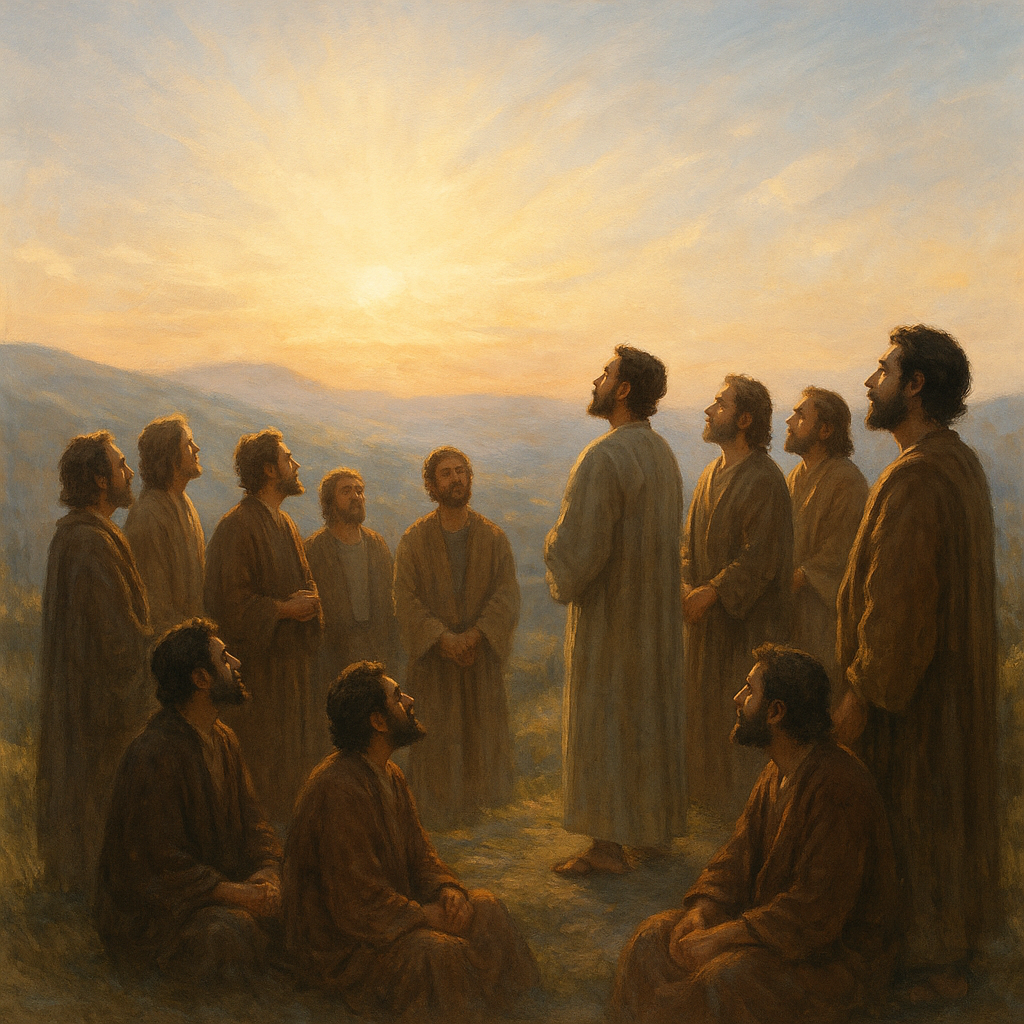
The Promise of the Holy Spirit
Reference information available at: NKJVCompanion by Bonnie Moore
Acts 1:1–3
1 The former account I made, O Theophilus, of all that Jesus began both to do and teach,
2 until the day in which He was taken up, after He through the Holy Spirit had given commandments to the apostles whom He had chosen,
3 to whom He also presented Himself alive after His suffering by many infallible proofs, being seen by them during forty days and speaking of the things pertaining to the kingdom of God.
👣 Traces of Jesus’ Ministry
These opening verses of Acts immediately anchor us to the life and teachings of Jesus. Luke reminds Theophilus—and us—that everything Acts will describe flows directly from what Jesus began to do and teach (v.1), suggesting His work continues even after His ascension, now through His Spirit-led apostles.
- “Of all that Jesus began both to do and teach” – This recalls how Jesus lived a perfect unity of action and message. His miracles, mercy, and teachings were never separate. This theme now passes to His followers.
- “Until the day in which He was taken up” – This echoes Luke 24:50–53 and ties directly to Jesus’ ascension, which the Gospels prepared us for. Jesus didn’t leave His disciples unprepared—He taught and guided them faithfully until His last earthly moment.
- “After He through the Holy Spirit had given commandments…” – Even in His resurrected state, Jesus acted through the Holy Spirit, modeling the very dependence He would later call His followers into. He gave divine instructions not from His own human strength but through God’s power.
- “Many infallible proofs… for forty days” – Just like after His resurrection in the Gospels (John 20, Luke 24), Jesus continued to appear, speak, and demonstrate His aliveness. This extended interaction reassures the apostles—and us—of the reality of His victory over death.
📜 From the Early Church
How the Church was formed and how it should remain today
These verses are more than a bridge—they’re a foundation. Luke opens Acts by testifying to the certainty of Jesus’ resurrection, His Spirit-led commands, and His preparation of the apostles. The Church wasn’t built on mystery or myth but on eyewitness testimony and Holy Spirit guidance.
Let’s highlight a few vital insights for the Church today:
- Rooted in Christ’s Work: The early Church wasn’t a new invention. It was the continuation of all Jesus had begun. Everything the apostles would preach, teach, and suffer for stemmed from Jesus’ life and instructions (v.1). The Church today should also be rooted only in His Word and example—not modern trends or feelings.
- Holy Spirit-Directed Leadership: Before Jesus ascended, He gave commandments through the Holy Spirit (v.2). This sets a divine pattern: leaders are to be led by the Spirit, not their own wisdom. The early Church didn’t operate by human authority—it moved under God’s direction. So should we. 🙏
- Built on Resurrection Evidence: Jesus showed Himself alive with “many infallible proofs” (v.3). The Church’s message isn’t vague encouragement—it’s grounded in the factual, bodily resurrection of Christ. This truth gave the apostles boldness and should give us confidence too! ✝️
- Kingdom-Focused Teaching: For forty days after the resurrection, Jesus continued to speak “of the things pertaining to the kingdom of God” (v.3). The Church wasn’t built on vague spirituality or social movements but on the kingdom of God—His reign, His will, His truth.
Together, these truths tell us that the early Church wasn’t confused or unsure—it was anchored in Jesus, guided by the Holy Spirit, and focused on the kingdom. That’s the path the Church should still follow today. 🌿
🕰️ Historical and Cultural Background
Understanding Acts 1:1–3 in Its Original Setting
To appreciate these verses fully, we need to understand the world the apostles were living in—and what Luke assumed his readers already knew.
✍️ Author and Audience
- The book of Acts is the second volume written by Luke, a physician and companion of Paul (see Colossians 4:14; 2 Timothy 4:11).
- Acts continues the narrative from the Gospel of Luke, picking up where it left off (Luke 24:50–53).
- “Theophilus” means “lover of God.” This could be a real individual (possibly a patron or Roman official) or a symbolic name for any believer seeking to understand the truth.
🏛️ Historical Setting
- These events occur in the first century A.D., likely around 30–33 A.D., in Jerusalem, during a politically and religiously volatile time.
- Rome ruled over Israel, and tensions were high between Roman authorities and Jewish nationalists.
- Many Jews were looking for a military Messiah to liberate them from Roman oppression—Jesus’ spiritual kingdom was not what they expected.
- Jesus’ resurrection appearances happened during this same tense time, and His followers were gathering quietly, likely still afraid of persecution from both the Roman and Jewish leadership.
🕊️ The Significance of the Forty Days
- The mention of “forty days” (v.3) is not accidental. In Jewish thought, the number 40 symbolizes testing, preparation, and transition:
- 40 days of rain in Noah’s time (Genesis 7:12)
- 40 years in the wilderness for Israel (Deuteronomy 8:2)
- 40 days of Jesus fasting in the wilderness (Matthew 4:2)
In Acts, the forty days between Jesus’ resurrection and ascension mark a sacred time of instruction, confirmation, and empowerment before the Church begins its mission.
🕎 The Cultural Impact of “Infallible Proofs”
- Greeks and Romans placed high value on evidence and eyewitness accounts. Luke, being a Gentile, writes to show the certainty and credibility of the resurrection, using a legal-sounding phrase: “many infallible proofs” (Greek: tekmēriois pollois).
- This affirms to both Jewish and Gentile readers that belief in Christ is not blind—it is based on truth that was seen, heard, and touched (see 1 John 1:1–3).
🗝️ Key Word Studies
Exploring the rich meanings behind Acts 1:1–3
🔑 “Began” (Greek: ἤρξατο, ērxato) – v.1
- This verb shows that Jesus started something that was still ongoing.
- Luke doesn’t say Jesus finished His work but that He began to do and teach.
- It implies that what follows in Acts is Jesus continuing His work through the apostles and the Holy Spirit.
- 💡 Application: The Church is not launching a new mission—it’s continuing Jesus’ mission in the world. That includes us! 🙌
🔑 “Taken up” (Greek: ἀνελήμφθη, anelēmphthē) – v.2
- A passive verb meaning He was taken up—not by His own doing, but by the will and power of God.
- This is a reverent phrase used to describe ascension to heaven.
- 💡 This connects Acts with Luke 24:51, where Jesus is “carried up into heaven.”
🔑 “Commandments” (Greek: ἐντελλόμενος, entellomenos) – v.2
- Not just casual words—this refers to official, authoritative instructions.
- These were not suggestions; they were divine orders for the apostles’ mission.
- 💡 Through the Holy Spirit: Jesus gave these commands under God’s spiritual authority, not just as a rabbi but as the risen Son of God.
🔑 “Infallible proofs” (Greek: τεκμηρίοις πολλοῖς, tekmēriois pollois) – v.3
- This rare Greek phrase emphasizes decisive, undeniable evidence.
- It was a term used in Greek legal settings for proof that leaves no room for doubt.
- 💡 This tells us the apostles weren’t asked to believe blindly—they saw, touched, and heard the risen Jesus.
🔑 “Kingdom of God” (Greek: τῆς βασιλείας τοῦ θεοῦ, tēs basileias tou theou) – v.3
- This refers to God’s reign and rule, not an earthly empire.
- Jesus’ resurrection didn’t mark the end of His kingdom teaching—it marked its beginning in full power.
- The Church is called to live under God’s reign and share His rule with the world.
🔍 Theological Themes
Core truths revealed in Acts 1:1–3
✝️ 1. The Ongoing Work of Christ
- Jesus’ earthly ministry didn’t end with the resurrection or even the ascension. Luke emphasizes that Acts is a record of what Jesus continues to do through the Spirit and His followers.
- ✨ Jesus is still active, leading and working through His body—the Church—by the Spirit. That includes you and me today, carrying His light into the world! 🌟
🕊️ 2. The Role of the Holy Spirit
- Right from the start, we see that Jesus gave instructions through the Holy Spirit (v.2).
- The Spirit is not a background figure but a central actor in the story of Acts.
- 🎯 This sets a model for us: true instruction, power, and mission come only when led by the Spirit of God.
👁️🗨️ 3. The Historical Reality of the Resurrection
- Luke underscores the factual basis of the faith—Jesus really rose from the dead and showed Himself alive with “many infallible proofs” (v.3).
- The apostles didn’t follow a dream or a vision—they followed a risen Lord whom they saw, heard, and touched.
- 🛡️ This reinforces our trust: Christianity is not based on myth but on truth.
👑 4. The Kingdom of God as Central Message
- During the forty days before His ascension, Jesus spoke “of the things pertaining to the kingdom of God” (v.3).
- The message of Acts—and of the entire Church—is not just forgiveness or moral living. It is God’s reign in every part of life, starting now and culminating in eternity.
- 💡 The Church should remain kingdom-focused, not distracted by worldly movements or trends.
🔗 Old Testament Connections
How Acts 1:1–3 fulfills and echoes earlier Scripture
🔗 1. God’s Chosen Messengers
“…the apostles whom He had chosen” (v.2)
- In the Old Testament, God frequently called and empowered specific individuals—like Moses, Elijah, and Jeremiah—to carry out His mission.
- Now, Jesus, acting as the Divine Son, chooses apostles to carry His message to the world.
- 🪔 See also: Exodus 3:10 (Moses), 1 Kings 19:16 (Elisha), Jeremiah 1:5 (Jeremiah)
🔗 2. The Kingdom of God Foretold
“…speaking of the things pertaining to the kingdom of God” (v.3)
- The kingdom was not a new idea. The Old Testament foretold a coming reign of God, especially through prophecies like:
- Daniel 2:44 – “The God of heaven will set up a kingdom which shall never be destroyed…”
- Isaiah 9:7 – “Of the increase of His government and peace there will be no end…”
- Jesus’ teachings continued this vision—but not in earthly terms. His kingdom is spiritual, eternal, and righteous.
🔗 3. Forty Days as a Pattern of Preparation
“…being seen by them during forty days” (v.3)
- The number 40 is a repeating symbol of preparation and transition:
- Genesis 7:17 – 40 days of rain during the flood
- Exodus 24:18 – Moses on the mountain for 40 days
- 1 Kings 19:8 – Elijah travels 40 days to Mount Horeb
- Jonah 3:4 – Nineveh given 40 days to repent
- Jesus’ 40-day period between resurrection and ascension is a divinely patterned time of preparation, signaling the start of a new covenant mission.
🔗 4. God’s Voice through the Spirit
“Through the Holy Spirit had given commandments…” (v.2)
- The Old Testament often describes God’s Spirit speaking through prophets (see Ezekiel 2:2, Micah 3:8).
- In Acts, that same Spirit empowers Jesus’ followers to proclaim God’s truth.
- This marks a continuity: the Spirit who inspired prophets now fills the Church.
🔗 New Testament Connections
How Acts 1:1–3 is echoed and expanded throughout the New Testament
🔗 1. Luke and Acts as a Unified Testimony
“The former account I made, O Theophilus…” (v.1)
- This opening links directly back to Luke 1:1–4, where Luke first writes to Theophilus “to set in order a narrative of those things which have been fulfilled among us.”
- Together, Luke and Acts form one continuous story—from the birth of Jesus to the birth of the Church.
🔗 2. The Commissioning of the Apostles
“Given commandments to the apostles…” (v.2)
- Jesus’ commissioning of the apostles in Matthew 28:19–20 (“Go therefore and make disciples…”) and John 20:21–22 (“As the Father has sent Me, I also send you…”) is directly reflected here.
- Acts is the living-out of the Great Commission.
🔗 3. The Resurrection as Foundational
“Presented Himself alive… by many infallible proofs…” (v.3)
- Paul later emphasizes the certainty and importance of the resurrection in:
- 1 Corinthians 15:3–8 – “He was seen by Cephas, then by the twelve… last of all He was seen by me also…”
- Romans 1:4 – Jesus was declared to be the Son of God with power… by the resurrection from the dead.
The resurrection appearances in Acts 1 provide the firm historical ground upon which the apostles preach (especially Peter in Acts 2).
🔗 4. The Kingdom Teaching Continued
“Speaking of the things pertaining to the kingdom of God” (v.3)
- Jesus taught extensively about the kingdom in the Gospels (see Matthew 5–7; Luke 17:20–21).
- After the Gospels, this same kingdom message continues:
- Colossians 1:13 – “He has delivered us from the power of darkness and conveyed us into the kingdom of the Son…”
- Hebrews 12:28 – “Receiving a kingdom which cannot be shaken…”
- The New Testament consistently shows the kingdom of God as present now, growing through the Church, and to be fulfilled completely when Christ returns.
✨ Thoughtful Reflection Questions
Letting the Word sink deeply into our hearts
- “What Jesus began…” (v.1) —Do I see myself as part of Jesus’ ongoing work in the world?
- 🌱 How is He continuing His mission through my daily life, my choices, and my relationships?
- “Through the Holy Spirit…” (v.2) —Do I rely on the Holy Spirit for wisdom, direction, and courage like Jesus did?
- 🙏 In what areas of my life am I trying to lead myself instead of being led by God’s Spirit?
- “Presented Himself alive by many infallible proofs…” (v.3) —What gives me the most confidence that Jesus is truly risen?
- ✝️ Have I shared my reasons for believing with someone who may be struggling to believe?
- “Speaking of the kingdom of God…” (v.3) —Is my life focused on God’s kingdom—or have I become more wrapped up in worldly concerns?
- 👑 What changes can I make this week to live more intentionally under God’s reign?
- Luke writes to Theophilus with careful clarity—Am I intentionally encouraging someone else in the faith, like Luke did?
- 🕊️ Who might God be placing on my heart to guide, teach, or uplift this week?
✅ References
📖 Scripture
- The Holy Bible, New King James Version (NKJV). Thomas Nelson, 1982.
🔍 Word Studies and Language Tools
- Strong, James. Strong’s Exhaustive Concordance of the Bible. Abingdon Press, 1890.
- Mounce, William D. Complete Expository Dictionary of Old and New Testament Words. Zondervan, 2006.
🕰️ Historical and Theological Background
- Bruce, F.F. The Book of Acts. Rev. ed., Eerdmans, 1988. (Paid Print or Digital Book)Available from Christianbook or Amazon
- Polhill, John B. Acts: An Exegetical and Theological Exposition of Holy Scripture (NAC). B&H Publishing, 1992. (Paid Print or Digital Book)Available from Lifeway or Amazon
🌐 Free Online Resources
- Blue Letter Bible. “Acts 1 – NKJV.” https://www.blueletterbible.org/nkjv/act/1/1/t_conc_1000001
- BibleHub Greek Interlinear. “Acts 1:1–3.” https://biblehub.com/interlinear/acts/1-1.htm
🤖✨ Artificial Intelligence Assistance
ChatGPT. “✨ The Ongoing Work of Jesus ✨ — Acts 1:1–3.” OpenAI, 2025, https://chat.openai.com.
This post was prayerfully prepared in collaboration with ChatGPT 🤖, a research assistant designed to support deep, Christ-centered Bible study. All Scripture is taken from the New King James Version (NKJV), and supporting references include Strong’s Concordance, cultural background texts, and trusted Gospel study materials. May this work bring glory to God and encouragement to the hearts of those who read it. 🕊️💕
Leave a Reply