
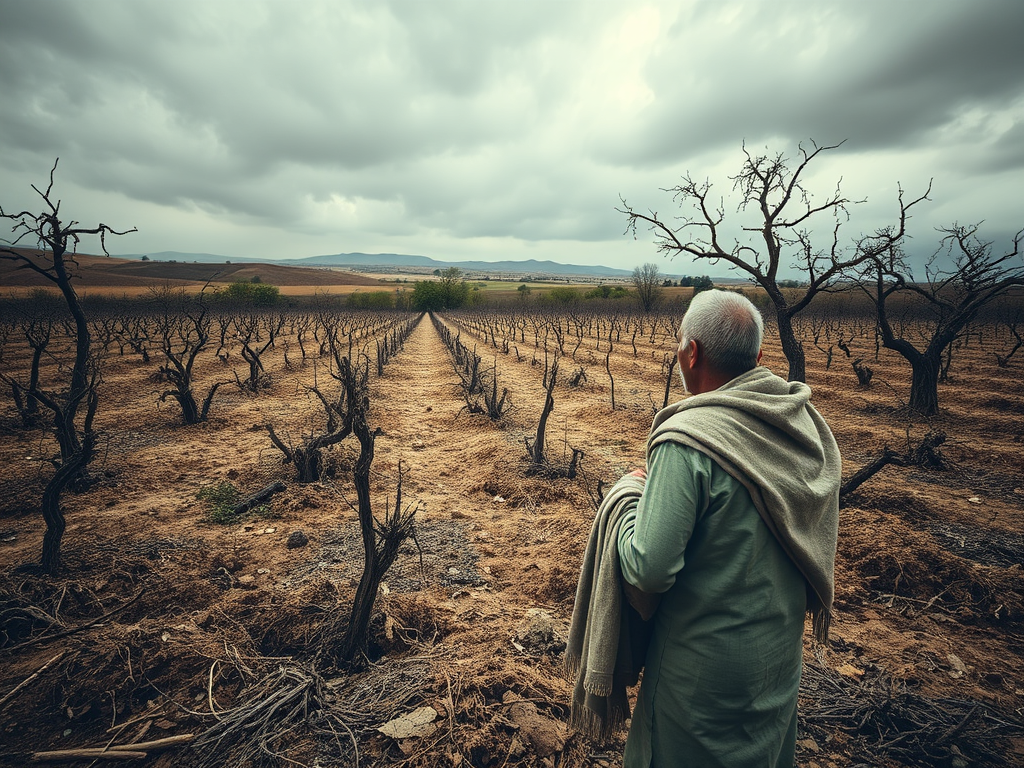
💧 “The Land Mourns, The People Wither”
📖 Joel 1:1–12 (NKJV)
1 The Word of the Lord that came to Joel the son of Pethuel.
2 Hear this, you elders,
And give ear, all you inhabitants of the land!
Has anything like this happened in your days,
Or even in the days of your fathers?
3 Tell your children about it,
Let your children tell their children,
And their children another generation.
4 What the chewing locust left, the swarming locust has eaten;
What the swarming locust left, the crawling locust has eaten;
And what the crawling locust left, the consuming locust has eaten.
5 Awake, you drunkards, and weep;
And wail, all you drinkers of wine,
Because of the new wine,
For it has been cut off from your mouth.
6 For a nation has come up against My land,
Strong, and without number;
His teeth are the teeth of a lion,
And he has the fangs of a fierce lion.
7 He has laid waste My vine,
And ruined My fig tree;
He has stripped it bare and thrown it away;
Its branches are made white.
8 Lament like a virgin girded with sackcloth
For the husband of her youth.
9 The grain offering and the drink offering
Have been cut off from the house of the Lord;
The priests mourn, who minister to the Lord.
10 The field is wasted,
The land mourns;
For the grain is ruined,
The new wine is dried up,
The oil fails.
11 Be ashamed, you farmers,
Wail, you vinedressers,
For the wheat and the barley;
Because the harvest of the field has perished.
12 The vine has dried up,
And the fig tree has withered;
The pomegranate tree,
The palm tree also,
And the apple tree—
All the trees of the field are withered;
Surely joy has withered away from the sons of men.
🕰️ Historical and Cultural Background
Setting the scene for Joel 1:1–12
The prophet Joel, whose name means “Yahweh is God,” speaks during a time of devastating locust invasion and national drought in the land of Judah. While scholars debate the exact date, most believe Joel ministered sometime between 835–796 BC, during the early reign of King Joash, when the high priest Jehoiada helped guide the nation spiritually (see 2 Kings 11–12).
Unlike prophets who rebuke specific kings or name foreign enemies, Joel’s focus is the land itself and its people’s spiritual condition. His words echo an agricultural catastrophe so complete that every source of joy — grain, wine, oil, even shade — is stripped away. This wasn’t just a natural disaster; it was a wake-up call from God.
In ancient Israel, locust plagues were symbols of divine judgment. These swarms could strip fields bare in hours, leaving famine in their wake. Joel presents this judgment not as arbitrary punishment, but as a call to repentance and national mourning. The loss of crops also meant the temple offerings ceased, cutting off a major channel of communion with God (v.9).
The people are addressed by role:
- Elders (v.2) — the respected decision-makers
- Drunkards (v.5) — symbolic of self-indulgent carelessness
- Farmers and vinedressers (v.11) — those hit hardest by the drought
- Priests (v.9) — mourning the loss of worship itself
This background helps us hear Joel’s voice not as one of condemnation alone, but of urgency and invitation — “Turn to the Lord before it is too late.”
🗝️ Key Word Studies
Unpacking the Hebrew phrases in Joel 1:1–12
- 🦗 “Locust” (v.4) — גָּזָם (gāzām), אַרְבֶּה (’arbeh), יֶלֶק (yeleq), חָסִיל (ḥāsîl)
- Joel uses four different Hebrew words to describe the destruction — not just repetition, but a poetic layering of ruin:
- Gāzām (Strong’s H1501): the chewing locust, likely the first stage ’Arbeh (Strong’s H697): the swarming locust, most commonly used in the BibleYeleq (Strong’s H3218): the crawling or young locust, a devourer Ḥāsîl (Strong’s H2625): the consuming locust, often the final, destructive stage
- Joel uses four different Hebrew words to describe the destruction — not just repetition, but a poetic layering of ruin:
- 💔 “Lament” (v.8) — אֵלִי (’ēlî)
- This word means to wail deeply, to grieve with raw and unguarded sorrow.
- ➤ The comparison is striking: “Like a virgin girded with sackcloth for the husband of her youth.” It paints a picture of deep loss and innocence shattered — the kind of grief that silences songs and stops celebrations.
- This word means to wail deeply, to grieve with raw and unguarded sorrow.
- 🌾 “Joy has withered away” (v.12) — הֹבִישׁ (hōvîsh)
- From yābash (Strong’s H3001), meaning “to dry up” or “be ashamed.”
- ➤ This same root is used for land that fails, faces that turn red in shame, or hearts that grow faint. Joel ties physical drought to spiritual dryness — even joy is shriveled like a vine in the sun.
- From yābash (Strong’s H3001), meaning “to dry up” or “be ashamed.”
- 🕊️ “Minister to the Lord” (v.9) — שָׁרַת (shārat)
- A tender word meaning “to serve with devotion.” This verb is often used for Levitical service, especially in temple worship.
- ➤ Their mourning wasn’t only about hunger — it was about being cut off from the presence of God.
- A tender word meaning “to serve with devotion.” This verb is often used for Levitical service, especially in temple worship.
🔍 Theological Themes
What Joel teaches us about God’s heart through suffering
- 🕊️ God’s Sovereign Wake-Up Call – This wasn’t just a natural disaster — it was a divinely appointed disruption. Joel doesn’t point to politics, enemies, or weather patterns. He draws a straight line from the land’s suffering to the people’s need to return to the Lord.
- ➤ Sometimes, God allows what we depend on to fail, so we’ll remember to depend on Him.
- 💔 The Grief of Separation – When the offerings cease (v.9), it isn’t just about ritual — it’s about relationship. The temple system was the center of Israel’s worship, and the lack of grain and wine meant the regular fellowship with God was broken.
- ➤ This foreshadows the spiritual hunger that sin always causes. Sin doesn’t just damage us — it cuts us off from the Source of joy.
- 🌾 Joy Fades When We Wither Spiritually – In verse 12, we see: “Surely joy has withered away from the sons of men.”
- ➤ Joel ties physical desolation to emotional and spiritual ruin. This isn’t just a farming problem — it’s a soul problem. Without God, even blessings like grain and wine lose their sweetness.
- 📢 Prophetic Urgency Across Generations – Joel calls the elders to remember and the children to be told (v.2–3).
- ➤ God’s warnings are not meant for a single moment. They’re meant to echo “to another generation.”
- ➤ God wants every generation to know His mercy, His power, and His call to repentance.
- 🛐 Worship Isn’t a Side Activity — It’s a Lifeline – When the land dried up, worship dried up. No grain = no offerings.
- ➤ Worship is not just an act — it’s the very center of life with God. When it’s neglected or removed, our souls begin to starve.
🔗 Old Testament Connections
Echoes of Joel 1:1–12 throughout Israel’s history
- 🪳 Locust Plagues in Egypt — Exodus 10:12–15
- ➤ God used locusts as one of the ten plagues to judge Egypt.“They covered the face of the whole earth, so that the land was darkened… they ate every herb of the land.”
- 📍Joel draws on this terrifying image — but here, the judgment falls on God’s people for their drifting hearts.
- ➤ God used locusts as one of the ten plagues to judge Egypt.“They covered the face of the whole earth, so that the land was darkened… they ate every herb of the land.”
- 📜 Covenant Curses Foretold — Deuteronomy 28:38–42
- ➤ Moses warned Israel that if they turned away from the Lord, curses would follow, including crop failure and locusts:“You shall carry much seed out to the field but gather little in, for the locust shall consume it.”
- 📍Joel’s prophecy isn’t new — it’s the covenant being enforced. God is faithful, even in judgment.
- ➤ Moses warned Israel that if they turned away from the Lord, curses would follow, including crop failure and locusts:“You shall carry much seed out to the field but gather little in, for the locust shall consume it.”
- 🕊️ Sackcloth and Mourning — Isaiah 22:12–13; Jeremiah 4:8
- ➤ Joel’s call to lament (v.8) mirrors the prophets’ calls for humble, heartfelt repentance:“Gird yourselves with sackcloth and wail… for the fierce anger of the Lord has not turned back.” (Jer. 4:8)
- 📍Joel continues the prophetic pattern of grief as a path to return.
- ➤ Joel’s call to lament (v.8) mirrors the prophets’ calls for humble, heartfelt repentance:“Gird yourselves with sackcloth and wail… for the fierce anger of the Lord has not turned back.” (Jer. 4:8)
- 🌾 Joy Tied to the Harvest — Psalm 4:7; Isaiah 9:3
- ➤ In the Old Testament, grain, wine, and oil often symbolized God’s blessing and favor.“You have put gladness in my heart, more than in the season that their grain and wine increased.” (Ps. 4:7)
- 📍Joel shows what happens when that gladness is removed — the people realize how much they depended on their blessings, not their Blesser.
- ➤ In the Old Testament, grain, wine, and oil often symbolized God’s blessing and favor.“You have put gladness in my heart, more than in the season that their grain and wine increased.” (Ps. 4:7)
- 📖 Generational Responsibility — Deuteronomy 6:6–7
- ➤ Joel’s command to tell your children (v.3) echoes Moses’ great Shema teaching:“You shall teach them diligently to your children…”
- 📍Every generation has the sacred duty to pass down the truth — especially in times of warning and repentance.
- ➤ Joel’s command to tell your children (v.3) echoes Moses’ great Shema teaching:“You shall teach them diligently to your children…”
📖 New Testament Connections
How Joel 1:1–12 echoes into the life and teaching of Christ and the Church
- 🔥 Joel’s Prophecy and Pentecost — Acts 2:16–21
- ➤ Peter famously quotes Joel in Acts 2, connecting the outpouring of the Holy Spirit at Pentecost to Joel’s later prophecy (Joel 2:28–32).
- ➤ But even Joel 1 foreshadows this moment: before the blessing comes, there is mourning, drought, and spiritual famine.
- ➤ Peter’s message builds on Joel’s: “You’ve seen devastation — now behold the Spirit of life!”
- 🌿 Jesus and the Withered Fig Tree — Mark 11:12–14, 20–21
- ➤ In Joel 1:7 and 12, the fig tree is stripped and withered. Jesus echoes this image when He curses the fig tree for having leaves but no fruit — a symbol of spiritual barrenness in Israel.
- 📍Joel and Jesus both use the fig tree to represent God’s people failing to bear fruit in their season.
- ➤ In Joel 1:7 and 12, the fig tree is stripped and withered. Jesus echoes this image when He curses the fig tree for having leaves but no fruit — a symbol of spiritual barrenness in Israel.
- 💔 The Call to Mourn and Repent — Matthew 5:4; James 4:9–10
- ➤ Jesus said, “Blessed are those who mourn, for they shall be comforted.” (Matt. 5:4)
- ➤ James exhorts believers to “Lament and mourn and weep!” (James 4:9)
- 📍These echoes affirm Joel’s message: genuine grief over sin leads to deep joy in God.
- 🌾 Jesus, the True Vine — John 15:1–6
- ➤ While Joel speaks of destroyed vines and wasted branches, Jesus declares, “I am the true vine… abide in Me and you will bear much fruit.”
- 📍Joel shows the failure of Israel’s harvest; Jesus shows the way to spiritual fruitfulness through Him.
- ➤ While Joel speaks of destroyed vines and wasted branches, Jesus declares, “I am the true vine… abide in Me and you will bear much fruit.”
- ⚠️ Warnings of Coming Judgment — Revelation 9:3–10
- ➤ John’s vision includes a terrifying locust plague with symbolic force — echoing Joel’s army of destruction.
- 📍The locust becomes a picture not just of physical ruin but of spiritual warfare and judgment in the last days.
- ➤ John’s vision includes a terrifying locust plague with symbolic force — echoing Joel’s army of destruction.
✨ Thoughtful Reflection Questions
- What might God be trying to show me through seasons of drought — spiritually, emotionally, or physically?
- ➤ Am I paying attention to what He’s removing or allowing in order to draw my heart back?
- Have I ever experienced the fading of joy like the withered vine in Joel 1:12?
- ➤ What caused it, and what helped restore my closeness with God?
- Do I mourn over sin the way Joel calls for — like a bride mourning her beloved?
- ➤ Or do I sometimes treat repentance as routine instead of heartfelt?
- How can I help tell the next generation about the seriousness of God’s warnings and the beauty of His mercy?
- ➤ Is there someone I should gently speak to, write to, or pray for right now?
- Where am I placing my joy — in the blessings of God, or in God Himself?
- ➤ If all the “grain and wine” of my life were stripped away, would I still have praise?
✅ References
📖 Scripture
- The Holy Bible, New King James Version. Nashville: Thomas Nelson, 1982.
🔍 Word Studies and Language Tools
- Strong, James. Strong’s Exhaustive Concordance of the Bible. Nashville: Thomas Nelson, 1990.
- Mounce, William D. Complete Expository Dictionary of Old and New Testament Words. Grand Rapids: Zondervan, 2006.Available from Zondervan
🕰️ Historical and Theological Background
- Smith, James E. The Minor Prophets. College Press Publishing, 1994.Available from College Press
- Chisholm, Robert B. Interpreting the Minor Prophets. Grand Rapids: Academie Books, 1990.Available from Christianbook
🤖✨ Artificial Intelligence Assistance
ChatGPT. “✨Joel: Mini-Series — ‘The Land Mourns, The People Wither’✨.” OpenAI, 2025, https://chat.openai.com.
This post was prayerfully prepared in collaboration with ChatGPT 🤖, a research assistant designed to support deep, Christ-centered Bible study.
All Scripture is taken from the New King James Version (NKJV), and supporting references include Strong’s Concordance, cultural background texts, and trusted prophetic study materials.
May this work bring glory to God and encouragement to the hearts of those who read it. 🕊️💕
Leave a Reply