
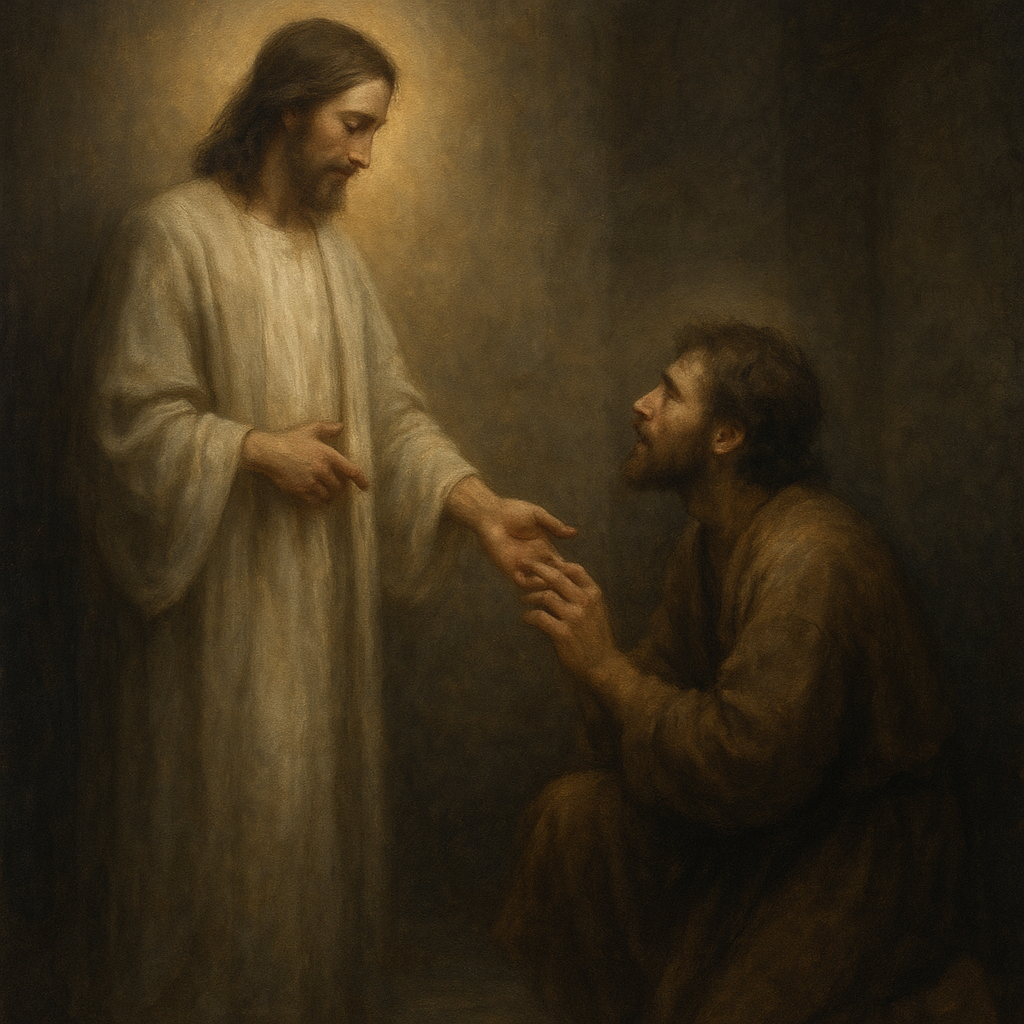
The Continuing Study of Jesus
John 20:24-29
📖 Scripture Reading (NKJV)
🕊️ 24 Now Thomas, called the Twin, one of the twelve, was not with them when Jesus came.
🌿 25 The other disciples therefore said to him, “We have seen the Lord.” So he said to them, “Unless I see in His hands the print of the nails, and put my finger into the print of the nails, and put my hand into His side, I will not believe.”
🌸 26 And after eight days His disciples were again inside, and Thomas with them. Jesus came, the doors being shut, and stood in the midst, and said, “Peace to you!”
💫 27 Then He said to Thomas, “Reach your finger here, and look at My hands; and reach your hand here, and put it into My side. Do not be unbelieving, but believing.”
🙏 28 And Thomas answered and said to Him, “My Lord and my God!”
🌟 29 Jesus said to him, “Thomas, because you have seen Me, you have believed. Blessed are those who have not seen and yet have believed.”
📋 Gospel Parallels: Harmony with the Other Gospels
While Thomas’ specific encounter with Jesus is found only in the Gospel of John, there are other resurrection appearances in the Synoptic Gospels that show Jesus appearing to His disciples and offering proof of His risen body:
| 📖 Gospel | ✨ Parallel Content | 🔍 Key Details |
|---|---|---|
| Matthew 28:16–20 | Jesus appears to the eleven in Galilee | No mention of Thomas’ doubt, but includes Jesus’ Great Commission and His divine authority |
| Mark 16:14(longer ending) | Jesus appears to the eleven and rebukes their unbelief | A general reference to unbelief, not naming Thomas specifically |
| Luke 24:36–49 | Jesus appears in Jerusalem to the gathered disciples | He shows them His hands and feet and invites them to touch Him — similar to what He does for Thomas |
🕊️ Only John includes the personal moment with Thomas, showing how Jesus lovingly addressed one man’s doubt — a scene filled with both divine compassion and a powerful declaration of faith.
🕰️ Historical and Cultural Background
This scene unfolds just over a week after Jesus’ resurrection, likely still in Jerusalem, during the Feast of Unleavened Bread, which continued for a full seven days after Passover (Leviticus 23:6–8). The disciples were in hiding, gathered in a locked room (v. 26), afraid of persecution from the Jewish leaders — much like they were in verse 19.
🪟 The mention of “the doors being shut” isn’t just a casual detail — it paints the atmosphere of fear, secrecy, and vulnerability. Jesus miraculously appears despite the locked doors, reinforcing His divine power and glorified, resurrected nature.
✝️ Thomas (also called Didymus, meaning the Twin) had not been present during Jesus’ first appearance to the disciples (John 20:19–23). We’re not told where he was — perhaps isolated in his grief, or scattered like many others after the crucifixion. It’s worth noting that Jewish tradition emphasized the importance of two or more witnesses for something to be considered credible (Deuteronomy 19:15), and Thomas was unwilling to accept the testimony of the other ten.
🖐️ Thomas’ demand to touch Jesus’ wounds reflects a broader cultural mindset — Jewish law and teaching highly valued visible, tangible proof for spiritual claims. His language about the “print of the nails” also confirms that crucifixion had literally marked Jesus’ body — a horrifying Roman form of execution meant to publicly shame and torture.
💬 Jesus’ greeting — “Peace to you” — was the traditional Jewish shalom (שָׁלוֹם), a word rich in meaning: not only wishing peace, but fullness, wholeness, and restoration. It was the perfect message to deliver to a doubting heart.
🗝️ Key Word Studies
✨ “Believe” — πιστεύω (pisteuō) — Strong’s G4100
This verb appears twice in this passage, once in Thomas’ refusal (“I will not believe,” v. 25) and once in Jesus’ invitation (“Do not be unbelieving, but believing,” v. 27).
- Meaning: to think to be true, to place confidence in, to trust, to be persuaded.
- It’s more than intellectual agreement — it’s an act of the heart and will.💡 In context, Jesus is not just asking for belief in the event of His resurrection, but trust in who He is: the risen Lord and God.
🕊️ “Peace” — εἰρήνη (eirēnē) — Strong’s G1515
Used in Jesus’ greeting both in verse 19 and again here in verse 26: “Peace to you.”
- Meaning: peace, quietness, rest; a state of reconciliation with God.
- It corresponds to the Hebrew word shalom (שָׁלוֹם), which implies not just absence of conflict but wholeness, harmony, and restoration.💗 Jesus speaks peace over fear and over doubt — a healing word.
🙌 “Lord” — Κύριός (Kyrios) — Strong’s G2962
Spoken by Thomas in verse 28: “My Lord and my God!”
- Meaning: master, one in supreme authority, sovereign.
- This is a title of divine honor. Throughout the New Testament, this term is used for both God the Father and Jesus.📖 Thomas is declaring Jesus not just as a rabbi or prophet — but as God Himself.
✨ “God” — Θεός (Theos) — Strong’s G2316
- Meaning: God, the Creator and supreme deity.
- In Greek, Theos is the most general term used to refer to the divine.🌟 Thomas’ confession is the strongest and clearest declaration of Jesus’ divinity in the entire Gospel of John.
🔍 Theological Themes
✝️ 1. Jesus Meets Us in Our Doubt
Thomas is often called “Doubting Thomas,” but the text reveals something more beautiful — Jesus knew Thomas’ heart and met him where he was. He didn’t rebuke him harshly or shame him for his hesitation.
Instead, Jesus invited him to come closer, to touch the wounds, and to believe.
🌿 Application: Faith in Christ does not require perfect certainty — it begins with openness and is nurtured by Jesus’ own patience and mercy. He welcomes honest hearts.
👑 2. Jesus as Lord and God
Thomas’ declaration — “My Lord and my God!” — is one of the most powerful theological moments in the New Testament.
This is the climactic confession of John’s Gospel, affirming the very truth introduced in John 1:1 — that the Word isGod.
- He is Lord (Master, Authority) — one to be obeyed.
- He is God (Theos) — divine, eternal, worthy of worship.🔥 This moment is both deeply personal and profoundly theological.
🌟 3. Blessed Are Those Who Have Not Seen
Jesus says, “Blessed are those who have not seen and yet have believed” (v. 29).
This isn’t a rebuke — it’s a beatitude for future generations. It’s us He’s speaking of! 💕
We didn’t get to touch His wounds or see Him in the flesh, yet we believe through the Word, the testimony of the apostles, and the working of the Holy Spirit.
📖 Faith is not built on physical evidence alone — it is a spiritual trust in the unseen (Hebrews 11:1).
🔗 Old Testament Connections
👁️ 1. The Need for Signs and Seeing
Thomas’ insistence on physical proof echoes a long tradition in the Hebrew Scriptures of people asking God for signs to confirm His word:
- Gideon asked for signs involving dew and fleece to confirm God’s call (Judges 6:36–40).
- Moses asked, “What if they do not believe me?” and was given signs (Exodus 4:1–9).
- Hezekiah was given a miraculous shadow sign to confirm his healing (2 Kings 20:8–11).
💡 These examples show that while faith is always the goal, God has compassion on those who seek assurance — and often responds with mercy.
🧔 2. Confessing God as “My Lord and My God”
Thomas’ exact phrase, “My Lord and my God,” (John 20:28) is deeply Jewish in its language and roots.
- In Psalm 35:23, David prays:“Stir up Yourself, and awake to my vindication,To my cause, my God and my Lord.”
💖 Thomas’ declaration mirrors this worship language — except now he is addressing Jesus with titles reserved for YHWH. This is a monumental acknowledgment of Jesus’ divine identity.
✡️ 3. The Theme of Blessed Belief Without Seeing
Jesus’ words in verse 29, “Blessed are those who have not seen and yet have believed,” connect with the Old Testament’s call to faith in the unseen:
- Habakkuk 2:4 — “The just shall live by his faith.”
- Isaiah 7:9b — “If you will not believe, surely you shall not be established.”
- Deuteronomy 29:4 — “Yet the Lord has not given you a heart to perceive and eyes to see and ears to hear, to this very day.” These verses highlight the longing for spiritual sight — something fulfilled by Jesus through the Spirit.
📖 New Testament Connections
👣 1. Walking by Faith, Not by Sight
Jesus’ words in verse 29 — “Blessed are those who have not seen and yet have believed” — are echoed in several NT passages that affirm the beauty of faith without physical evidence:
- 2 Corinthians 5:7 — “For we walk by faith, not by sight.”
- Hebrews 11:1 — “Now faith is the substance of things hoped for, the evidence of things not seen.”
- 1 Peter 1:8–9 —“Whom having not seen you love. Though now you do not see Him, yet believing, you rejoice with joy inexpressible and full of glory,receiving the end of your faith—the salvation of your souls.”
These passages directly mirror the encouragement Jesus gave in John 20:29 — a word of comfort for generations of believers to come. 🕊️💕
💬 2. The Apostles’ Testimony as the Foundation of Faith
Thomas’ initial disbelief highlights the significance of apostolic witness. Jesus expected His disciples to believe the testimony of the others. This is the very foundation of Christian faith today:
- John 17:20 — Jesus prays for those “who will believe in Me through their word.”
- Romans 10:17 — “So then faith comes by hearing, and hearing by the word of God.”
- 1 John 1:1–3 —“That which we have seen and heard we declare to you…”
🧡 Our faith is built on the trustworthy testimony of eyewitnesses — just like Thomas was invited to trust his friends’ witness, we’re invited to trust theirs.
✝️ 3. Jesus’ Post-Resurrection Appearances
This appearance is one of several that affirm Jesus’ bodily resurrection:
- To Mary Magdalene (John 20:11–18)
- To the disciples without Thomas (John 20:19–23)
- To two on the road to Emmaus (Luke 24:13–35)
- To over 500 brethren at once (1 Corinthians 15:6)
🕯️ Each encounter serves as a unique testimony — but Thomas’ is the one that affirms divine identity and blesses those who believe later.
✨ Thoughtful Reflection Questions
- What do I do with my doubts — do I bring them humbly to Jesus, or hide them in shame?
- 🌿 Thomas was honest. He spoke his doubt aloud… and Jesus responded with grace. Is there anything you’re struggling to believe right now that you could hand over to the Lord?
- What does it mean for me to say, like Thomas, “My Lord and my God”?
- 🙌 This isn’t just a title — it’s a surrender. Do you speak these words with the same awe and personal faith? What might it look like to live them out daily?
- Do I truly believe I am among those “blessed” by Jesus — even though I have not seen Him with my eyes?
- ✨ How might your heart be comforted or strengthened today by this personal blessing spoken over you?
- How can I become a faithful witness to others, as the disciples were to Thomas?
- 🕯️ Who in your life needs gentle encouragement to believe — not through pressure, but through your love, testimony, and patient presence?
✅ References
📚 Free Online Sources
- Blue Letter Bible — Strong’s Concordance and Greek word studies
- Bible Hub — Parallel translations and interlinear tools
- NET Bible Notes — Textual and cultural commentary
- GotQuestions.org — “Why was Thomas called ‘Doubting Thomas’?” (used for context and summary)
🤖✨ Artificial Intelligence Assistance
ChatGPT. “✨My Lord and My God✨ — John 20:24–29.” OpenAI, 2025, https://chat.openai.com.
This post was prayerfully prepared in collaboration with ChatGPT 🤖, a research assistant designed to support deep, Christ-centered Bible study.
All Scripture is taken from the New King James Version (NKJV), and supporting references include Strong’s Concordance, cultural background texts, and trusted Gospel study materials.
May this work bring glory to God and encouragement to the hearts of those who read it. 🕊️💕
Leave a Reply