
✨ When Jesus Appears, Fear Must Flee
🌷 Opening Invitation – John 20:19–23
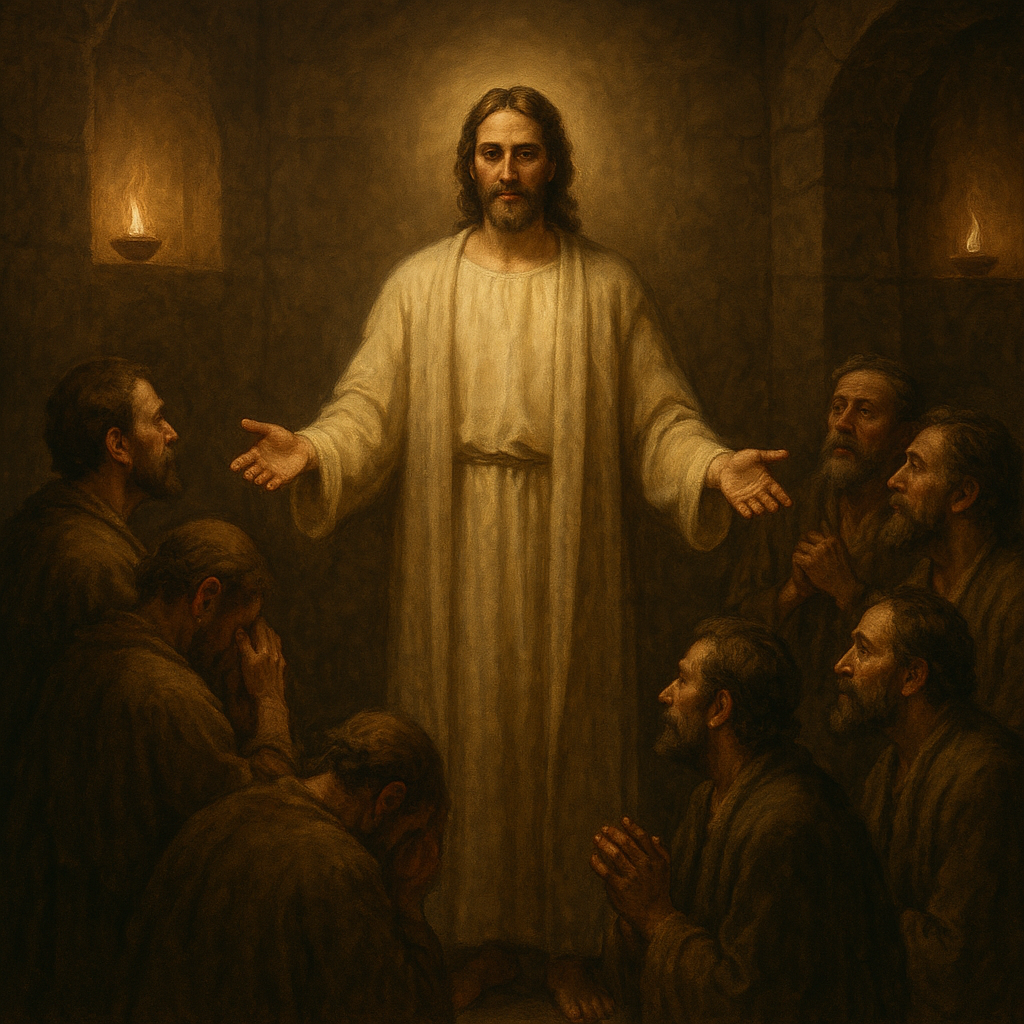
After the joy and wonder of Resurrection morning, the day was far from over. As the sun set and shadows settled over Jerusalem, Jesus’ disciples were still hiding behind locked doors — afraid, confused, and unsure of what to believe. But Jesus didn’t wait for their faith to be perfect. He came to them. He stood in the middle of their fear and spoke the words their hearts most needed to hear: “Peace be with you.”
In this quiet evening moment, Jesus gave His followers not only comfort but purpose. He breathed the Holy Spirit upon them — not with fire and wind, but with breath and blessing. This is the Savior who enters locked rooms, calms trembling hearts, and whispers the beginning of the mission that will change the world.
Come close and listen. Let Him breathe peace into your soul, too.
📖 Scripture Reading (NKJV)
John 20:19–23 — Jesus Appears to His Disciples
19 Then, the same day at evening, being the first day of the week, when the doors were shut where the disciples were assembled, for fear of the Jews, Jesus came and stood in the midst, and said to them, “Peace be with you.”
20 When He had said this, He showed them His hands and His side. Then the disciples were glad when they saw the Lord.
21 So Jesus said to them again, “Peace to you! As the Father has sent Me, I also send you.”
22 And when He had said this, He breathed on them, and said to them, “Receive the Holy Spirit.
23 If you forgive the sins of any, they are forgiven them; if you retain the sins of any, they are retained.”
📋 Quick Preview
- Main Theme: Jesus brings peace, purpose, and the Holy Spirit to His fearful disciples — even behind locked doors.
- Verse Focus: “Peace to you! As the Father has sent Me, I also send you.” — John 20:21 (NKJV)
- Takeaway Thought: The risen Savior meets us right where we are — even in fear and uncertainty — and gently breathes His Spirit upon us to send us into the world with peace and purpose.
🧭 Gospel Harmony Context
📖 John 20:19–23
John gives us the most detailed and intimate account of this moment. It takes place that very evening, still Resurrection Sunday. The disciples are gathered behind locked doors out of fear. Jesus appears in their midst — not knocking, not entering in a natural way — and says, “Peace be with you.” He shows His wounds, speaks peace again, and breathes the Holy Spirit upon them.
📖 Luke 24:36–49 — Parallel Account
Luke records the same event with a few additional details:
- The two disciples from Emmaus have just returned to Jerusalem and are telling the others what happened (Luke 24:33–35).
- As they are speaking, Jesus suddenly appears among them and says, “Peace to you.”
- They are terrified, thinking they’ve seen a spirit.
- Jesus invites them to touch His hands and feet and even eats broiled fish to show He is real.
- He opens their minds to understand the Scriptures and reminds them of the coming promise of the Holy Spirit.
📝 Not Mentioned in Matthew or Mark
- Matthew ends his Gospel with Jesus meeting the disciples in Galilee (Matthew 28:16–20).
- Mark briefly references Jesus appearing to the eleven (Mark 16:14) and rebuking their unbelief, but offers little detail.
Together, John and Luke give us a fuller picture of this tender evening scene — the disciples still reeling from the resurrection reports, unsure and afraid, and then… Jesus stands among them. The peace He brings is not just comfort — it’s commission. The Spirit begins to move, quietly but powerfully.
🕰️ Historical and Cultural Background
🔒 “The Doors Were Shut” — A Scene of Fear
The disciples were not gathered in confidence. They were afraid — afraid of being arrested, humiliated, or even killed like their Lord. The Jewish leaders had stirred the crowds, condemned Jesus, and now His body was missing. “The doors were shut” implies secrecy and fear — yet it’s here that Jesus appears.
This setting highlights that Jesus is not hindered by human barriers. Locked doors, trembling hearts, or confused minds cannot keep Him out. His presence is not dependent on boldness — but His presence produces boldness.
✡️ Evening of the First Day of the Week
This is still Resurrection Sunday, but now evening. In Jewish timekeeping, the day would have turned at sunset. So this moment, even though happening at night, is still considered part of the day of resurrection — a sacred capstone to Sunday’s dawn light.
🕊️ Breathing the Spirit
Jesus breathes on them — a symbolic and deeply theological act. This is a preview of what will be poured out at Pentecost (Acts 2), but it also calls us back to Genesis 2:7, when God breathed life into Adam. Here, the new creation begins. The Spirit comes not with a storm but with breath — personal, intentional, and holy.
🕎 The Mission Begins in a Private Room
Jesus doesn’t wait to gather a crowd or plan a public sermon. He begins with His closest followers, in a room that feels like hiding. This emphasizes the tenderness of His shepherding. Before He sends them into the world, He comes quietly to be with them in their fear.
🗝️ Key Word Studies
1. “Peace” — εἰρήνη (eirēnē)
- Strong’s G1515 – a state of quietness, rest, harmony, restoration; from the Hebrew “shalom”
- Jesus repeats this word twice (v. 19 & 21): “Peace be with you.” This was not a casual greeting — it was the fulfillment of His promise from John 14:27: “My peace I give to you.”
- It signals restoration: between God and man, between fear and faith.
2. “Stood in the midst” — ἵστημι ἐν μέσῳ (histēmi en mesō)
- Strong’s G2476 – to stand, to cause to be established
- He didn’t just appear — He stood among them, taking His place in the center. He had been crucified outside the city, but now He is firmly planted inside their midst. It is a picture of Him reestablishing His presence among His people.
3. “Breathed on them” — ἐνεφύσησεν (enephusēsen)
- Strong’s G1720 – to breathe into or upon
- This word is used only here in the New Testament, but it directly mirrors Genesis 2:7 (LXX) where God breathes life into Adam. It marks a moment of new creation — spiritual life given through Christ.
4. “Receive” — λάβετε (labete)
- Strong’s G2983 – to take, accept, actively receive
- Jesus doesn’t say “wait for” — He says “receive.” It is an act of grace and commission, placing responsibility and spiritual empowerment in the disciples’ hands immediately.
5. “Forgive” — ἀφίημι (aphiēmi)
- Strong’s G863 – to release, send away, cancel a debt
- This word is deeply tied to the Gospel. Jesus links the Spirit with the mission of forgiveness — not that the disciples themselves forgive sin, but they are now His ambassadors, proclaiming the offer of it (2 Cor. 5:20).
🔍 Theological Themes
🕊️ 1. The Peace of the Risen Christ
Jesus’ first words after the resurrection are not a rebuke or an explanation — they are peace. This peace is not circumstantial; it’s eternal. It comes not from things being calm but from Christ being present. He offers peace that the world cannot give (John 14:27), even when fear locks us in.
🧍 2. Christ in the Midst
Jesus “stood in the midst” — not outside, not above, but among them. His presence is not distant. This echoes Matthew 18:20: “Where two or three are gathered… I am there in the midst of them.” The risen Christ remains Emmanuel — God with us.
🔄 3. The Apostolic Mission Begins
Jesus says, “As the Father has sent Me, I also send you.” This is a powerful echo of John 17:18 — a handoff of heavenly purpose. Just as Jesus was sent in love, sacrifice, and truth, the disciples are now sent with that same commission.
🌬️ 4. The Breath of New Creation
When Jesus breathes on the disciples, it marks the beginning of the Spirit’s work in the church. It’s a quiet Pentecost preview — a promise of what’s to come, and a reminder that the Spirit’s presence begins not with spectacle, but with breath. Just as God breathed life into man in Genesis, Jesus now breathes spiritual life into His followers.
💬 5. The Ministry of Forgiveness
Jesus ties the gift of the Spirit with the forgiveness of sins. While only God forgives sin (Mark 2:7), Jesus entrusts His followers with the message of forgiveness. The church becomes His voice in the world, proclaiming the Gospel that frees hearts and cancels debts.
🔗 Old Testament Connections
🌬️ Genesis 2:7 — “God breathed into his nostrils the breath of life…”
“And the LORD God formed man of the dust of the ground, and breathed into his nostrils the breath of life; and man became a living being.”
When Jesus breathes on the disciples and says, “Receive the Holy Spirit,” He is initiating new creation. Just as Adam received physical life from God’s breath, the disciples receive spiritual life — the indwelling presence of God.
🕊️ Isaiah 61:1 — “The Spirit of the Lord GOD is upon Me…”
“…Because the LORD has anointed Me to preach good tidings to the poor; He has sent Me to heal the brokenhearted…”
Jesus had already quoted this verse to describe His own mission (Luke 4:18). Now, as He sends the disciples in the same way the Father sent Him, this passage becomes theirs as well — they are being sent in the Spirit’s power to carry the same message of healing and release.
📜 Numbers 11:25–29 — The Spirit Shared with the Elders
In the wilderness, God took some of the Spirit from Moses and placed it upon the elders. Here, Jesus personally imparts the Spirit to His followers — a more intimate and powerful moment that prefigures the full outpouring of the Spirit on all believers.
✡️ Ezekiel 37:9–10 — “Come from the four winds, O breath…”
“…and breathe on these slain, that they may live.”
This prophetic vision of dry bones being raised to life by the breath of God mirrors what’s happening spiritually in the upper room. Jesus breathes, and fearful men begin to awaken to new life and mission. The Spirit brings vitality and courage where there was once death and fear.
This moment in John is not isolated. It stands on the foundation of creation, prophecy, and promise — and it points forward to the full outpouring yet to come.
🔗 New Testament Connections & Future Appearances
💬 John 14:26 — The Spirit Was Promised
“But the Helper, the Holy Spirit, whom the Father will send in My name, He will teach you all things…”
This moment in John 20 fulfills the beginning of that promise. Jesus had spoken of the Spirit as the Comforter, Teacher, and Reminder — now He breathes that presence into His disciples personally.
🔥 Acts 2:1–4 — Pentecost Fulfilled
“And suddenly there came a sound from heaven, as of a rushing mighty wind…”
What begins as a quiet breath in a locked room will explode into a rushing wind and tongues of fire fifty days later. The breath becomes a blaze — but it starts here, with peace and personal presence.
✝️ Luke 24:36–49 — The Broader Commission
Luke records the same scene but adds that Jesus explained the Scriptures and promised the Spirit:
“You are witnesses of these things. Behold, I send the Promise of My Father upon you…”
It is the same mission: go and proclaim repentance and forgiveness in His name.
🙌 2 Corinthians 5:20 — Ambassadors of Reconciliation
“Now then, we are ambassadors for Christ, as though God were pleading through us…”
What Jesus begins in John 20 — breathing peace and entrusting the message of forgiveness — becomes the foundation of Paul’s theology of reconciliation. The Spirit-filled church is now the voice of Christ in the world.
🕊️ Romans 8:15–16 — The Spirit of Adoption
“For you did not receive the spirit of bondage again to fear, but you received the Spirit of adoption…”
The Spirit Jesus imparts is not just power — it’s relational. His peace replaces their fear. His breath gives them identity as sons and daughters, not slaves to fear.
The locked room becomes the launchpad. This moment quietly sets the Church in motion, powered not by might, but by the Spirit.
✨ Thoughtful Reflection Questions
- Where in my life do I feel like the doors are locked — emotionally, spiritually, or relationally?
- What would it mean for Jesus to stand in the midst of that space?
- Why do I think Jesus said “Peace be with you” twice?
- Do I need to hear those words again today?
- When have I felt like Jesus breathed life into a fearful or dry part of my spirit?
- How did that change my heart, my outlook, or my purpose?
- How does it shape my faith to know that Jesus didn’t wait for the disciples to be strong or ready — He came to them as they were?
- What does that say about how He sees me?
- What mission has Jesus called me into, even in the midst of my weakness or uncertainty?
- Am I listening for the quiet beginnings of that call?
- Have I ever experienced the peace of Christ in a moment when I expected anything but peace?
- How did it feel to receive something so undeserved, so holy?
✅ References
📚 Free Online Sources
- The Holy Bible, New King James Version. Thomas Nelson, 1982.https://www.biblegateway.com/versions/New-King-James-Version-NKJV-Bible/
- Strong’s Concordance. Blue Letter Bible Lexicon.https://www.blueletterbible.org/lexicon/
- “Harmony of the Gospels.” Blue Letter Bible study tools and Gospel comparison resources.https://www.blueletterbible.org/study/harmony/index.cfm
📚 Paid Print or Digital Books Used in This Post
- Bullinger, E.W., ed. The Companion Bible. Kregel Publications, 1999.Available at Christianbook, Logos, or Amazon
🤖✨ Artificial Intelligence Assistance
ChatGPT. “🕊️ Receive the Holy Spirit — When Jesus Appears, Fear Must Flee.” OpenAI, 2025, https://chat.openai.com.
This post was prayerfully prepared in collaboration with ChatGPT 🤖, a research assistant designed to support deep, Christ-centered Bible study. All Scripture is taken from the New King James Version (NKJV), and supporting references include Strong’s Concordance, cultural background texts, and trusted Gospel study materials. May this work bring glory to God and encouragement to the hearts of those who read it. 🕊️💕
Leave a Reply