
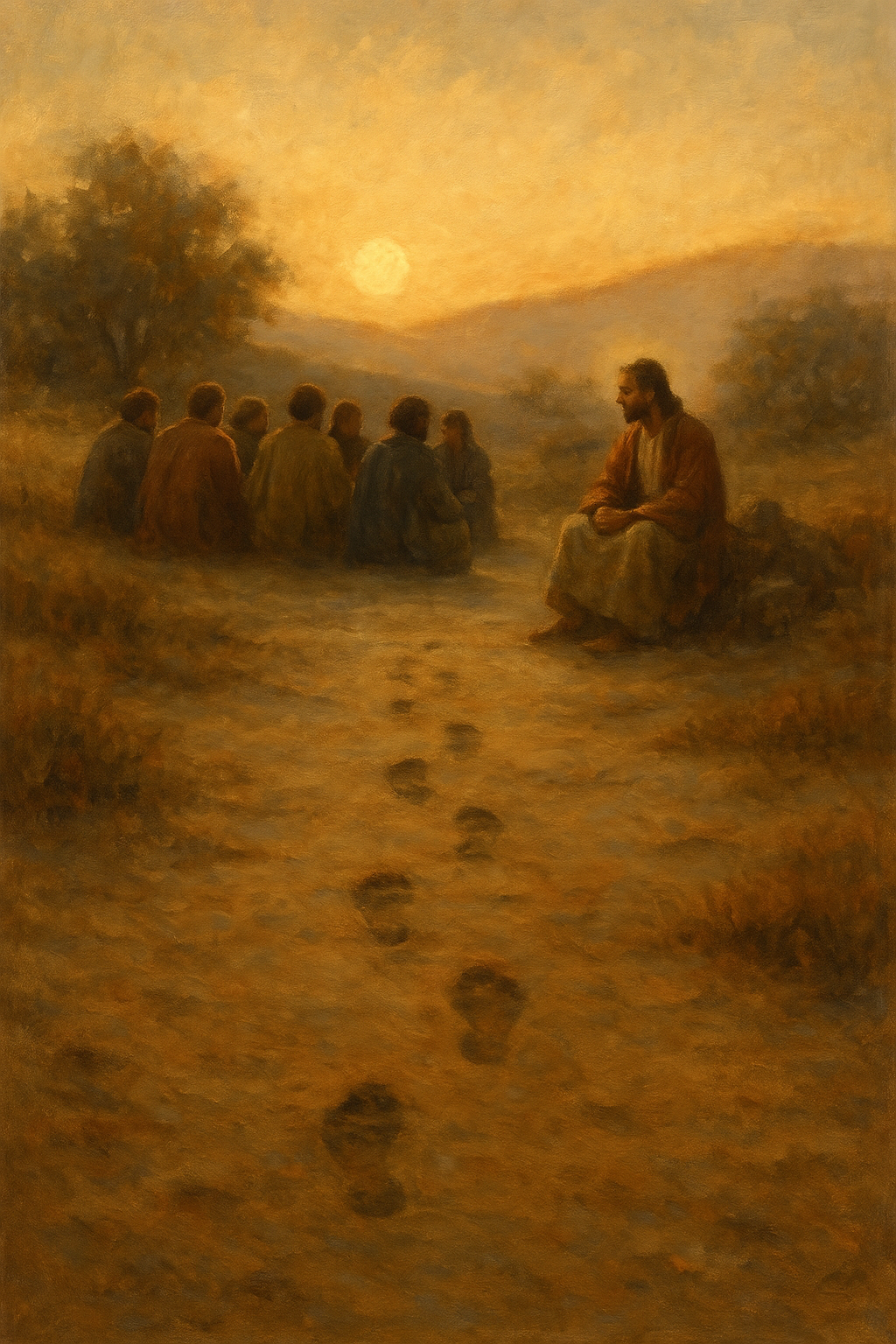
John 6:60–71 — Many Disciples Turn Away
Theme: True belief is revealed when the teachings become difficult. Jesus asks the Twelve the most piercing question of all: “Do you also want to go away?”
Many Disciples Turn Away
60 Therefore many of His disciples, when they heard this, said, “This is a hard saying; who can understand it?”
61 When Jesus knew in Himself that His disciples complained about this, He said to them, “Does this offend you?
62 What then if you should see the Son of Man ascend where He was before?
63 It is the Spirit who gives life; the flesh profits nothing. The words that I speak to you are spirit, and they are life.
64 But there are some of you who do not believe.” For Jesus knew from the beginning who they were who did not believe, and who would betray Him.
65 And He said, “Therefore I have said to you that no one can come to Me unless it has been granted to him by My Father.”
66 From that time many of His disciples went back and walked with Him no more.
67 Then Jesus said to the twelve, “Do you also want to go away?”
68 But Simon Peter answered Him, “Lord, to whom shall we go? You have the words of eternal life.
69 Also we have come to believe and know that You are the Christ, the Son of the living God.”
70 Jesus answered them, “Did I not choose you, the twelve, and one of you is a devil?”
71 He spoke of Judas Iscariot, the son of Simon, for it was he who would betray Him, being one of the twelve.
📋 Gospel Parallel Table
This profound moment—where many disciples turn away—is recorded only in John. However, its themes of confession, falling away, and divine calling resonate deeply with events in the Synoptic Gospels.
| Theme or Event | Matthew | Mark | Luke | John |
|---|---|---|---|---|
| Peter’s Confession of Faith | Matt. 16:13–20 | Mark 8:27–30 | Luke 9:18–21 | John 6:68–69 |
| Many Turn Away | — | — | — | John 6:60–66 |
| Judas Foretold as Betrayer | Matt. 26:20–25 | Mark 14:17–21 | Luke 22:21–23 | John 6:70–71 |
🕊️ Parallel Highlights
- Peter’s confession in John 6:68–69 matches the tone and content of the confession in Matthew 16:16:“You are the Christ, the Son of the living God.”
- The falling away in John 6 foreshadows what will come again in John 18: many will flee when the cost becomes too high.
- Jesus’ warning about Judas here comes long before the actual betrayal—showing that even in this moment of confession, a shadow is present. Personal Note: I was reading that bit and thought how did I get to the betrayal already and then realized it was a foreshadowing. Always surprises to find every day!
🧭 Harmony with the Gospels
Although this event is recorded only in John, the themes it reveals—confession, desertion, and betrayal—are echoed powerfully in the Synoptic Gospels:
💬 1. Peter’s Confession of Faith
- John 6:68–69 — “You have the words of eternal life… You are the Christ, the Son of the living God.”
- Matthew 16:16 — “You are the Christ, the Son of the living God.”
- Mark 8:29 / Luke 9:20 — “You are the Christ.”
In all four Gospels, Peter speaks from a place of Spirit-led conviction, distinguishing the true disciple from those who only followed for benefit or curiosity.
🚪 2. Many Turn Away
- John 6:66 — “Many of His disciples went back and walked with Him no more.”
- This painful departure foreshadows the falling away at the crucifixion (Matthew 26:56) and the parable of the sower (Matthew 13:20–21), where some fall away when trials come.
🕯️ 3. The Cost of Following
- Compare John’s account with:
- Luke 14:27 — “Whoever does not bear his cross and come after Me cannot be My disciple.”
- Matthew 10:38 — “He who does not take his cross… is not worthy of Me.”
Jesus never softens the cost of discipleship. True followers remain not because it’s easy, but because they know there is no other way to life.
🕵️ 4. Judas Foretold
- John 6:70–71 — “One of you is a devil…”
- Compare with:
- Matthew 26:21–25
- Mark 14:18–21
- Luke 22:21–23
This is the first direct mention of Judas as the betrayer—long before the Last Supper—revealing Jesus’ full knowledge and authority over what was to come.
Personal Note: I was watching a movie that was a version of Jesus’ life and it made the impression that Jesus received a vision only moments before he spoke to Judas at the Last Supper about the betrayal. I was not really sure when he knew, if it was all along or not. Now I know it was not like the movie. It is a good reminder that the Scripture is the best teacher.
🕰️ Historical and Cultural Background
😠 “This is a hard saying” (v. 60)
- The phrase “hard saying” doesn’t just mean difficult to understand—it also means difficult to accept.
- In the ancient Jewish context, a rabbi’s disciples were expected to trust and submit to his teaching. But here, Jesus had just told them they must eat His flesh and drink His blood—symbolic language deeply offensive to Jewish sensitivities (see Leviticus 17:10–12).
- This is where many drew the line. Jesus’ teaching crossed their comfort, and they turned away.
🧍 “Many of His disciples walked with Him no more” (v. 66)
- The word disciples here doesn’t mean the Twelve only—it refers to the larger group of followers who had been traveling with Him.
- These were people who had seen miracles, eaten the loaves, and followed Jesus out of interest and excitement…But when Jesus called for total spiritual surrender, they walked away.
🧠 Jesus’ Knowledge of Judas (v. 64, 70–71)
- This is an early and clear statement: Jesus already knew who would not believe—and who would betray Him.
- In Jewish thought, betrayal by a close friend was especially disgraceful. Psalm 41:9 prophesied this pain:“Even my own familiar friend… has lifted up his heel against me.”
- By stating this here—long before the betrayal occurs—Jesus reveals His divine foreknowledge and calm authority. He is never taken by surprise.
🕯️ Peter’s Confession (v. 68–69)
- Spoken in Capernaum, this is one of Peter’s earliest public declarations of faith.
- His words echo the Shema (“Hear, O Israel…”) and Jewish confession of monotheism—except now they are directed toward Jesus:“You have the words of eternal life… You are the Christ, the Son of the living God.”
- This was radical faith—not because it was eloquent, but because it held fast in the moment when everyone else was leaving.
This moment marks a turning point in Jesus’ ministry. No longer is He just followed for miracles—now, the truth divides those who truly believe from those who cannot accept what He came to give. 💔
🗝️ Key Word Studies
😣 1. “Hard saying” — Greek: sklēros (σκληρός)
- Used in: v. 60 — “This is a hard saying…”
- Meaning: Harsh, severe, offensive, or difficult to endure.
- Insight: It doesn’t mean confusing—it means challenging to the will and heart. Jesus’ words cut deeply, and some hearts refused to yield.
🧠 2. “Offend” — Greek: skandalízō (σκανδαλίζω)
- Used in: v. 61 — “Does this offend you?”
- Meaning: To cause to stumble or fall into a trap.
- Insight: This is where we get the word scandal. Jesus knew that some would stumble over truth, but He still spoke it. His question is gentle—but reveals a spiritual barrier.
🕊️ 3. “Spirit” — Greek: pneuma (πνεῦμα)
- Used in: v. 63 — “The Spirit gives life…”
- Meaning: Wind, breath, or divine Spirit.
- Insight: Human understanding isn’t enough—life and understanding come from the Spirit. Flesh alone cannot comprehend or produce faith.
✨ 4. “Life” — Greek: zōē (ζωή)
- Used in: v. 63, 68 — “They are life… words of eternal life.”
- Meaning: Not just biological life, but eternal, spiritual, God-breathed life.
- Insight: Jesus offers more than survival—He offers Zōē life, the kind only the Father can give.
🧍♂️ 5. “Walked with Him no more” — Greek: peripateō (περιπατέω)
- Used in: v. 66 — “They walked with Him no more.”
- Meaning: To walk with, to live alongside, to conduct one’s life.
- Insight: This is more than just leaving physically—it represents turning away from following His way of life. A tragic moment of spiritual retreat.
🔍 Theological Themes
🧠 1. True Discipleship Is Tested by Difficult Truth
“This is a hard saying… Who can understand it?” (v. 60)
- Real faith isn’t proven during the miracles—it’s proven when the teachings get difficult, unpopular, or personally costly.
- Jesus doesn’t water down the truth to retain followers; He offers life, but only on His terms.
🧲 2. Faith Is a Result of God’s Drawing, Not Human Will Alone
“No one can come to Me unless it has been granted… by My Father.” (v. 65)
- This passage reinforces a consistent truth: salvation is initiated by the Father, and responded to in faith.
- It guards against pride and reminds us of the grace behind belief.
💬 3. Jesus’ Words Are Spirit and Life
“The words that I speak… are spirit, and they are life.” (v. 63)
- Jesus’ words don’t just inform—they transform.
- They are alive through the Spirit, bringing true spiritual awakening to those willing to receive them.
🕯️ 4. Betrayal Is Foreseen, Yet God’s Plan Stands
“One of you is a devil.” (v. 70)
- Jesus isn’t caught off guard by Judas. He chooses and commissions His disciples knowing full well the outcome.
- This reveals the sovereignty of God even in painful things—betrayal didn’t derail the plan of redemption; it fulfilled it.
🌿 5. Peter’s Confession Shows What Anchors a True Disciple
“Lord, to whom shall we go? You have the words of eternal life.” (v. 68)
- When others leave, Peter stays—not because he understands everything, but because he knows the One who gives life.
- His confession is humble, faithful, and deeply human: Where else could we even go?
This passage reminds us that the road of discipleship is narrow—but it leads to everlasting life. Not everyone follows to the end, but those who stay do so because they know Jesus is the only way. 🌾
🔗 Old Testament Connections
📜 1. God’s Word Brings Life — Deuteronomy 8:3
“The words that I speak to you are spirit, and they are life.” (v. 63)
- 📖 Deut. 8:3 — “Man shall not live by bread alone; but man lives by every word that proceeds from the mouth of the Lord.”
- Jesus affirms that true life comes not through physical bread, but through God’s living Word—a truth first revealed in the wilderness.
🕯️ 2. Betrayal Foretold — Psalm 41:9
“One of you is a devil.” (v. 70)
- 📖 Psalm 41:9 — “Even my own familiar friend in whom I trusted… has lifted up his heel against me.”
- Jesus’ knowledge of Judas fulfills David’s sorrow and points to the Messianic betrayal that would come from within His own circle.
🕊️ 3. God Draws People to Himself — Jeremiah 31:3
“No one can come to Me unless it has been granted… by My Father.” (v. 65)
- 📖 Jer. 31:3 — “I have loved you with an everlasting love; therefore with lovingkindness I have drawn you.”
- The Father’s drawing is not mechanical—it is personal, patient, and loving. Jesus affirms that this drawing is necessary for true belief.
📣 4. Many Fall Away — Isaiah 6:9–10
Many could not understand or accept Jesus’ words, fulfilling Isaiah’s prophecy of spiritual dullness:
- 📖 Isaiah 6:9–10 — “Hearing you will hear, and shall not understand… lest they should understand with their heart and return…”
- The hardness of hearts was foretold—and Jesus’ hard sayings revealed where the hearts truly were.
🌿 5. The Son of Man Ascending — Daniel 7:13–14
“What then if you should see the Son of Man ascend…?” (v. 62)
- 📖 Daniel 7:13–14 — “Behold, One like the Son of Man, coming with the clouds of heaven…”
- Jesus subtly reminds them that He will return to the Father, fulfilling Daniel’s vision of the Messianic King in glory.
✨
Thoughtful Reflection Questions
1. 💔 Have I ever struggled with a “hard saying” from Jesus?
“This is a hard saying; who can understand it?” (v. 60)
- What part of following Jesus has felt most challenging to accept or trust?
- How do I respond when something offends my understanding?
2. 🌿 Am I walking with Jesus for who He is—or only for what He gives?
- When the blessings feel fewer, or the path becomes lonely, do I still stay?
- Is my relationship with Him based on comfort, or conviction?
3. 🙏 Can I echo Peter’s words with honesty and love?
“Lord, to whom shall we go? You have the words of eternal life.” (v. 68)
- What does this confession mean to me personally?
- Where would I turn if not to Christ? And what keeps me holding on?
4. 🔐 Do I trust the Father’s drawing and Jesus’ sovereign calling?
- When I feel weak in faith, does it comfort me to know God is the one who draws and holds me?
- How can I rest more deeply in the truth that Jesus knows who are His?
5. 🕯️ What do I learn from Jesus’ patience with betrayal and loss?
“Did I not choose you, the twelve, and one of you is a devil?” (v. 70)
- How do I handle disappointments or heartbreaks within my own circle?
- What does Jesus teach me about faithfulness even when hurt?
✅
References
📖
Bible Translation
- The Holy Bible, New King James Version (NKJV). Nashville: Thomas Nelson, 1982.
- Purchase: Thomas Nelson NKJV or Amazon
🆓 Free Online Resources
- Strong, James. Strong’s Exhaustive Concordance of the Bible. Abingdon Press, 1890.
- Free access: Blue Letter Bible
- Greek words studied in this post:
- sklēros (G4642) – hard
- skandalízō (G4624) – offend/stumble
- pneuma (G4151) – spirit
- zōē (G2222) – life
- peripateō (G4043) – walk with
- BibleHub Commentary on John 6:60–71.
- Cross-referenced passages available free at BibleGateway:
- Deuteronomy 8:3
- Psalm 41:9
- Isaiah 6:9–10
- Jeremiah 31:3
- Daniel 7:13–14
💵 Paid Print or Digital Books used in this Post
- Carson, D.A. The Gospel According to John.Grand Rapids: Eerdmans, 1991.
- Tenney, Merrill C. John: The Gospel of Belief.Grand Rapids: Eerdmans, 1948.
- Purchase: Christianbook.com or Amazon
- Robertson, A.T. A Harmony of the Gospels.Grand Rapids: Harper & Row, 1922.
- Purchase: Christianbook.com or Amazon
Artificial Intelligence Assistance
ChatGPT. “Day 26 — The Study of Jesus, with Bonnie Moore: John 6:60–71 – Many Disciples Turn Away.” OpenAI, 2025, https://chat.openai.com.
This post was prayerfully prepared in collaboration with ChatGPT. All Scripture is from the New King James Version (NKJV). Supporting materials include Strong’s Concordance, cultural background texts, and trusted harmony of the Gospels materials. May it encourage and equip every heart that reads. 🕊️
Leave a Reply