
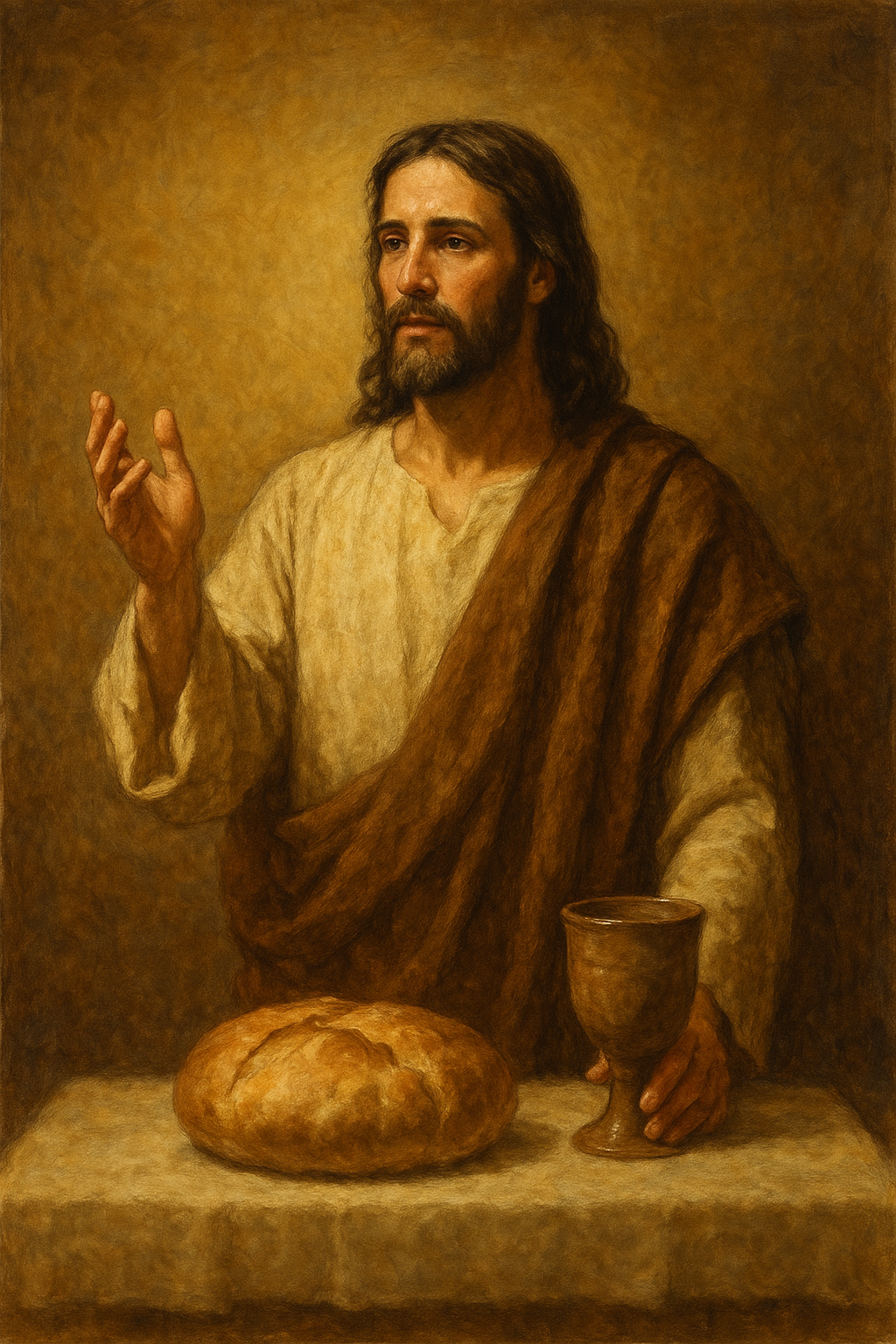
📖 John 6:41–59 — My Flesh Is Food Indeed
41 The Jews then complained about Him, because He said, “I am the bread which came down from heaven.”
42 And they said, “Is not this Jesus, the son of Joseph, whose father and mother we know? How is it then that He says, ‘I have come down from heaven’?”
43 Jesus therefore answered and said to them, “Do not murmur among yourselves.
44 No one can come to Me unless the Father who sent Me draws him; and I will raise him up at the last day.
45 It is written in the prophets, ‘And they shall all be taught by God.’ Therefore everyone who has heard and learned from the Father comes to Me.
46 Not that anyone has seen the Father, except He who is from God; He has seen the Father.
47 Most assuredly, I say to you, he who believes in Me has everlasting life.
48 I am the bread of life.
49 Your fathers ate the manna in the wilderness, and are dead.
50 This is the bread which comes down from heaven, that one may eat of it and not die.
51 I am the living bread which came down from heaven. If anyone eats of this bread, he will live forever; and the bread that I shall give is My flesh, which I shall give for the life of the world.”
52 The Jews therefore quarreled among themselves, saying, “How can this Man give us His flesh to eat?”
53 Then Jesus said to them, “Most assuredly, I say to you, unless you eat the flesh of the Son of Man and drink His blood, you have no life in you.
54 Whoever eats My flesh and drinks My blood has eternal life, and I will raise him up at the last day.
55 For My flesh is food indeed, and My blood is drink indeed.
56 He who eats My flesh and drinks My blood abides in Me, and I in him.
57 As the living Father sent Me, and I live because of the Father, so he who feeds on Me will live because of Me.
58 This is the bread which came down from heaven—not as your fathers ate the manna, and are dead. He who eats this bread will live forever.”
59 These things He said in the synagogue as He taught in Capernaum.
📋 Gospel Parallel Table
This portion of teaching—often called the Bread of Life Discourse—is found only in the Gospel of John. It does not appear in Matthew, Mark, or Luke in the same form. However, there are echoes and connections in other Gospels regarding Jesus’ role as sustainer, source of eternal life, and the giving of His flesh and blood.
| Theme or Event | Matthew | Mark | Luke | John |
|---|---|---|---|---|
| Feeding of the 5,000 | Matt. 14:13–21 | Mark 6:30–44 | Luke 9:10–17 | John 6:1–15 |
| Bread of Life Teaching | — | — | — | John 6:22–59 |
| Jesus speaks of giving His body and blood | Matt. 26:26–28 | Mark 14:22–24 | Luke 22:19–20 | John 6:51–58 |
The language about Jesus’ flesh and blood in John 6 finds deep sacramental and theological echoes in the Last Supper accounts in the Synoptics. John doesn’t record the institution of the Lord’s Supper directly—but this chapter prepares the way for understanding it.
🔁 Harmony Highlights:
- In Matthew, Mark, and Luke, Jesus says at the Last Supper:“Take, eat; this is My body… Drink… this is My blood…”
- In John 6, Jesus prepares their hearts for that moment by describing Himself as:“The bread which came down from heaven… My flesh… My blood…”
Though John’s Gospel doesn’t record the institution of the Lord’s Supper in the Upper Room, this passage gives us the spiritual meaning behind it all:
Jesus offers Himself as the true and eternal nourishment of the soul. 🍞🩸
🧭 Harmony with the Gospels
Though John 6:41–59 has no direct match in Matthew, Mark, or Luke, the themes and language used here harmonize richly with other Gospel teachings:
🍞 1. “I Am the Living Bread” (John 6:51) vs. the Last Supper
- In the Synoptic Gospels, Jesus breaks bread and says:“This is My body, given for you…”
- Matthew 26:26, Mark 14:22, Luke 22:19
- These words point forward to the meaning of what Jesus says here in John:“…the bread that I shall give is My flesh, which I shall give for the life of the world.”
- While John doesn’t record the Last Supper the same way, his Gospel captures the theology behind it: self-giving sacrifice and spiritual nourishment.
- His coming sacrifice
- The new covenant
- The way we commune with Him spiritually
🩸 2a. “Drink My Blood” and the Cup
- In all three Synoptic Gospels, Jesus speaks of drinking His blood:“This is My blood of the new covenant, which is shed for many…”
- Matt. 26:28, Mark 14:24, Luke 22:20
- In John 6:53–56, this theme is spoken symbolically but boldly:“Unless you eat the flesh… and drink His blood, you have no life in you.”
🩸 2b. Atonement and Sacrificial Language
- Mark 10:45 — “The Son of Man came… to give His life a ransom for many.”
- John 6:51 — “The bread that I shall give is My flesh, which I shall give for the life of the world.”
In both Gospels, Jesus makes clear that He gives His life—not just teachings or miracles, but Himself.
🙌 3. Drawing Near to the Father
- John 6:44 — “No one can come to Me unless the Father who sent Me draws him…”
- Matthew 11:27 — “No one knows the Son except the Father… and no one knows the Father except the Son, and he to whom the Son wills to reveal Him.”
Jesus emphasizes mutual relationship between the Father and Son in both passages, and how only through divine revelation can a soul truly come to God.
🕊️ 4. Abiding in Christ
- John 6:56 — “He who eats My flesh and drinks My blood abides in Me, and I in him.”
- John 15:4 — “Abide in Me, and I in you.”
- Though from a different chapter, this theme of spiritual abiding is consistent in John’s Gospel: true life is found only in ongoing union with Jesus.
🕰️ Historical and Cultural Background
🕍 Location: The Synagogue at Capernaum (v. 59)
- This teaching took place in Capernaum’s synagogue, a known center of Jewish worship and Scripture reading.
- Archaeological remains of a synagogue from that era have been uncovered in Capernaum—likely built on the very site where Jesus spoke these words.
- Capernaum was Jesus’ home base during much of His Galilean ministry (cf. Matthew 4:13).
- Jesus taught here often during His Galilean ministry (cf. Luke 4:31).
🍞 The Scandal of Flesh and Blood
- Jesus’ words would have been shocking to His listeners.
- The Law strictly forbade drinking blood (Leviticus 17:10–12) and consuming human flesh was unthinkable.
- But Jesus wasn’t speaking literally—He was using symbolic language to reveal a spiritual truth:To receive eternal life, one must take Jesus into themselves as their spiritual nourishment and life-source.
📜 Echoes of the Exodus
- Just as the Israelites had eaten manna to survive the wilderness, Jesus now offers heavenly bread for eternal life.
- But the people resisted, murmuring just like their forefathers did in the desert.
- 📖 Exodus 16:2 — “Then the whole congregation… murmured against Moses and Aaron.”
- Jesus is revealing that He is the true fulfillment of all God’s past provision.
✡️ Messianic Expectations
- The Jews expected a Messiah who would teach with power, but not one who would make claims of heavenly origin or speak of sacrifice.
- Verse 42 shows their struggle: “Is this not Jesus, son of Joseph…?”
- They were stuck in the earthly, and couldn’t yet grasp the heavenly truth standing before them.
This teaching, spoken in a public place of worship, was deeply confrontational to the religious mindset of the day—yet tender and life-giving to those drawn by the Father. 🕊️
🗝️ Key Word Studies
🍞 1. “Bread” — Greek: artos (ἄρτος)
- Verse: “I am the living bread…” (v. 51)
- Meaning: Regular, nourishing bread—basic sustenance in Jewish daily life.
- Spiritual Insight: Jesus uses a common, humble food to reveal an uncommon, eternal truth. He is not just from God—He is the essential food from God.
✝️ 2. “Flesh” — Greek: sarx (σάρξ)
- Verse: “…the bread that I shall give is My flesh…” (v. 51)
- Meaning: Literal flesh or body.
- Insight: Used symbolically here to represent Jesus’ physical body, offered in sacrificial death (John 1:14, “The Word became flesh”). It points forward to the cross.
🩸 3. “Blood” — Greek: haima (αἷμα)
- Verse: “…drink His blood…” (v. 53)
- Meaning: Physical blood, but also represents life poured out.
- Spiritual Insight: In Levitical law, blood represented life and was used in atonement (Leviticus 17:11). Jesus is offering His blood as the new covenant sacrifice.
🧲 4. “Draws” — Greek: helkō (ἕλκω)
- Verse: “No one can come to Me unless the Father… draws him.” (v. 44)
- Meaning: To drag, pull, or compel gently with influence.
- Insight: Not forceful, but divine persuasion. God lovingly draws souls to Jesus like a shepherd guiding sheep.
🌱 5. “Abide” — Greek: menō (μένω)
- Verse: “…abides in Me, and I in him.” (v. 56)
- Meaning: To remain, dwell, continue, or stay connected.
- Spiritual Insight: Deep communion—not a fleeting visit but a lasting relationship. True nourishment brings abiding life.
🔍 Theological Themes in John 6:41–59
🍞 1. Jesus Is the Living Bread from Heaven
- Jesus repeats and intensifies His claim:“I am the living bread… If anyone eats of this bread, he will live forever.” (v. 51)
- He’s not merely a teacher, prophet, or provider—He is the source of eternal life.
- Like manna fed the Israelites physically, Jesus offers spiritual sustenance that leads to everlasting life.
✝️ 2. The Necessity of His Sacrifice
- Jesus declares that the bread He gives is “My flesh… for the life of the world.” (v. 51)
- This is a clear foreshadowing of the cross—His bodily death and poured-out blood.
- Salvation requires receiving His sacrifice personally, not merely admiring Him from afar.
🩸 3. Participation in Jesus Brings Life
- Jesus speaks of eating His flesh and drinking His blood as the path to eternal life (v. 53–56).
- This language points beyond a physical act—it means embracing Jesus fully, depending on Him entirely, drawing life from Him alone.
🔐 4. Security for the Believer
- Repeated again: “I will raise him up at the last day.” (v. 44, 54)
- Jesus affirms the resurrection hope and final victory for all who come to Him.
- Eternal life isn’t a vague dream—it’s a guaranteed promise to those who believe and abide.
📖 5. God’s Role in Drawing People to Jesus
- “No one can come to Me unless the Father… draws him.” (v. 44)
- Faith is not initiated by human effort alone. It is a divinely initiated relationship, grounded in grace and truth.
- The Father and Son are united in their mission to redeem and restore.
This passage is a high point in John’s Gospel—and a moment of division for the listeners. But for the believer, it is a declaration of grace, sacrifice, and the intimacy of abiding in Christ. 🌾
🔗 Old Testament Connections
🍯 1. Manna in the Wilderness — Exodus 16
“Your fathers ate the manna in the wilderness, and are dead.” (v. 49)
- God provided manna daily to the Israelites during their journey in the wilderness (Exodus 16:4).
- But that manna could not give eternal life—only daily survival.
- Jesus contrasts this: He is the true bread from heaven, offering everlasting life, not temporary sustenance.
✋ 2. Prohibition Against Blood — Leviticus 17:10–12
“Unless you… drink His blood, you have no life in you.” (v. 53)
- According to the Law, consuming blood was forbidden, as blood represented life (Leviticus 17:11).
- Jesus’ statement would have shocked His audience.
- Yet, He is revealing that His blood is the true atonement—the life-giving covenant blood they must spiritually receive.
📜 3. Taught by God — Isaiah 54:13
“It is written in the prophets, ‘And they shall all be taught by God.’” (v. 45)
- Jesus quotes Isaiah directly: “All your children shall be taught by the Lord.” (Isaiah 54:13)
- He shows that true teaching and understanding come from the Father, and that those who listen will be drawn to the Son.
🕊️ 4. The Promise of Resurrection — Daniel 12:2
“I will raise him up at the last day.” (v. 44, 54)
- In Daniel 12:2, we read: “Many… shall awake, some to everlasting life…”
- Jesus affirms this hope and reveals Himself as the one who brings it to pass.
🔥 5. Sacrificial Offerings
- Jesus’ words about His flesh and blood point directly to the sacrificial system, especially the Passover lamb(Exodus 12).
- Just as the lamb had to be eaten under the old covenant, Jesus must be received spiritually under the new.
From manna to Messiah, from law to life, from sacrifice to salvation—Jesus fulfills every shadow and promise. He is not like the Bread from heaven—He is the Bread. 🍞✨
✨ Thoughtful Reflection Questions
1. 🍞 How do I respond when Jesus’ words are difficult to understand or accept?
The people murmured and even quarreled at Jesus’ hard sayings.
Am I tempted to explain away or avoid the deeper demands of following Him? Or do I lean in, trusting His goodness even when it’s hard?
2. ✝️ Have I truly received Jesus as my life-source—or just admired Him from afar?
Jesus says we must eat His flesh and drink His blood—that is, fully depend on Him.
What does it look like for me to daily feed on Christ? Is there anything I’m trying to survive on apart from Him?
3. 🩸 Do I understand the weight and wonder of His sacrifice?
When I read these words, do I see how deeply personal and costly His offering was—for me?
How might I grow in gratitude and reverence for His blood poured out?
4. 🕊️ Am I abiding in Jesus—and is He abiding in me?
What practices in my life help me remain close to Him? Are there distractions that pull me away?
5. 🔐 Do I rest in the security of resurrection hope?
Jesus promises to raise up those who come to Him at the last day.
How might I live differently if I fully embraced that promise—no fear, no striving, only trust?
✅ References
📖 Bible Translation
- The Holy Bible, New King James Version (NKJV).Nashville: Thomas Nelson, 1982.
- Purchase: Thomas Nelson NKJV Bibles or Amazon
🆓 Free Online Resources
- Strong, James.Strong’s Exhaustive Concordance of the Bible. Abingdon Press, 1890.
- Free access: Blue Letter Bible
- Greek words studied in this post:
- artos (G740) – bread
- sarx (G4561) – flesh
- haima (G129) – blood
- helkō (G1670) – draws
- menō (G3306) – abide
- BibleHub Commentary on John 6:51–58.
- Isaiah 54:13 (cross-referenced via Bible Gateway)
- Leviticus 17:10–12, Daniel 12:2, Exodus 16:4 — Free access via BibleGateway
💵
Paid Print or Digital Books used in this Post
- Carson, D.A.The Gospel According to John.Grand Rapids: Eerdmans, 1991.
- Tenney, Merrill C.John: The Gospel of Belief.Grand Rapids: Eerdmans, 1948.
- Purchase: Christianbook.com or Amazon
- Robertson, A.T.A Harmony of the Gospels.Grand Rapids: Harper & Row, 1922.
- Purchase: Christianbook.com or Amazon
Artificial Intelligence Assistance
ChatGPT. “Day 25 — The Study of Jesus, with Bonnie Moore: John 6:41–59 – My Flesh Is Food Indeed.” OpenAI, 2025, https://chat.openai.com.
This post was prayerfully prepared in collaboration with ChatGPT, a research assistant designed to support deep, Christ-centered Bible study. All Scripture is taken from the New King James Version (NKJV), and supporting references include Strong’s Concordance, cultural background texts, and trusted harmony of the Gospels materials. May this work bring glory to God and encouragement to the hearts of those who read it. 🕊️
Leave a Reply