
Acts 21:1–14 Paul’s Journey to Jerusalem.
🕊️ “The will of the Lord be done.”
📖 Full NKJV Scripture Reading 📚
1 Now it came to pass, that when we had departed from them and set sail, running a straight course we came to Cos, the following day to Rhodes, and from there to Patara.
2 And finding a ship sailing over to Phoenicia, we went aboard and set sail.
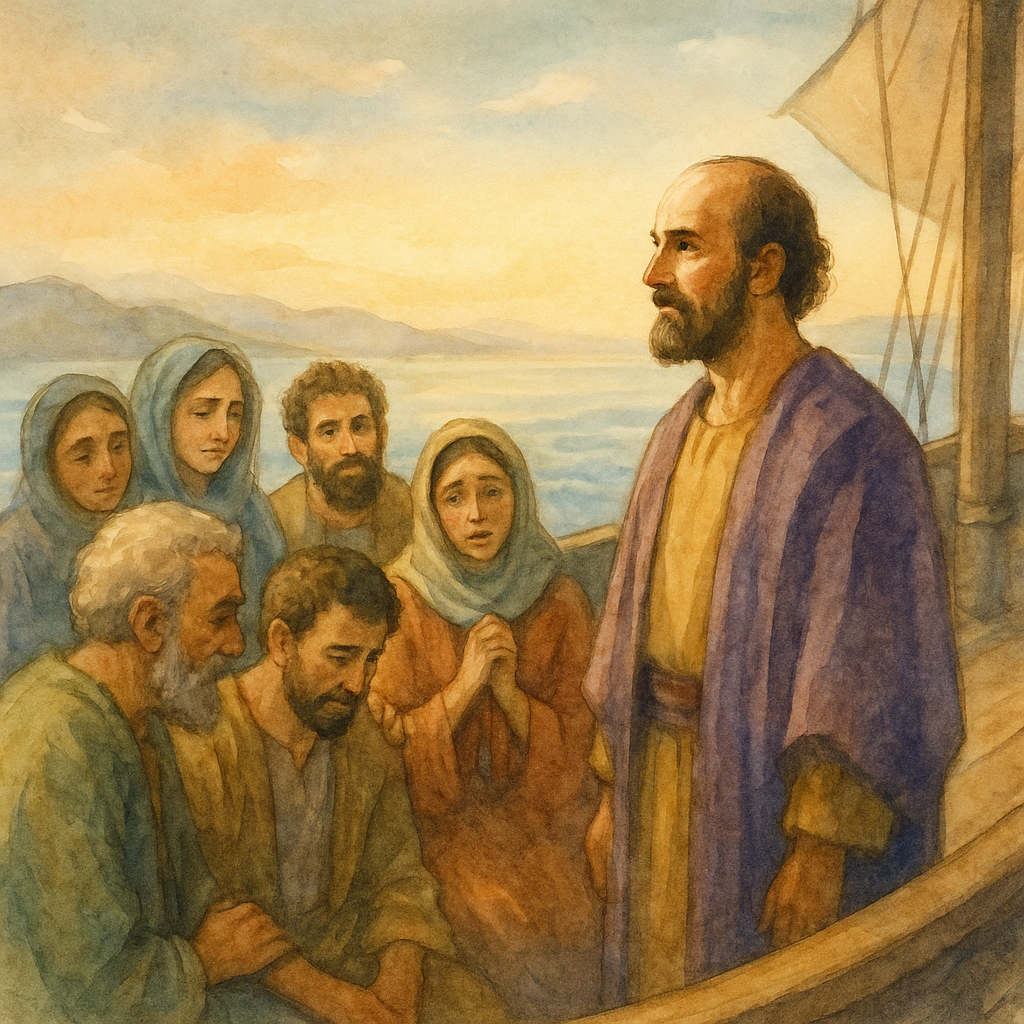
3 When we had sighted Cyprus, we passed it on the left, sailed to Syria, and landed at Tyre; for there the ship was to unload her cargo.
4 And finding disciples, we stayed there seven days. They told Paul through the Spirit not to go up to Jerusalem.
5 When we had come to the end of those days, we departed and went on our way; and they all accompanied us, with wives and children, till we were out of the city. And we knelt down on the shore and prayed.
6 When we had taken our leave of one another, we boarded the ship, and they returned home.
7 And when we had finished our voyage from Tyre, we came to Ptolemais, greeted the brethren, and stayed with them one day.
8 On the next day we who were Paul’s companions departed and came to Caesarea, and entered the house of Philip the evangelist, who was one of the seven, and stayed with him.
9 Now this man had four virgin daughters who prophesied.
10 And as we stayed many days, a certain prophet named Agabus came down from Judea.
11 When he had come to us, he took Paul’s belt, bound his own hands and feet, and said, “Thus says the Holy Spirit, ‘So shall the Jews at Jerusalem bind the man who owns this belt, and deliver him into the hands of the Gentiles.’ ”
12 Now when we heard these things, both we and those from that place pleaded with him not to go up to Jerusalem.
13 Then Paul answered, “What do you mean by weeping and breaking my heart? For I am ready not only to be bound, but also to die at Jerusalem for the name of the Lord Jesus.”
14 So when he would not be persuaded, we ceased, saying, “The will of the Lord be done.”

👣 Traces of Jesus’ Ministry 👣

✝️ Following the Will of the Father — Paul’s determination to go to Jerusalem echoes Jesus’ own steadfast journey toward the Cross (Luke 9:51). Both knew what awaited them, yet obeyed in love and trust.
🌊 Prayer on the Shore — The believers kneeling with Paul at Tyre recall Jesus praying with His disciples at Gethsemane. Both moments overflow with devotion and sorrow mingled with peace.
🕊️ Prophecy and Suffering — Agabus’ symbolic act mirrors the prophets who foretold Jesus’ suffering (Isaiah 53). God often revealed hardship ahead, not to deter faith, but to prepare hearts for obedience.
💞 Tears of Love — The believers weeping over Paul resemble Mary and the others who wept over Jesus’ path to Calvary (Luke 23:27). Love grieves, but still yields to God’s greater purpose.
🌅 “The Will of the Lord Be Done” — These words echo Jesus’ own prayer: “Not My will, but Yours, be done” (Luke 22:42). Both surrendered completely, resting in the Father’s perfect plan.

📜 From the Early Church 📜
🏛️ Philip the Evangelist — Once chosen among the seven deacons (Acts 6:5), Philip continued to serve faithfully years later. His four daughters who prophesied show how the Spirit worked powerfully through women in the early church.
🕊️ Prophecy as Confirmation — Agabus’ act fulfilled the pattern of Old Testament prophets like Jeremiah (Jeremiah 13:1–11). The early church understood prophecy as revelation and warning, not contradiction of God’s will.
💔 Community Love and Obedience — The believers’ pleas for Paul reveal how Christian fellowship had grown deep and affectionate. Yet when Paul persisted, they submitted to the will of God. True unity is found in shared surrender.
💡 Early Christian Households — Philip’s home in Caesarea represents the open, hospitable heart of early believers. Homes were places of fellowship, teaching, and prophetic witness long before church buildings existed.

⏳ Historical and Cultural Background ⌛️
⚓ Journey Route — Paul’s voyage from Cos to Patara to Phoenicia followed established Roman sea lanes. Each port was part of a vibrant trade network, connecting the Mediterranean world to Jerusalem.
🏠 Tyre and Ptolemais — Major Phoenician cities with mixed Gentile and Jewish populations. The church there reflected early missionary success among diverse cultures.
📜 Philip’s Household — Philip the evangelist had been one of the first to preach outside Jerusalem (Acts 8). His daughters’ prophetic gifts highlight how the Spirit moved across generations.
🕊️ Agabus’ Symbolic Prophecy — Acts 21:11 recalls ancient prophetic customs—using physical symbols to convey divine messages (e.g., Isaiah 20:2–4, Ezekiel 4:1–3).
💬 Paul’s Resolve — His readiness “to die at Jerusalem for the name of the Lord Jesus” shows the courage and clarity of a heart fully yielded to God.

🗝️ Key Word Studies 🔑
“Prophesied” (προφητεύω, prophēteuō) — To speak forth, under divine inspiration. (Strong’s G4395)
Used of both men and women who declared God’s truth through the Spirit.
“Bound” (δέω, deō) — To tie, to bind, to fasten. (Strong’s G1210)
Agabus bound his own hands to show the physical restraint Paul would soon endure.
“Weeping” (κλαίω, klaio) — To weep, mourn, lament. (Strong’s G2799)
A word that reflects the deep emotion of those who loved Paul yet trusted God’s will.
“Ready” (ἕτοιμος, hetoimos) — Prepared, willing, eager. (Strong’s G2092)
Paul’s readiness to suffer expresses courage anchored in eternal hope.
“Will” (θέλημα, thelēma) — Desire, purpose, will. (Strong’s G2307)
Used of God’s divine will—Paul’s peace rests in total submission to it.
✨ Thoughtful Reflection Questions ⍰
1️⃣ When have I sensed God calling me toward something difficult, yet knew obedience was the only faithful response?
2️⃣ How can I cultivate the same peace Paul expressed in saying, “The will of the Lord be done”?
3️⃣ What does it mean for me to trust that even painful obedience can be part of God’s loving plan?
4️⃣ How can I strengthen my fellowship with other believers through prayer and shared surrender to God’s will?

📚 References 📚
Free Online Sources:
- Blue Letter Bible — NKJV text, lexicon, and Strong’s Concordance. https://www.blueletterbible.org
- Bible Hub — Parallel translations and commentaries. https://biblehub.com
Image Credits (Wordless, Created for This Post):
- Paul and his companions sailing toward Jerusalem at sunrise. — Watercolor pastoral style AI image created by ChatGPT for this study (Acts 21:1–14).
- Believers kneeling in prayer with Paul at Tyre. — Watercolor pastoral style AI image created by ChatGPT for this study (Acts 21:1–14).
- Paul visiting Philip the Evangelist’s home in Caesarea. — Watercolor pastoral style AI image created by ChatGPT for this study (Acts 21:1–14).
- Agabus binding his hands and feet with Paul’s belt. — Watercolor pastoral style AI image created by ChatGPT for this study (Acts 21:1–14).
- Paul’s companions pleading with him not to go to Jerusalem. — Watercolor pastoral style AI image created by ChatGPT for this study (Acts 21:1–14).
- Paul walking along the dusty road toward Jerusalem at sunrise. — Watercolor pastoral style AI image created by ChatGPT for this study (Acts 21:1–14).
🤖✨ Artificial Intelligence Assistance:
ChatGPT. “✨ Paul’s Journey to Jerusalem ✨ — Acts 21:1–14.” OpenAI, 2025, https://chat.openai.com.
This post was prayerfully prepared in collaboration with ChatGPT 🤖, a research assistant designed to support deep, Christ-centered Bible study.
All Scripture is taken from the New King James Version (NKJV).
May this work bring glory to God and encouragement to the hearts of those who read it. 🕊️💕
Leave a Reply