
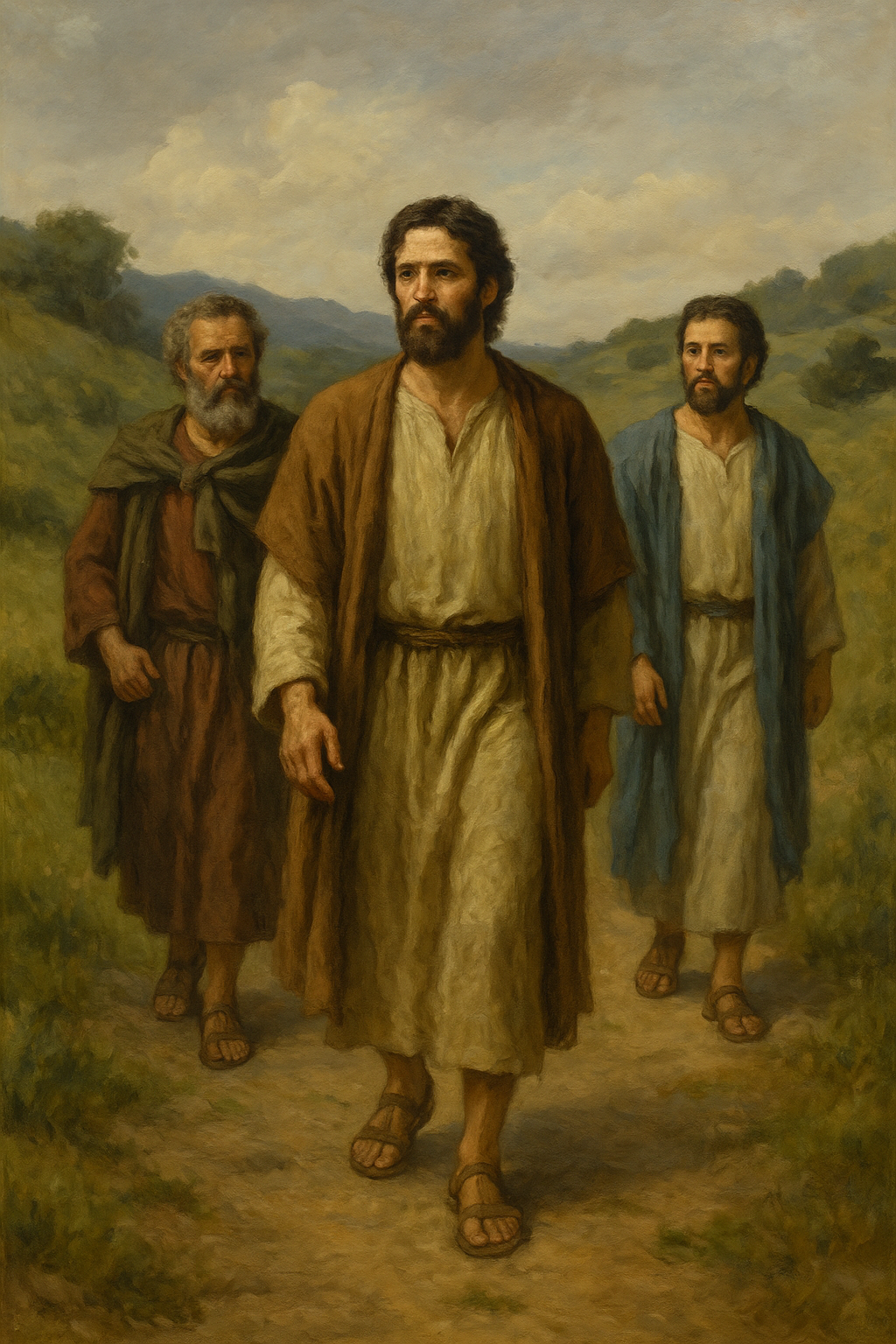
6 Now when they had gone through Phrygia and the region of Galatia, they were forbidden by the Holy Spirit to preach the word in Asia.
7 After they had come to Mysia, they tried to go into Bithynia, but the Spirit did not permit them.
8 So passing by Mysia, they came down to Troas.
9 And a vision appeared to Paul in the night. A man of Macedonia stood and pleaded with him, saying, “Come over to Macedonia and help us.”
10 Now after he had seen the vision, immediately we sought to go to Macedonia, concluding that the Lord had called us to preach the gospel to them.

👣 Traces of Jesus’ Ministry 👣
- ✝️ Jesus Himself often spoke of being led by the Spirit (Luke 4:1, John 16:13). In this passage, Paul and his companions experienced that same Spirit’s direction, showing continuity between Christ’s walk and the apostles’ mission 🕊️.
- 🌍 The vision of the Macedonian man echoes Jesus’ own compassion for the crowds (Matthew 9:36) — both highlight the cry for help that moved God’s servants into action.
- 👀 Just as Jesus sometimes delayed or redirected His disciples (John 11:6–7, Matthew 10:5–6), Paul’s team was forbidden by the Spirit from going into Asia or Bithynia. The Lord’s timing and direction are always purposeful.
- 🌊 Jesus once crossed the sea to minister to the Gentiles in the region of the Gadarenes (Mark 5:1). Here, Paul and his companions were called to cross the sea into Macedonia, continuing that outward push of the gospel.
- 💡 The vision Paul received mirrors how Jesus guided His disciples through both word and revelation, ensuring the mission aligned with the Father’s will (John 5:19).

📜 From the Early Church 📜
- 🕊️ The apostles and early missionaries were sensitive to the Spirit’s leading. They did not see closed doors as failure but as divine redirection — a model for the church in every age.
- 🌍 The vision of the Macedonian man marked a turning point: the gospel moved from Asia Minor into Europe for the first time. This shaped the course of Christian history.
- 👥 The early church understood mission as Spirit-initiated, not man-driven. Paul and his companions “concluded” (v.10) that God Himself had called them. This shows communal discernment in action.
- ✝️ The use of “we” in v.10 is the first time Luke, the author of Acts, includes himself in the narrative. This marks the beginning of his eyewitness account in the mission journeys.
- 🌱 The church expanded not by human planning alone but by divine orchestration — Spirit-blocked paths and Spirit-opened doors. This was a powerful reminder to the early believers that God’s mission unfolds in His timing.

⏳ Historical and Cultural Background ⌛️
- 🏛️ Asia and Bithynia — These regions were important centers in Asia Minor (modern Turkey). Asia included cities like Ephesus, while Bithynia lay in the north by the Black Sea. Both were strategic and populous, yet the Spirit withheld permission for Paul to go there at that time.
- 🌍 Macedonia — Located in northern Greece, Macedonia was a Roman province with great influence. Its cities (Philippi, Thessalonica, Berea) later became key centers of Christian witness. This moment signaled the spread of the gospel from Asia to Europe for the first time.
- 👤 The Macedonian man — Macedonia was known for its proud history, producing leaders like Alexander the Great. The vision of a Macedonian begging for help may have symbolized the readiness of Europe to receive the gospel.
- 🕊️ Spirit’s guidance — In the ancient world, travel was difficult and dangerous. Closed doors could be due to illness, political unrest, or lack of resources. Yet Luke attributes these hindrances specifically to the Holy Spirit’s direction, showing divine providence beyond human circumstance.
- ✍️ The “we” passages — Acts 16:10 introduces Luke as part of the missionary team. As a physician and careful historian, his inclusion adds an eyewitness depth to the account.
- 🚢 Troas as a port city — Troas (ancient Troy) was a major harbor on the Aegean Sea. From here, Paul and his companions would sail to Macedonia, making it the launch point for the gospel’s entrance into Europe.

🔍 Theological Themes
- 🕊️ The Spirit Directs the Mission — The apostles were “forbidden” and “not permitted” by the Spirit, showing that Christian mission is not human-driven but Spirit-led. God determines the timing and place of gospel work.
- 🌍 The Gospel Crosses into Europe — This passage marks a pivotal moment in salvation history: the gospel moving westward into Macedonia, beginning the spread of Christianity into Europe.
- ✝️ Divine Guidance Through Vision — Paul’s vision of the Macedonian man highlights how God sometimes gives specific direction to His servants. While Scripture is our guide today, the Spirit still leads with clarity and conviction.
- 👥 Communal Discernment — After Paul shared the vision, “we sought to go” (v.10). The decision was not Paul’s alone; the mission was discerned together, reflecting the church’s unity in following God’s call.
- 🔥 Obedience to God’s Call — The response was immediate: “immediately we sought to go.” This shows the early church’s readiness to act promptly when God revealed His will.
- 🌱 God’s Timing and Sovereignty — Though Asia and Bithynia would later hear the gospel, this passage shows God’s sovereign plan unfolding step by step, opening some doors and closing others for His purposes.
🕎 Old Testament Connections 🏛️
- 🕊️ Guidance by God’s Spirit — Just as Israel was led by the pillar of cloud and fire in the wilderness (Exodus 13:21–22), Paul and his companions were guided by the Holy Spirit, showing continuity in God’s leading of His people.
- 🌍 The Nations Await God’s Word — The vision of the Macedonian man pleading for help recalls prophecies like Isaiah 49:6: “I will also give You as a light to the Gentiles, that You should be My salvation to the ends of the earth.”
- 👀 Visions and Calls — Paul’s vision parallels Old Testament callings through visions, such as Isaiah’s call in the temple (Isaiah 6:1–8) or Samuel’s hearing of God’s voice (1 Samuel 3:4–10). God often directed His servants with clarity.
- ✝️ The “Man of Macedonia” — The image of a man pleading for help echoes the cries of those in need throughout the Psalms (e.g., Psalm 79:9: “Help us, O God of our salvation.”). The gospel answers that eternal plea.
- 🌊 Crossing the Sea — Just as God parted the Red Sea (Exodus 14:21–22) to bring Israel to a new land, here Paul and his companions prepared to cross the Aegean Sea into Europe, carrying salvation’s message onward.

🗝️ Key Word Studies 🔑
- “Forbidden” (κωλύω, kōlyō) 🚫 — Strong’s G2967
- “Permit” (εἴασεν, eiasen) ✅ — Strong’s G1439
- To allow, grant permission.
- In v.7, the Spirit “did not permit” them to go into Bithynia, emphasizing divine authority over mission plans.
- “Vision” (ὅραμα, horama) 👀 — Strong’s G3705
- A supernatural sight or vision.
- Paul received a vision of a Macedonian man, a divine revelation guiding their next step.
- “Plead” (παρακαλέω, parakaleō) 🙏 — Strong’s G3870
- To call near, beseech, exhort.
- The Macedonian man’s plea symbolizes the spiritual hunger and need for the gospel.
- “Help” (βοηθέω, boētheō) 🤲 — Strong’s G997
- To run to the aid of, to bring assistance.
- The request for help captures the desperate condition of those without Christ.
- “Concluding” (συμβιβάζω, sumbibazō) 💡 — Strong’s G4822
- To bring together, reason out, infer.
- The team reasoned and discerned together that God had called them.
- “Called” (καλέω, kaleō) 📣 — Strong’s G2564
- To summon, invite, appoint.
- God Himself called them to Macedonia, highlighting His sovereign direction.
⁉️ Thoughtful Reflection Questions ⍰
- 🕊️ Paul and his companions were forbidden by the Spirit to go certain places. Do I trust God’s closed doors as much as His open ones?
- 👀 Paul received a vision of a Macedonian man pleading for help. Who in my life is spiritually “pleading” for help, and how am I responding?
- 🌍 The gospel crossed into Europe for the first time here. Am I open to God’s call to step into new, unfamiliar places for His mission?
- 💡 Paul and his team concluded together that God had called them (v.10). Do I seek confirmation in community, or do I try to discern God’s will alone?
- 📣 The Macedonian call was urgent, and Paul’s response was immediate. How quick am I to obey when God’s direction becomes clear?
📚 References 📚
Free Online Sources:
- Blue Letter Bible — NKJV text, lexicon, and Strong’s Concordance. https://www.blueletterbible.org
- Bible Hub — Parallel translations and commentaries. https://biblehub.com
Image Credits (Wordless, Created for This Post):
- “Paul, Silas, and Timothy walking together through the countryside, prevented by the Spirit.” — Realistic oil painting style AI image created by ChatGPT for this study (Acts 16:6–10).
- “Paul resting thoughtfully at night by a small fire, prayerfully seeking God’s direction.” — Realistic oil painting style AI image created by ChatGPT for this study (Acts 16:6–10).
- “Paul’s vision of the Macedonian man pleading for help.” — Realistic oil painting style AI image created by ChatGPT for this study (Acts 16:6–10).
- “Paul awakening from the vision and sharing it with Silas and Timothy.” — Realistic oil painting style AI image created by ChatGPT for this study (Acts 16:6–10).
- “Paul, Silas, and Timothy preparing at the shoreline to journey to Macedonia.” — Realistic oil painting style AI image created by ChatGPT for this study (Acts 16:6–10).
- “Word cloud of English and Greek key terms from Acts 16:6–10.” — Watercolor-style AI image created by ChatGPT for this study.
Artificial Intelligence Assistance:
ChatGPT. “🌸 The Macedonian Call 🌻 — Acts 16:6–10.” OpenAI, 2025, https://chat.openai.com.
This post was prayerfully prepared in collaboration with ChatGPT 🤖, a research assistant designed to support deep, Christ-centered Bible study.
All Scripture is taken from the New King James Version (NKJV).
May this work bring glory to God and encouragement to the hearts of those who read it. 🕊️💕
Leave a Reply