
📖 Acts 14:8–18– NKJV Scripture Reading 📚
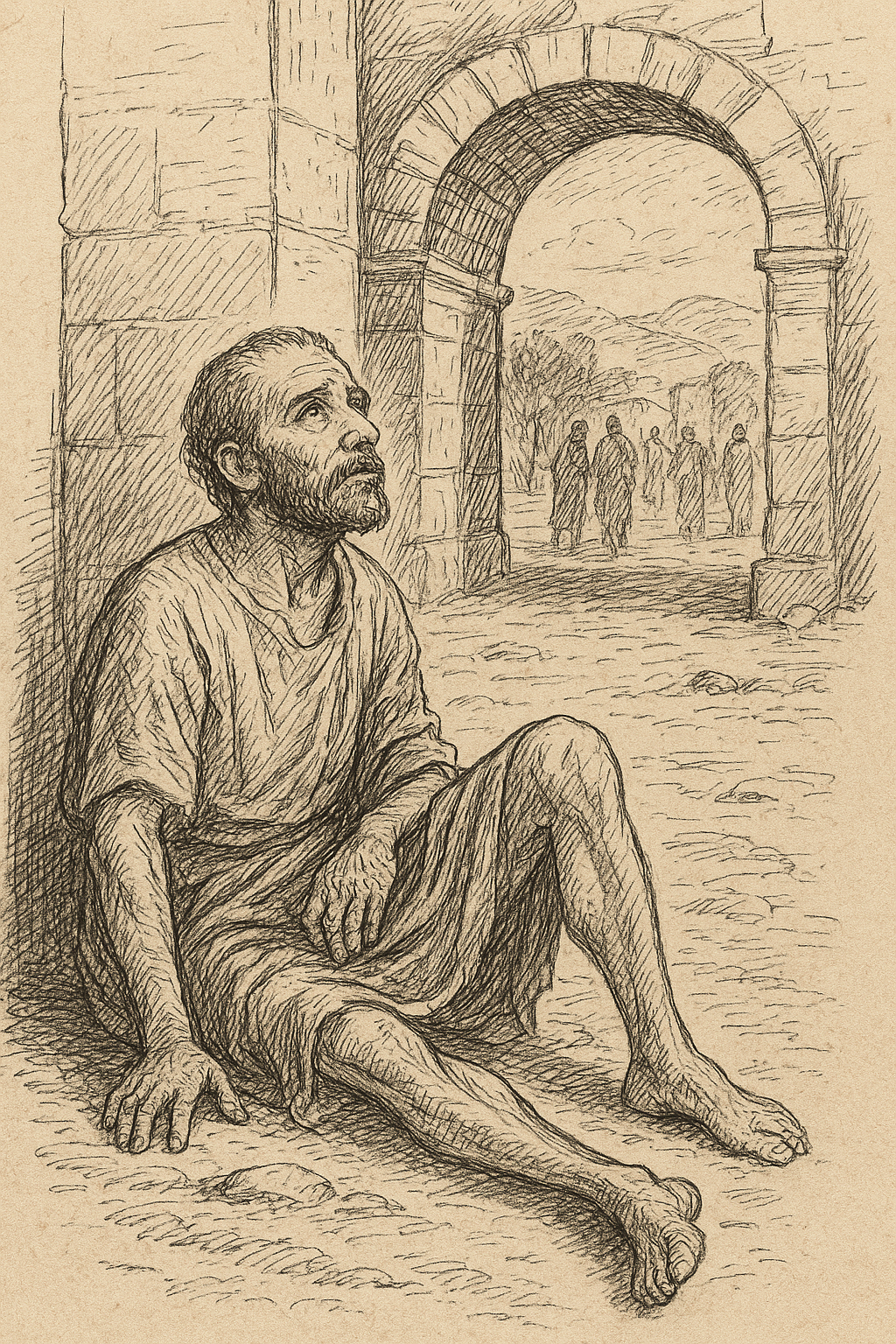
8 And in Lystra a certain man without strength in his feet was sitting, a cripple from his mother’s womb, who had never walked.
9 This man heard Paul speaking. Paul, observing him intently and seeing that he had faith to be healed,
10 said with a loud voice, “Stand up straight on your feet!” And he leaped and walked.
11 Now when the people saw what Paul had done, they raised their voices, saying in the Lycaonian language, “The gods have come down to us in the likeness of men!”
12 And Barnabas they called Zeus, and Paul, Hermes, because he was the chief speaker.
13 Then the priest of Zeus, whose temple was in front of their city, brought oxen and garlands to the gates, intending to sacrifice with the multitudes.
14 But when the apostles Barnabas and Paul heard this, they tore their clothes and ran in among the multitude, crying out
15 and saying, “Men, why are you doing these things? We also are men with the same nature as you, and preach to you that you should turn from these useless things to the living God, who made the heaven, the earth, the sea, and all things that are in them,
16 who in bygone generations allowed all nations to walk in their own ways.
17 Nevertheless He did not leave Himself without witness, in that He did good, gave us rain from heaven and fruitful seasons, filling our hearts with food and gladness.”
18 And with these sayings they could scarcely restrain the multitudes from sacrificing to them.
👣 Traces of Jesus’ Ministry 👣

- ✝️ Just as Jesus healed the lame 🦵 (John 5:8–9; Luke 5:24–25), Paul, through Christ’s power, commands the crippled man to stand and walk 🙌. The healing continues Jesus’ work through His apostles.
- 👀 Jesus often recognized faith in those who sought healing 💕 (Mark 2:5; Luke 8:48). Paul, “seeing that the man had faith to be healed,” mirrors Jesus’ ability to discern hearts.
- 🌟 The crowd’s reaction — trying to exalt Paul and Barnabas as gods 👑 — recalls moments when people misunderstood Jesus, wanting to make Him king by force (John 6:15).
- 😢 Paul and Barnabas tearing their clothes in grief shows their humility 💔, reflecting Jesus’ own rejection of earthly glory (John 8:50) — always pointing worship back to the Father.
- 🌍 Their preaching about the “living God who made heaven and earth” echoes Jesus’ own teachings about the Father’s care for creation 🌿🌧️ (Matthew 5:45; 6:26).
- 🕊️ Just as Jesus came not to be served but to serve (Mark 10:45) ✨, Paul and Barnabas refused worship and redirected the people to the true God, showing Christ’s pattern of humble service.
📜 From the Early Church 📜

- ✝️ The healing at Lystra showed the early church that miracles continued through the apostles 🕊️, just as Jesus had promised (Mark 16:17–18).
- 🙌 The man crippled from birth 🦵 became a living testimony of God’s grace — proof that the gospel brought both spiritual and physical renewal 🌿.
- 😮 The crowd’s misunderstanding — worshiping Paul and Barnabas as Zeus and Hermes 👑 — revealed the challenge of spreading the gospel in deeply pagan cultures 🏛️.
- 💔 Paul and Barnabas’ refusal of worship showed that the early church was zealous for God’s glory alone ✨, guarding against even the appearance of self-exaltation.
- 🌍 Their message to the Gentiles emphasized the “living God, who made heaven and earth” 🌌 — a reminder that the Creator had always left witness of Himself, even to nations without the Law.
- 🐂 The priest of Zeus bringing oxen and garlands 🪷 showed how religion was tied to daily life in the Greco-Roman world. For the early church, this highlighted the need to patiently correct error and direct worship to the true God.
- 🌧️ Paul’s words about rain and fruitful seasons 🌾 remind us that the early church proclaimed God’s goodness in creation as a witness to all people, not just to Israel.
⏳ Historical and Cultural Background ⌛️

- 🏛️ Lystra was a Roman colony in the region of Lycaonia 🌍, a rural area compared to Iconium. The people spoke the Lycaonian language 🗣️, which explains why Paul and Barnabas didn’t immediately understand their cries about Zeus and Hermes.
- 🦵 The crippled man had been lame from birth — a condition viewed in ancient society as incurable and often linked with shame or dependence 💔. His healing would have been considered nothing short of divine intervention ✨.
- 👑 The identification of Barnabas as Zeus (the chief god) and Paul as Hermes (the messenger god) reflects Greco-Roman mythology. In art and legend, Hermes was known as the speaker 🗣️, which explains why Paul, as the preacher, was given that title.
- 🐂 The oxen and garlands 🌿 brought by the priest of Zeus were part of traditional pagan sacrifices. Garlands were draped over animals or altars in preparation for offering them to the gods.
- 📜 Ancient legends told of gods visiting towns disguised as mortals 👥. One well-known story in that region (retold by Ovid in Metamorphoses) described Zeus and Hermes visiting earth. Locals may have feared rejecting gods in disguise, fueling their eagerness to honor Paul and Barnabas.
- 👕 Paul and Barnabas tore their clothes — a Jewish sign of grief and horror 😢 when God’s honor was threatened (cf. 2 Kings 18:37; Matthew 26:65). To the locals, it would have been a shocking act of refusal.
- 🌦️ Paul’s mention of rain and fruitful seasons 🌾 reflected not only God’s care for humanity but also challenged local beliefs — in Lycaonia, rain was often attributed to Zeus. By pointing to the living God as the source, Paul redirected credit from idols to the Creator Himself.
🔍 Theological Themes

- ✝️ The Power of Faith 🙌 — Paul discerned that the crippled man “had faith to be healed” (v.9). Healing was not mechanical, but rooted in trust in the living God 🕊️.
- 🌟 God’s Power Confirmed through Miracles ✨ — The man leaping to his feet echoes the miracles of Jesus and the apostles in earlier chapters. These signs validated the truth of the gospel 📖.
- 😮 Human Tendency to Misplace Worship 👑 — The crowd mistook Paul and Barnabas for gods. Humanity, without truth, will worship anything — idols, people, or false ideas — unless directed to the living God 🌿.
- 💔 The Humility of True Servants 👕 — Paul and Barnabas tore their garments and rejected worship, showing that glory belongs to God alone ✨. This humility contrasted sharply with pagan religious leaders who gladly received honor.
- 🌍 Natural Revelation 🌦️ — Paul preached not from the Law and Prophets but from creation itself: rain, fruitful seasons, and glad hearts (vv.15–17). This shows that even those without Scripture are given witness to God’s goodness 🌌.
- ⚖️ Patience of God ⏳ — Paul declared that in past generations, God “allowed nations to walk in their own ways” (v.16). Yet even then, He still bore witness to Himself, preparing hearts for the gospel 🕊️.
- 🎶 The Struggle of Mission 🌪️ — Though miracles were performed, the apostles could “scarcely restrain” the people from idolatry (v.18). This reminds us that the gospel is always proclaimed in tension with misunderstanding, opposition, and cultural blindness.
🕎 Old Testament Connections 🏛️

- 🦵 Healing the crippled man — echoes God’s promises in Isaiah 35:6: “Then the lame shall leap like a deer”🌿✨. Paul’s miracle is a fulfillment of this Messianic vision.
- 🌍 The living God who made heaven and earth 🌌 — Paul’s words in v.15 recall Genesis 1:1 (“In the beginning God created the heavens and the earth”) and Psalm 146:6 (“Who made heaven and earth, the sea, and all that is in them”).
- ⏳ God’s patience with the nations — v.16 reflects God’s dealings in the Old Testament, when He allowed Gentile nations to follow their ways, as seen in passages like Deuteronomy 32:8 🌍 and Judges (cycles of nations going their own way).
- 🌧️ Rain and fruitful seasons 🌾 — a sign of God’s covenant blessing, echoing Deuteronomy 11:14: “Then I will give you the rain for your land in its season, the early rain and the latter rain.” Paul uses this imagery to show God’s universal kindness.
- ⚖️ Tearing garments at blasphemy or idolatry 👕 — Paul and Barnabas’ reaction recalls Jewish leaders tearing their clothes in horror at blasphemy (e.g., 2 Kings 18:37, Ezra 9:3, Matthew 26:65).
- 🔥 Turning from idols to the living God — echoes 1 Samuel 12:21: “Do not turn aside; for then you would go after empty things which cannot profit or deliver, for they are nothing.” Paul’s plea continues the prophetic call to worship the true God only.
🗝️ Key Word Studies 🔑
- “Crippled” (ἀδύνατος, adynatos) 🦵 — Strong’s G1410/1411 (root)
- Literally “without strength, powerless.”
- Describes the man’s lifelong condition 💔 — helpless in himself, a picture of humanity apart from God’s power.
- “Healed” (σῴζω, sōzō) ✨ — Strong’s G4982
- To save, deliver, make whole.
- Used both for physical healing and spiritual salvation 🕊️, showing the link between body and soul restoration.
- “Faith” (πίστις, pistis) 🙌 — Strong’s G4102
- Trust, reliance, conviction of truth.
- Paul discerned this man’s faith not as mere hope but as true trust in God’s power ✝️.
- “Gods” (θεοί, theoi) 👑 — Strong’s G2316 (plural form)
- Refers to the pagan deities of the Greco-Roman world.
- The people mistook the miracle as proof that Zeus and Hermes had come down among them 🌍.
- “Living God” (ζῶντα θεόν, zōnta theon) 🌌 — Strong’s G2198 + G2316
- In contrast to dead idols, this phrase emphasizes God as active, real, and sustaining all creation 🌿.
- “Turn” (ἐπιστρέφω, epistrephō) 🔄 — Strong’s G1994
- To turn around, return, or convert.
- Paul urged the people to turn from useless idols ➡️ to the living God.
- “Useless things” (ματαίος, mataios) ❌ — Strong’s G3152
- Empty, futile, powerless.
- Paul labels idols as worthless — incapable of saving or helping 💔.
- “Witness” (μαρτύριον, martyrion) 👀 — Strong’s G3142
- Testimony, evidence, proof.
- God left witness of Himself through creation 🌦️ and providence, pointing all people to His reality.
⁉️ Thoughtful Reflection Questions ⍰
- 🦵 The man crippled from birth was healed by faith 🙌.
- Where in my life do I feel “without strength” 💔 — and how can I trust God’s power to make me whole?
- ✨ Paul saw the man’s faith to be healed 👀.
- Do I allow my faith to be visible in how I live, so others can see my trust in God?
- 😮 The people mistook Paul and Barnabas for gods 👑.
- In what ways might I be tempted to place worship or trust in people, possessions, or “useless things” ❌ instead of the living God 🌌?
- 👕 Paul and Barnabas tore their clothes in grief 😢 to reject false worship.
- Do I respond with the same seriousness when God’s honor is threatened in my culture, home, or heart?
- 🌦️ Paul preached about God’s kindness in creation — rain, fruitful seasons, glad hearts 🌾🎶.
- Do I stop to recognize God’s daily provision as His witness to me, or do I overlook these everyday blessings?
- 🔄 How might I better “turn from useless things” ➡️ and more fully embrace worship of the living God ✝️ who alone gives life?
📚 References 📚
Free Online Sources:
- Blue Letter Bible — NKJV text, lexicon, and Strong’s Concordance. https://www.blueletterbible.org
- Bible Hub — Parallel translations and commentaries. https://biblehub.com
Image Credits (Wordless, Created for This Post):
- “A crippled man listening at the city gate of Lystra.” — Pen-and-ink style AI image created by ChatGPT for this study (Acts 14:8–18).
- “Paul perceives the man’s faith to be healed, hand stretched forward.” — Pen-and-ink style AI image created by ChatGPT for this study (Acts 14:8–18).
- “The crippled man leaping to his feet as the crowd looks on in awe.” — Pen-and-ink style AI image created by ChatGPT for this study (Acts 14:8–18).
- “Townspeople preparing oxen and garlands for sacrifice.” — Pen-and-ink style AI image created by ChatGPT for this study (Acts 14:8–18).
- “Paul and Barnabas tearing their clothes, rejecting worship, and pointing to the living God.” — Pen-and-ink style AI image created by ChatGPT for this study (Acts 14:8–18).
- “Leaping Deer” — Fantasy Art style AI image created by WordPress for this study (Acts 14:8-18).
Artificial Intelligence Assistance:
ChatGPT. “🌸 Acts 14:8–18 — Healing at Lystra and Mistaken Identities 🌻.” OpenAI, 2025, https://chat.openai.com.
This post was prayerfully prepared in collaboration with ChatGPT 🤖, a research assistant designed to support deep, Christ-centered Bible study.
All Scripture is taken from the New King James Version (NKJV).
May this work bring glory to God and encouragement to the hearts of those who read it. 🕊️💕
Leave a Reply