

📖 Acts 13:13–41 (NKJV)
13 Now when Paul and his party set sail from Paphos, they came to Perga in Pamphylia; and John, departing from them, returned to Jerusalem.
14 But when they departed from Perga, they came to Antioch in Pisidia, and went into the synagogue on the Sabbath day and sat down.
15 And after the reading of the Law and the Prophets, the rulers of the synagogue sent to them, saying, “Men and brethren, if you have any word of exhortation for the people, say on.”
16 Then Paul stood up, and motioning with his hand said, “Men of Israel, and you who fear God, listen:
17 The God of this people Israel chose our fathers, and exalted the people when they dwelt as strangers in the land of Egypt, and with an uplifted arm He brought them out of it.
18 Now for a time of about forty years He put up with their ways in the wilderness.
19 And when He had destroyed seven nations in the land of Canaan, He distributed their land to them by allotment.
20 After that He gave them judges for about four hundred and fifty years, until Samuel the prophet.
21 And afterward they asked for a king; so God gave them Saul the son of Kish, a man of the tribe of Benjamin, for forty years.
22 And when He had removed him, He raised up for them David as king, to whom also He gave testimony and said, ‘I have found David the son of Jesse, a man after My own heart, who will do all My will.’
23 From this man’s seed, according to the promise, God raised up for Israel a Savior—Jesus—
24 after John had first preached, before His coming, the baptism of repentance to all the people of Israel.
25 And as John was finishing his course, he said, ‘Who do you think I am? I am not He. But behold, there comes One after me, the sandals of whose feet I am not worthy to loose.’
26 “Men and brethren, sons of the family of Abraham, and those among you who fear God, to you the word of this salvation has been sent.
27 For those who dwell in Jerusalem, and their rulers, because they did not know Him, nor even the voices of the Prophets which are read every Sabbath, have fulfilled them in condemning Him.
28 And though they found no cause for death in Him, they asked Pilate that He should be put to death.
29 Now when they had fulfilled all that was written concerning Him, they took Him down from the tree and laid Him in a tomb.
30 But God raised Him from the dead.
31 He was seen for many days by those who came up with Him from Galilee to Jerusalem, who are His witnesses to the people.
32 And we declare to you glad tidings—that promise which was made to the fathers.
33 God has fulfilled this for us their children, in that He has raised up Jesus. As it is also written in the second Psalm:
‘You are My Son,
Today I have begotten You.’
34 And that He raised Him from the dead, no more to return to corruption, He has spoken thus:
‘I will give you the sure mercies of David.’
35 Therefore He also says in another Psalm:
‘You will not allow Your Holy One to see corruption.’
36 “For David, after he had served his own generation by the will of God, fell asleep, was buried with his fathers, and saw corruption;
37 but He whom God raised up saw no corruption.
38 Therefore let it be known to you, brethren, that through this Man is preached to you the forgiveness of sins;
39 and by Him everyone who believes is justified from all things from which you could not be justified by the law of Moses.
40 Beware therefore, lest what has been spoken in the prophets come upon you:
41 ‘Behold, you despisers,
Marvel and perish!
For I work a work in your days,
A work which you will by no means believe,
Though one were to declare it to you.’ ”
👣 Traces of Jesus’ Ministry 👣
Paul’s sermon in Pisidian Antioch echoes so much of Jesus’ own ministry:

- Grounded in Scripture 📜 — Just as Jesus opened the Scriptures to explain Himself (Luke 4:16–21; Luke 24:27), Paul roots his sermon in the Law, the Prophets, and the Psalms, showing continuity between God’s promises and their fulfillment in Christ.
- Call to listen 👂 — Paul begins, “Men of Israel, and you who fear God, listen” (v. 16), much like Jesus often said, “He who has ears to hear, let him hear” (Mark 4:9).
- John the Baptist’s witness 🌊 — Paul recalls John’s role in preparing the way (vv. 24–25), just as Jesus’ own ministry was introduced by John’s baptism (Matthew 3:1–3, John 1:29–34).
- Focus on the cross and resurrection ✝️🌅 — Paul declares Jesus’ death and resurrection (vv. 28–30) as the central message, mirroring Jesus’ own repeated teaching to His disciples that He must die and rise again (Mark 8:31; Matthew 20:18–19).
- Forgiveness and justification 🕊️ — Paul proclaims forgiveness and justification through Christ (vv. 38–39), which is the heart of Jesus’ ministry — to seek and save the lost (Luke 19:10) and to offer life abundantly (John 10:10).
📜 From the Early Church
Paul’s sermon in Antioch sets a pattern for how the early church preached the gospel:

- Rooted in History 🏺 — The sermon walks through Israel’s story (vv. 17–22), showing God’s hand in choosing, delivering, judging, and guiding His people. The church always emphasized continuity: Jesus was not a break from God’s plan but its fulfillment.
- Centered on David’s Lineage 👑 — Just as Peter did at Pentecost (Acts 2:29–36), Paul highlights David and the promise of a Savior from his line (v. 23). This became a consistent anchor point in early church preaching.
- Witness of the Resurrection 🌅 — Paul proclaims that Jesus was raised and seen by many witnesses (vv. 30–31). The early church leaned heavily on eyewitness testimony (Acts 1:21–22, 1 Corinthians 15:3–8).
- Justification beyond the Law 📖✝️ — Paul makes clear that through Christ, believers are justified from what the Law of Moses could not accomplish (v. 39). This teaching became a central theme in the church’s understanding of salvation, especially in Paul’s later letters (Galatians, Romans).
- Warning against unbelief ⚠️ — Paul closes with a sober warning from the Prophets (vv. 40–41). The early church consistently warned hearers that rejecting Jesus meant rejecting God’s ultimate work.
This sermon captures the core of early Christian preaching: promise, fulfillment, resurrection, forgiveness, and a call to respond.
🕰️ Historical and Cultural Background

- Antioch in Pisidia 🏛️ — This was a major Roman colony in Asia Minor (modern-day Turkey). Situated along important trade routes, it was a city of both Roman influence and Jewish presence, making it strategic for the spread of the gospel.
- Synagogue Customs 📜 — On the Sabbath, the Law and Prophets were read aloud. Afterward, visiting teachers were often invited to give a “word of exhortation” (v. 15). This opened the door for Paul to preach directly to Jews and “God-fearers” (Gentiles who respected Israel’s God but had not fully converted).
- John Mark’s Departure 🛶 — Verse 13 notes that John (Mark) left Paul and Barnabas to return to Jerusalem. Though the reasons aren’t given, this later becomes a source of tension (Acts 15:37–39). His departure here highlights the difficulties of mission work in rugged, sometimes hostile areas.
- Scriptural Resonance ✡️ — Paul’s audience was steeped in Israel’s Scriptures. By recounting God’s acts from Egypt to David, Paul reminded them of their shared history, preparing them to see Jesus as the culmination of God’s promises.
- Roman Rule & Jewish Hope 🕊️ — Under Rome, Jewish communities longed for deliverance. Paul’s message of a Savior from David’s line would have struck a powerful chord — but it also challenged traditional expectations of what Messiah would do.
🗝️ Key Word Studies

- “Exalted” (v. 17) — ὕψωσεν (hupsōsen) ✨
- Strong’s G5312: to lift up, to raise high, to exalt.
- Used here of God’s action in lifting up Israel while they were strangers in Egypt. It points to God’s power in giving His people dignity even in oppression.
- “Put up with” (v. 18) — ἐτροποφόρησεν (etropophorēsen) 🌿
- Strong’s G5159: to bear, endure, sustain.
- Some manuscripts read “nurtured” (τροφοφόρησεν, trophophorēsen) instead of “put up with.” Either way, the sense is God’s patient care (or long-suffering!) during Israel’s 40 years in the wilderness.
- “A man after My own heart” (v. 22) — κατὰ τὴν καρδίαν μου (kata tēn kardian mou) 💖
- Strong’s G2588: kardia, heart, the center of one’s being.
- God’s testimony about David shows His desire for obedience and devotion, not outward appearance.
- “Justified” (v. 39) — δικαιόω (dikaioō) ⚖️
- Strong’s G1344: to declare righteous, to acquit.
- Paul contrasts justification in Christ with what the Law of Moses could not provide. This is a key word in Paul’s theology of salvation.
- “Corruption” (vv. 34–37) — διαφθορά (diaphthora) 🪦
- Strong’s G1312: decay, destruction, decomposition.
- Refers to the natural decay of the body after death. Paul stresses that unlike David, Jesus did not experience this — proof of His resurrection power.
- “Forgiveness” (v. 38) — ἄφεσις (aphesis) 🕊️
- Strong’s G859: release, pardon, sending away.
- Carries the sense of sins being sent away, completely removed. This ties back to the Day of Atonement imagery where sins were symbolically carried away.
🔍 Theological Themes
- God’s Faithful Plan Through History 🕰️Paul shows that Israel’s story — from Egypt, to the judges, to David — was never random. God was weaving a plan leading to Jesus. History itself becomes testimony of God’s sovereign purpose.
- Jesus as the Fulfillment of Promise 🌟The promise to David (2 Samuel 7:12–16) is fulfilled in Christ. Paul declares that Jesus is the true King — not just for Israel but for all who believe.
- The Cross and Resurrection as Central ✝️🌅The heart of the message is Jesus’ death and resurrection (vv. 28–30). The resurrection proves His identity, authority, and victory over sin and death.
- Forgiveness and Justification Through Christ Alone 🕊️Paul contrasts what the Law could not accomplish with what Christ does perfectly (v. 39). Forgiveness is not earned by works but given freely in Christ — a theme Paul expands later in Romans and Galatians.
- Warning Against Unbelief ⚠️The closing warning (vv. 40–41) underscores the danger of rejecting God’s work. Salvation is a gift, but it requires a response. To despise or ignore it is to miss God’s greatest act in history.
Together, these themes show the gospel as both a fulfillment of ancient promises and a present call to faith and obedience.
🕎 Old Testament Connections 📜
- Exodus and Wilderness 🏜️ — Paul recalls God bringing Israel out of Egypt and enduring them in the wilderness (vv. 17–18). This ties directly to Exodus 12–14 (deliverance) and Numbers 14 (God’s patience with their rebellion).
- Seven Nations of Canaan 🏺 — In verse 19, Paul echoes Deuteronomy 7:1, where God promised to drive out the nations before Israel and give them the land.
- Judges and Kings 👑 — Paul reminds them of Israel’s request for a king (1 Samuel 8:5), Saul’s reign (1 Samuel 10), and God’s choice of David (1 Samuel 16:1–13). His sermon summarizes whole chapters of Israel’s story.
- David the Man After God’s Heart 💖 — Quoted from 1 Samuel 13:14 and Psalm 89:20, Paul highlights David’s devotion and God’s covenant promise to him.
- Messianic Prophecy ✨
- Psalm 2:7 — “You are My Son, today I have begotten You” (v. 33) points to the divine Sonship of Christ.
- Isaiah 55:3 — “The sure mercies of David” (v. 34) recalls God’s eternal covenant promises.
- Psalm 16:10 — “You will not allow Your Holy One to see corruption” (v. 35), which Peter also used at Pentecost (Acts 2:27).
- Prophetic Warning ⚠️ — Verse 41 quotes Habakkuk 1:5, where God warned of a work in Israel’s days that would be unbelievable. Paul applies this as a warning not to reject the astonishing work of salvation in Christ.
📖 New Testament Connections
- Parallel to Peter’s Sermon at Pentecost 🔥 (Acts 2:22–36) Both sermons emphasize David, the resurrection, and forgiveness in Jesus’ name. This shows consistency in the apostles’ preaching.
- John the Baptist’s Testimony 🌊 (John 1:19–27; Matthew 3:11) Paul quotes John’s words (v. 25), which echo directly what John said about not being worthy to untie Jesus’ sandals.
- Justification by Faith ✝️ (Romans 3:28; Galatians 2:16) Paul’s line in v. 39 — “by Him everyone who believes is justified from all things from which you could not be justified by the law of Moses” — becomes the foundation of his teaching in Romans and Galatians.
- Jesus’ Resurrection 🌅 (1 Corinthians 15:3–8)Paul affirms here (vv. 30–31) the same truth he later writes to the Corinthians — that many witnesses saw Jesus alive, making the resurrection a public, verifiable event.
- Warning Against Rejection ⚠️ (Hebrews 2:1–3) Paul’s warning from Habakkuk (vv. 40–41) parallels the writer of Hebrews urging believers not to neglect so great a salvation.
- Forgiveness in Christ 🕊️ (Ephesians 1:7; Colossians 1:14) The promise of forgiveness Paul preaches (vv. 38–39) becomes a hallmark of his letters to the churches.
✨ Thoughtful Reflection Questions
- Paul reminded his listeners that God had patiently carried Israel through their history. 🌿 How have you seen God’s patience and guidance woven through the seasons of your own life?
- The heart of Paul’s sermon was Jesus’ death and resurrection. ✝️🌅 How can I keep the cross and resurrection at the center of my faith, even in daily routines and struggles?
- Paul declared that forgiveness and justification are found in Christ, not the Law. 🕊️⚖️ Am I still tempted to “earn” God’s favor, or do I rest fully in the gift of grace through Jesus?
- Paul closed with a warning not to reject God’s work. ⚠️ How can I cultivate a heart that remains soft and receptive to God’s Word, rather than resistant or dismissive?
📚 References
Free Online Sources:
- Blue Letter Bible — NKJV text, lexicon, and Strong’s Concordance.
- Bible Hub — Parallel translations and commentary on Acts 13:13–41.
- NET Bible Notes — Textual and cultural notes on Acts 13.
Historical/Print Sources:
- Background on Pisidian Antioch, synagogue customs, and early church preaching patterns from cultural and historical study references in commentaries on Acts.
- Josephus’ background writings (general) on Roman rule and Jewish life.
Map Reference:
- Paul’s First Missionary Journey (c. A.D. 46–48) — BibleMapper Interactive Map. https://biblemapper.com/blog/images/md-res/PaulsFirstMissionaryJourney.jpg
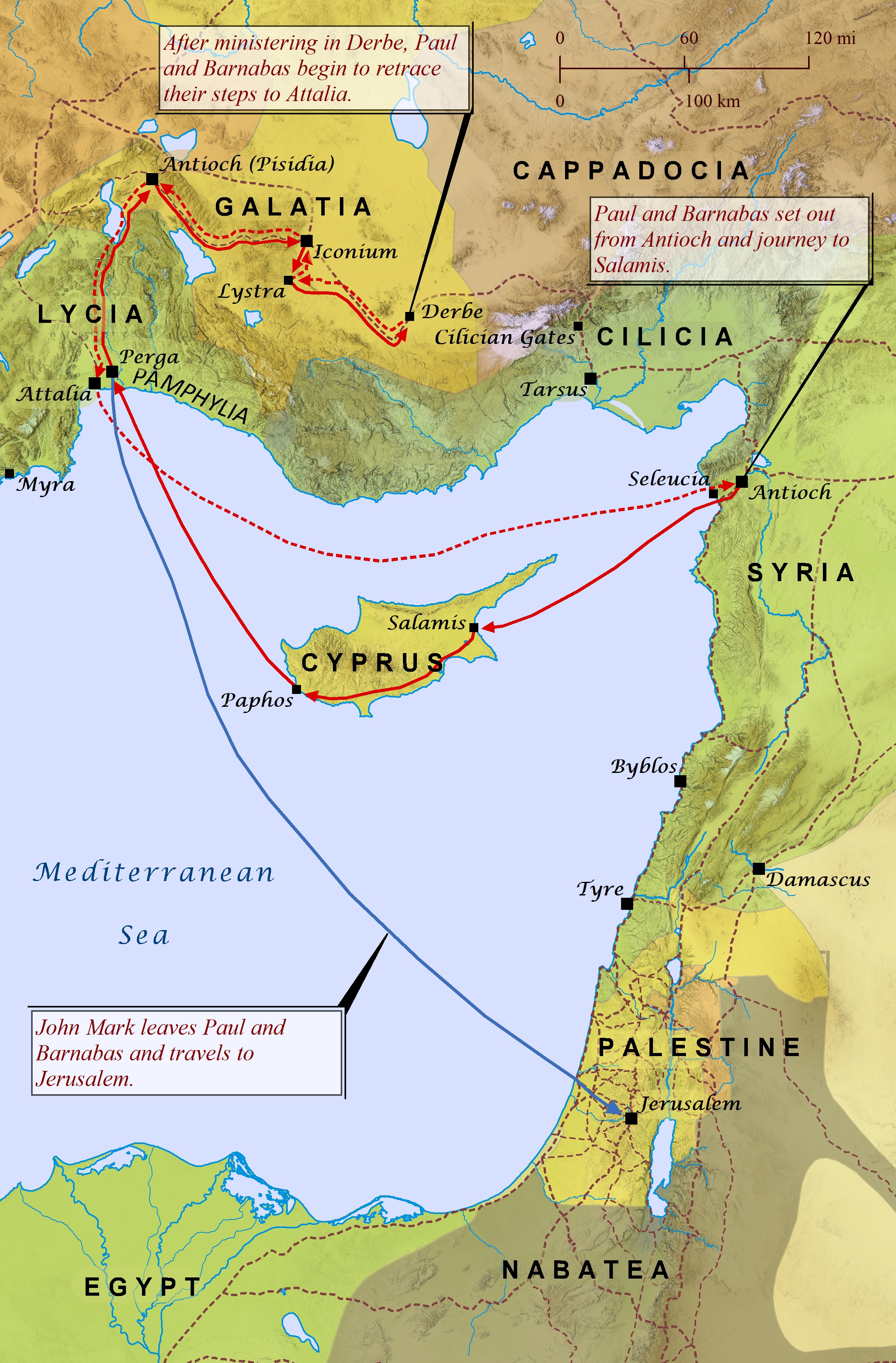
Image Credits (Wordless, Created for This Post):
- “The Road to Antioch” 🌄 — Original AI image created by ChatGPT for this study (Acts 13:13–41).
- “The Scroll of Prophecy” 📜 — Original AI image created by ChatGPT for this study (Acts 13:13–41).
- “The Synagogue Gathering” 🕍 — Original AI image created by ChatGPT for this study (Acts 13:13–41).
- “The Spirit’s Presence” 🕊️ — Original AI image created by ChatGPT for this study (Acts 13:13–41).
- “The Scroll in the Synagogue” 📜🌞 — Original AI image created by ChatGPT for this study (Acts 13:13–41).
🤖✨ Artificial Intelligence Assistance
ChatGPT. “✨ Acts 13:13–41 — 🌷 Paul’s Sermon in Antioch: The Promise Fulfilled ✨.” OpenAI, 2025, https://chat.openai.com.
This post was prayerfully prepared in collaboration with ChatGPT 🤖, a research assistant designed to support deep, Christ-centered Bible study. All Scripture is taken from the New King James Version (NKJV), and supporting references include Strong’s Concordance, cultural background texts, historical resources, and trusted Bible study materials. May this work bring glory to God and encouragement to the hearts of those who read it. 🕊️💕
Leave a Reply