
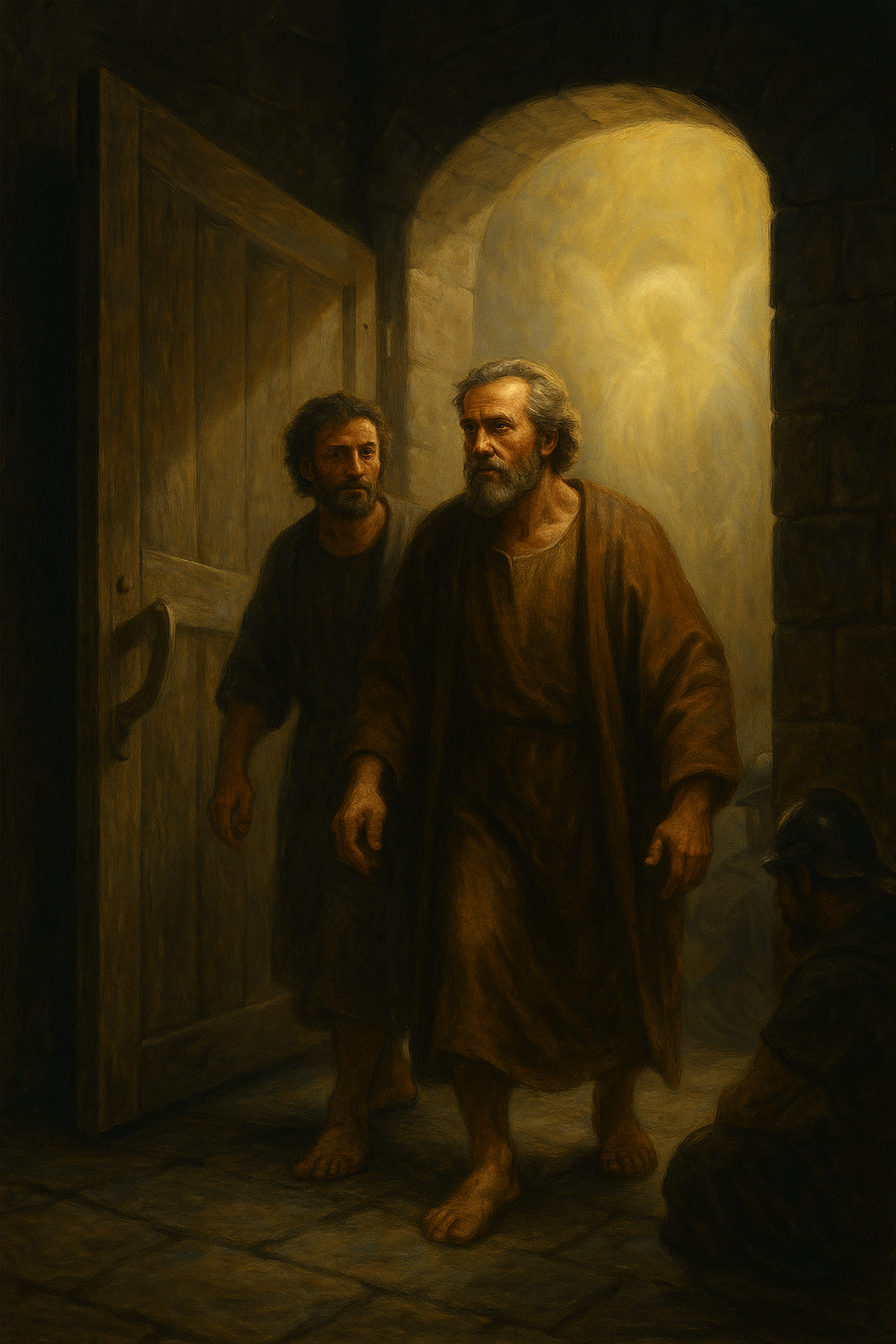
🌷 God’s messengers cannot be silenced.
Acts 5:17–32 — Arrested… but Not Silent
17 Then the high priest rose up, and all those who were with him (which is the sect of the Sadducees), and they were filled with indignation,
18 and laid their hands on the apostles and put them in the common prison.
19 But at night an angel of the Lord opened the prison doors and brought them out, and said,
20 “Go, stand in the temple and speak to the people all the words of this life.”
21 And when they heard that, they entered the temple early in the morning and taught.
But the high priest and those with him came and called the council together, with all the elders of the children of Israel, and sent to the prison to have them brought.
22 But when the officers came and did not find them in the prison, they returned and reported,
23 saying, “Indeed we found the prison shut securely, and the guards standing outside before the doors; but when we opened them, we found no one inside!”
24 Now when the high priest, the captain of the temple, and the chief priests heard these things, they wondered what the outcome would be.
25 So one came and told them, saying, “Look, the men whom you put in prison are standing in the temple and teaching the people!”
26 Then the captain went with the officers and brought them without violence, for they feared the people, lest they should be stoned.
27 And when they had brought them, they set them before the council. And the high priest asked them,
28 saying, “Did we not strictly command you not to teach in this name? And look, you have filled Jerusalem with your doctrine, and intend to bring this Man’s blood on us!”
29 But Peter and the other apostles answered and said: “We ought to obey God rather than men.
30 The God of our fathers raised up Jesus whom you murdered by hanging on a tree.
31 Him God has exalted to His right hand to be Prince and Savior, to give repentance to Israel and forgiveness of sins.
32 And we are His witnesses to these things, and so also is the Holy Spirit whom God has given to those who obey Him.”
👣 Traces of Jesus’ Ministry
This passage overflows with echoes of the life and teachings of Jesus — His own arrests, His bold proclamation of truth, and His divine authority:
- Like Jesus, the apostles were arrested by religious leaders who felt threatened by their influence. Just as the high priest plotted against Jesus (Luke 22:2), now the apostles face similar hostility.“Then the high priest rose up… filled with indignation.” (v. 17)
- Jesus often slipped away from danger or was mysteriously preserved until the right time — here, His apostles are miraculously freed by an angel. “An angel of the Lord opened the prison doors…” (v. 19) This reinforces that they, like Jesus, are on God’s timeline, not man’s.
- “Go… and speak to the people” (v. 20) reflects Jesus’ own command to preach the good news, even in dangerous circumstances. It mirrors His sending out of the 72 in Luke 10 — and His charge in Matthew 28:19–20.
- Peter’s bold words to the council echo Jesus’ confrontation of hypocrisy in the religious elite. Peter fearlessly preaches Christ crucified and risen — exactly what Jesus foretold they would do.
- The phrase in verse 20, “all the words of this life,” is a deeply Jesus-centered phrase. Jesus said, “I am the way, the truth, and the life” (John 14:6). The apostles are proclaiming His life — not just doctrine or reform, but a living Person.
- And finally, God exalted Jesus to His right hand (v. 31) — the apostles are proclaiming the very position Jesus foretold during His trial (Mark 14:62). His heavenly reign is being preached boldly on earth.
📜 From the Early Church
This scene reflects a key stage in the early church’s identity — bold, Spirit-filled, and unstoppable in their obedience to God:
- They were no longer afraid.
- After Jesus’ resurrection and the outpouring of the Holy Spirit in Acts 2, the apostles moved from hiding to proclaiming. Even prison and threats could not deter them.
- “They entered the temple early in the morning and taught.” (v. 21)
- After Jesus’ resurrection and the outpouring of the Holy Spirit in Acts 2, the apostles moved from hiding to proclaiming. Even prison and threats could not deter them.
- Obedience became their defining trait.
- The apostles’ statement in verse 29, “We ought to obey God rather than men,” became a cornerstone of early Christian conviction. This set the church apart — not by rebellion for its own sake, but by a willingness to suffer rather than deny the truth.
- They were seen by outsiders as powerful and uncontainable.
- The guards were baffled. The council was outraged. But the people were watching. This holy tension — between religious rulers trying to silence them and a growing public awe — was common in the early church.
- The message remained Jesus.
- Even under interrogation, Peter’s words are not defensive — they are evangelistic. He doesn’t just argue his case — he preaches:
- “The God of our fathers raised up Jesus whom you murdered… Him God has exalted… to give repentance… and forgiveness.” (vv. 30–31)
- Even under interrogation, Peter’s words are not defensive — they are evangelistic. He doesn’t just argue his case — he preaches:
- The Holy Spirit is acknowledged as a living witness.
- The apostles understood they weren’t alone.“We are His witnesses… and so also is the Holy Spirit.” (v. 32) This marked the ongoing divine partnership that would define the church’s mission — God working through His people by His Spirit.
🕰️ Historical and Cultural Background
This confrontation in Acts 5:17–32 unfolds in the very heart of Jewish religious authority: Jerusalem, under the watchful eyes of both the Sanhedrin and the Roman occupiers.
- The Sadducees
- Verse 17 tells us that those arresting the apostles were from the sect of the Sadducees, who dominated the priesthood and rejected belief in resurrection, angels, or the afterlife (Acts 23:8).
- They were powerful, wealthy, and closely tied to Rome — and they despised the apostles’ message, which preached both resurrection and miraculous power through the Holy Spirit.
- Verse 17 tells us that those arresting the apostles were from the sect of the Sadducees, who dominated the priesthood and rejected belief in resurrection, angels, or the afterlife (Acts 23:8).
- The High Priest
- Likely still Caiaphas, the same high priest who presided over Jesus’ trial — and the same one who told the council it was better for Jesus to die than for Rome to intervene (John 11:49–50).
- Now, he faces Jesus’ followers proclaiming that He is risen and reigning at God’s right hand. That’s not just a theological problem — it’s a political threat.
- Likely still Caiaphas, the same high priest who presided over Jesus’ trial — and the same one who told the council it was better for Jesus to die than for Rome to intervene (John 11:49–50).
- The Common Prison
- The apostles are thrown into a public prison, perhaps as a means of humiliation. But this is no ordinary story: “At night, an angel of the Lord opened the prison doors and brought them out…” (v. 19)
- The early readers of Acts would have recognized the divine irony — the very men deemed “dangerous” by earthly rulers are the ones walking in heaven’s authority.
- The apostles are thrown into a public prison, perhaps as a means of humiliation. But this is no ordinary story: “At night, an angel of the Lord opened the prison doors and brought them out…” (v. 19)
- The Temple
- God sends them back to the temple — not away to safety. This is the boldness of divine command:“Go, stand in the temple and speak…” (v. 20)
- The apostles return to the very place where they were arrested — because God’s Word cannot be shut behind bars.
- God sends them back to the temple — not away to safety. This is the boldness of divine command:“Go, stand in the temple and speak…” (v. 20)
- The Sanhedrin’s Power Was Being Challenged
- These rulers were accustomed to obedience and fear. But now, they’re afraid of the people (v. 26), and more than that — they’re afraid of the truth they can’t control.
🗝️ Key Word Studies
1. Indignation (v. 17)
Greek: ζῆλος (zēlos) — Strong’s G2205
Meaning: zeal, fervor, but also jealousy, envy, or rivalrous anger
💬 This word reveals that the high priest and Sadducees weren’t just angry — they were jealous of the apostles’ influence. Their indignation stemmed from losing control and popularity.
2. Angel (v. 19)
Greek: ἄγγελος (angelos) — Strong’s G32
Meaning: messenger, one who is sent
💬 This word doesn’t always mean a heavenly being — but here, it clearly is. The angel of the Lord breaking open prison doors shows God’s divine favor and intervention. Even earthly chains mean nothing to the God of heaven.
3. Stand (v. 20)
Greek: σταθέντες (stathentes) — from ἵστημι (histēmi), Strong’s G2476
Meaning: to stand firm, to take a position
💬 God doesn’t just want them to speak — He wants them to stand, publicly and firmly. This word implies courage and resolve, not casual conversation.
4. Obey (v. 29 & v. 32)
Greek: πειθαρχέω (peitharcheō) — Strong’s G3980
Meaning: to obey one in authority, to yield to a higher rule
💬 This word is used only a few times in the NT — always regarding obedience to God above human command. It has a legal tone, almost like obeying a Supreme Authority.
5. Exalted (v. 31)
Greek: ὑψόω (hypsōō) — Strong’s G5312
Meaning: to lift up, raise high; to dignify or elevate in status
💬 This word shows God’s action — He raised Jesus to His right hand. The Sadducees might reject resurrection, but Peter declares that God has already exalted the One they tried to destroy.
🔍 Theological Themes
1. Obedience to God over Man
The apostles’ courageous stand in verse 29 — “We ought to obey God rather than men” — captures a core principle of Christian discipleship.
This moment highlights that civil or religious pressure cannot override God’s will, especially when the truth of Jesus is at stake.
🕊️ This principle becomes a foundation for Christian ethics, resistance to injustice, and boldness in persecution.
2. Divine Authority Over Earthly Power
The apostles were arrested by the highest religious court in Israel — but God overrides the authority of the Sanhedrin with the silent arrival of an angel 🪽 and a divine jailbreak.
The contrast is stunning: human rulers think they’re in control, but God quietly undoes their decisions without violence or spectacle.
⚖️ This shows God’s sovereignty over all rulers, reminding us that no prison, no system, and no institution can restrain His will.
3. Jesus as Prince and Savior
In verse 31, Peter proclaims that God exalted Jesus as “Prince and Savior” — a rich title pairing:
- Prince (Greek: archēgos) means captain, originator, or trailblazer
- Savior speaks to redemption and healing✨ Together, they declare Jesus as both leader and liberator — the One who starts the journey and saves us through it.
4. Witness of the Holy Spirit
Verse 32 is one of the clearest declarations that the Holy Spirit is not only given to believers — He is also a co-witness alongside them.
“We are His witnesses… and so also is the Holy Spirit.”
This underscores the Godhead partnership in preaching Christ — the apostles speak, and the Spirit confirms and convicts.
🔥 It also teaches us that obedience invites the Spirit’s presence and power.
🕎📜 Old Testament Connections
1. Obedience Over Earthly Authority
Peter’s words in Acts 5:29 echo a deep Old Testament theme:
“We ought to obey God rather than men.”
💡 Think of Daniel, Shadrach, Meshach, and Abed-Nego, who defied kings and edicts when obedience to God was on the line:
- Daniel 3:16–18 — “Our God whom we serve is able to deliver us… but if not… we will not serve your gods.”
- Daniel 6:10 — Daniel continued praying, even when it was illegal. These stories prepared the Jewish mind for faithful civil disobedience rooted in trust and reverence for God.
2. The Angel of the Lord Delivering the Righteous
The apostles’ miraculous release by an angel connects to many moments in the OT where God’s messengers intervene:
- Psalm 34:7 — “The angel of the Lord encamps all around those who fear Him, and delivers them.”
- 2 Kings 6:16–17 — Elisha prays that his servant’s eyes would be opened to see the heavenly host surrounding them.
- Exodus 14:19 — The angel of God moves to protect Israel from Pharaoh’s army.
🕊️ These all remind us that God sends help to the faithful, often unseen, always timely.
3. God Raising Up a Deliverer
Peter’s claim that “The God of our fathers raised up Jesus” (v. 30) connects Jesus with OT deliverers like:
- Moses, who God raised up to lead Israel out of bondage
- Joseph, who was rejected by his brothers but exalted by God to save many
- David, the anointed king who was hunted by the powerful but chosen by God
These connections deepen the understanding of Jesus as God’s chosen Deliverer, foreshadowed throughout the Old Testament.
📖 New Testament Connections
1. “We must obey God rather than men.”
This theme doesn’t stop here — it becomes a defining mark of the early church and continues into the epistles:
- Romans 13:1–7 teaches submission to governing authorities, unless they conflict with God’s will.
- Hebrews 11:36–38 praises those who “suffered mocking and scourging… being destitute, afflicted, tormented” — for the sake of God.
- 1 Peter 4:19 — “Let those who suffer according to the will of God commit their souls to Him in doing good, as to a faithful Creator.”
💬 These echoes affirm that faithfulness may cost us peace with the world — but God honors those who remain true.
2. The Bold Witness of the Apostles
- Acts 4:13 — The rulers already noticed that Peter and John were “uneducated and untrained men,” yet they spoke with astonishing boldness.
- Acts 7:51–53 — Stephen’s speech before the Sanhedrin echoes Peter’s tone here: direct, courageous, and rooted in truth.
🔥 God’s messengers are never silenced for long — they speak because they’ve seen the risen Lord.
3. Jesus Exalted at God’s Right Hand
- Acts 2:33 — Peter already preached: “Therefore being exalted to the right hand of God…”
- Ephesians 1:20–21 — “He raised Him from the dead and seated Him at His right hand in the heavenly places.”
- Hebrews 1:3 — “…sat down at the right hand of the Majesty on high.”
💡 The apostles keep repeating this — not only to declare Jesus’ victory but to correct false teachings (especially from the Sadducees who denied resurrection and angels).
✨ Thoughtful Reflection Questions
- When have I faced a situation where I had to choose between pleasing people and obeying God?
- What helped me make the right choice — or what held me back?
- How do I respond when someone challenges my faith or beliefs?
- Do I rely on the Spirit’s strength and truth like the apostles did?
- Am I bold enough to speak the name of Jesus in places where it’s uncomfortable?
- What might it look like for me to be a “witness” in my daily life?
- Do I trust that God is sovereign — even when I feel powerless?
- How might remembering His control over all things help me walk in peace?
- What does this passage teach me about the unity of the Godhead — the Father, Son, and Spirit working together?
- How does that deepen my confidence and comfort as a believer?
📚 References — Sources Used in This Post
Free Online Sources:
- Blue Letter Bible. “Acts 5:17–32 (NKJV).” https://www.blueletterbible.org/nkjv/act/5/17
- Bible Hub. “Acts 5:17–32 Parallel Commentaries.” https://biblehub.com/commentaries/acts/5-17.htm
- GotQuestions.org. “Why did the Sadducees not believe in the resurrection?” https://www.gotquestions.org/Sadducees.html
🤖✨ Artificial Intelligence Assistance
ChatGPT. “✨ Arrested… but Not Silent ✨ — Acts 5:17–32.” OpenAI, 2025, https://chat.openai.com.
This post was prayerfully prepared in collaboration with ChatGPT 🤖, a research assistant designed to support deep, Christ-centered Bible study.
All Scripture is taken from the New King James Version (NKJV), and supporting references include Strong’s Concordance, historical context sources, and trusted commentary tools.
May this work bring glory to God and encouragement to the hearts of those who read it. 🕊️💕
Leave a Reply