
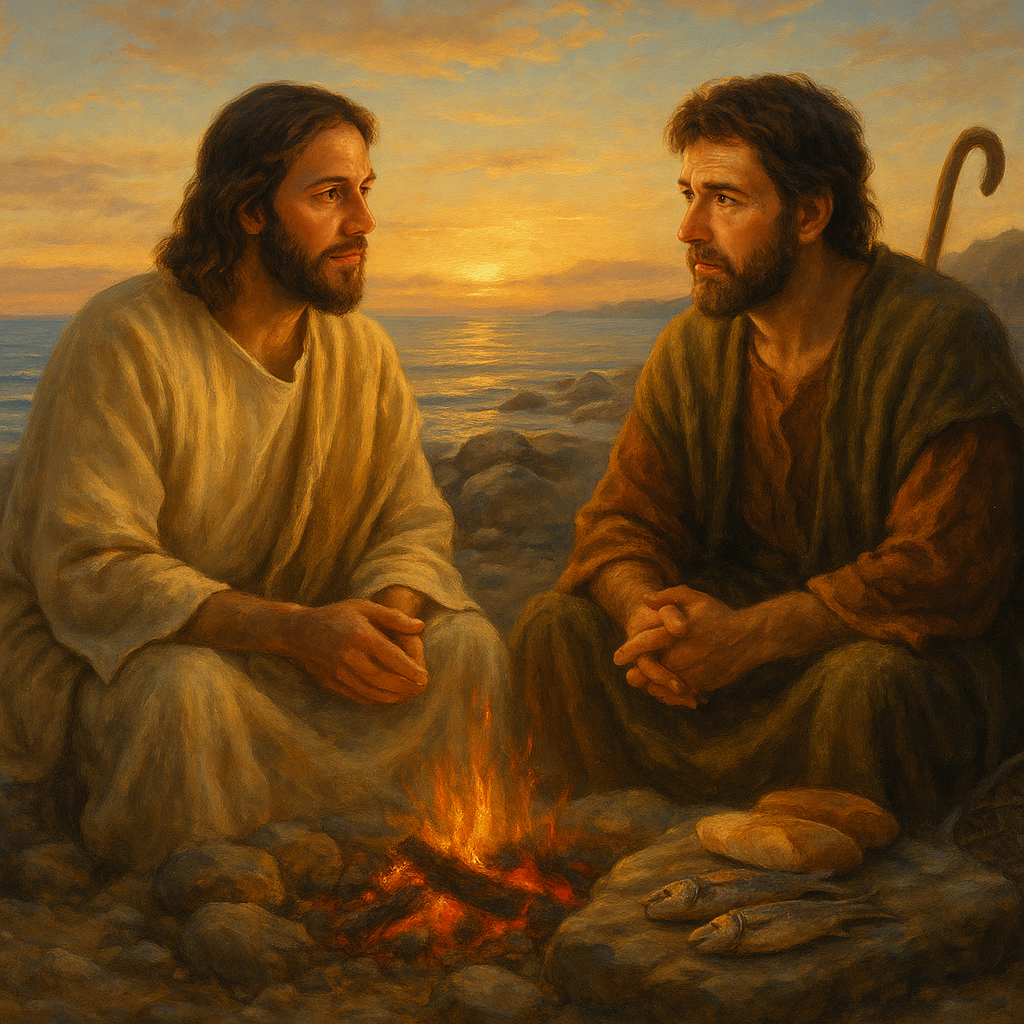
Feed My Sheep
📖 John 21:15–19
📖 Scripture Reading (NKJV)
John 21:15–19
🔥 15 So when they had eaten breakfast, Jesus said to Simon Peter,
“Simon, son of Jonah, do you love Me more than these?”
He said to Him, “Yes, Lord; You know that I love You.”
He said to him, “Feed My lambs.”
🕊️ 16 He said to him again a second time,
“Simon, son of Jonah, do you love Me?”
He said to Him, “Yes, Lord; You know that I love You.”
He said to him, “Tend My sheep.”
🌿 17 He said to him the third time,
“Simon, son of Jonah, do you love Me?”
Peter was grieved because He said to him the third time, “Do you love Me?”
And he said to Him, “Lord, You know all things; You know that I love You.”
Jesus said to him, “Feed My sheep.
✝️ 18 Most assuredly, I say to you, when you were younger, you girded yourself and walked where you wished; but when you are old, you will stretch out your hands, and another will gird you and carry you where you do not wish.”
🕯️ 19 This He spoke, signifying by what death he would glorify God.
And when He had spoken this, He said to him,
“Follow Me.”
📋 Gospel Parallels: Harmony with the Other Gospels
| 📖 Gospel | ✨ Parallel Content | 🔍 Key Detail |
|---|---|---|
| Matthew 26:33–35; 69–75 | Peter’s triple denial foretold and fulfilled | Peter insists he will never deny Jesus — then denies Him three times before the rooster crows |
| Mark 14:29–31; 66–72 | Similar denial and grief afterward | Peter weeps after realizing he fulfilled Jesus’ prediction |
| Luke 22:31–34; 54–62 | Jesus foretells Satan’s desire to sift Peter, and that Peter will return and “strengthen your brethren” | This matches Jesus’ call to “feed My sheep” in John 21 |
| Luke 22:61 | “And the Lord turned and looked at Peter…” | A moment of deep conviction that sets the stage for this later restoration |
| John 13:36–38 | Jesus foretells Peter’s denial at the Last Supper | Jesus knew Peter would fall — and also knew He would restore him |
🕊️ What’s unique about John 21:15–19 is that it gives us the healing conversation.
Where the other Gospels record Peter’s failure and grief, John shows us the forgiveness and renewed calling. 💖
🕰️ Historical and Cultural Background
🔥 Setting: The Charcoal Fire
Jesus and Peter are still sitting by the charcoal fire from verse 9 — the same Greek word (anthrakia) used in John 18:18, when Peter denied Jesus three times.
- This isn’t just a random campfire — it’s a place of intentional memory.
- Jesus is gently leading Peter back to the moment of failure, not to condemn him, but to redeem it.🕊️ The same setting where Peter denied Him is now the setting of healing grace.
🐑 Shepherd Imagery in Jewish Culture
When Jesus tells Peter, “Feed My lambs… Tend My sheep… Feed My sheep,” He is speaking in deeply Jewish pastoral language:
- The shepherd was a well-known image for spiritual leadership.
- In the Old Testament, God is the Shepherd (Psalm 23:1; Ezekiel 34), and leaders were tasked to care for His flock (Jeremiah 3:15; Isaiah 40:11).
- To be entrusted with God’s sheep was to be given a holy responsibility — a role of teaching, protecting, nurturing, and even laying down one’s life.
🌾 Jesus is not just forgiving Peter — He’s commissioning him to care for the precious people of God.
📜 Threefold Repetition in Rabbinic Teaching
In ancient Jewish teaching, repetition was a method of emphasis and confirmation. A truth stated three times was meant to seal it, make it unforgettable.
- Jesus asks three times, “Do you love Me?” — reflecting Peter’s three denials.
- But He also gives three commissions — one for each declaration of love.
💖 Peter’s failure is gently matched and replaced with a calling.
✝️ Jesus Foretelling Peter’s Martyrdom
In verse 18, Jesus refers to Peter stretching out his hands — a likely prophetic reference to crucifixion, as early church tradition confirms Peter was martyred in Rome.
- Peter once said, “I will lay down my life for Your sake” (John 13:37) — and now, Jesus says he will.
- But this time, it will not be a proud boast — it will be a glorifying act of faith.
🌟 The final words — “Follow Me” — echo the beginning of Peter’s discipleship, but now with greater depth, understanding, and purpose.
🗝️ Key Word Studies
💖 “Love” — ἀγαπάω (agapaō) and φιλέω (phileō)
This is the heart of the whole passage. Jesus and Peter use two different Greek words for love in this dialogue:
Jesus (v. 15–16): “Do you love (agapaō) Me?”
Peter (v. 15–16): “Yes, Lord; You know that I love (phileō) You.”
Jesus (v. 17): “Do you love (phileō) Me?”
- Agapaō (Strong’s G25): A selfless, sacrificial love — God’s kind of love
- Phileō (Strong’s G5368): A brotherly, affectionate, friendship love
🕊️ Peter, still humbled by his denial, responds with the love he feels confident offering — honest, loyal friendship. Jesus meets him there, switching to phileō in the third question. This isn’t Jesus lowering the standard — it’s Him stooping down to lift Peter up. 💕
🐑 “Feed” — βόσκω (boskō) — Strong’s G1006
“Feed My lambs.” / “Feed My sheep.”
- Meaning: To nourish, to provide food, to care for the physical and spiritual needs of others
- This word reflects active provision — not just giving knowledge, but giving life and sustenance.
📖 Used metaphorically in Scripture for teaching, guiding, and nurturing the people of God (cf. Acts 20:28).
🐏 “Tend” — ποιμαίνω (poimainō) — Strong’s G4165
“Tend My sheep.” (v. 16)
- Meaning: To shepherd, to guide, to lead with care and oversight
- This is more than feeding — it includes protecting, leading, and loving the flock.
💫 This is the word used of Jesus in Revelation 7:17:
“The Lamb… will shepherd them and lead them to living fountains of waters.”
✝️ “Follow” — ἀκολουθέω (akoloutheō) — Strong’s G190
“Follow Me.” (v. 19)
- Meaning: To walk with, to join oneself to another, to become a disciple
- This is the same invitation Jesus gave Peter at the beginning of his journey (John 1:43). Now it comes again — after failure, after forgiveness — with deeper meaning.
🕊️ Jesus doesn’t hold Peter’s past against him. Instead, He recommissions him with the same simple invitation:
Come with Me.
🔍 Theological Themes
💔 1. Grace Restores What Guilt Tries to Bury
Peter had denied Jesus three times — and now Jesus asks him three times, “Do you love Me?”
This wasn’t meant to shame Peter — it was surgical grace: a precise healing of a deep wound.
🌿 Where Peter once said, “I don’t know the man,” he now says, “You know that I love You.”
The very place of failure becomes the place of redemption.
🐑 2. Love for Jesus Results in Care for Others
Each time Peter affirms his love, Jesus gives him a task: Feed My lambs. Tend My sheep.
- This shows that love for Jesus is never just private or sentimental.
- It is expressed through serving, protecting, and nurturing others — especially His people.
📖 It’s the birth of Peter’s ministry. He’s not just forgiven — he’s entrusted.
🔥 3. Jesus Meets Us Where We Are, Not Where We Should Be
Jesus begins by asking, “Do you agapē Me?” — the highest kind of love. But Peter responds with phileō — a humbler, honest love.
On the third time, Jesus uses phileō too.
💡 This shows us the gentleness of our Savior. Jesus comes down to Peter’s level — not to leave him there, but to walk him forward.
He doesn’t demand perfection — He asks for devotion.
✝️ 4. Following Jesus May Involve Sacrifice
In verses 18–19, Jesus tells Peter that he will eventually be led where he doesn’t want to go — a reference to Peter’s future martyrdom.
This is a hard truth… but also a high honor.
🌟 Peter once said, “I will die for You” (John 13:37), and failed.
Now Jesus says, You will. And this time, Peter will follow through — with grace-driven courage.
🕊️ 5. Jesus Still Says, “Follow Me”
The final words of this passage — “Follow Me” — echo back to Peter’s very first call in John 1.
- Jesus doesn’t discard him.
- He doesn’t define him by failure.
- He reaffirms: You are still Mine. Come walk with Me.
💖 That’s the Gospel: no matter how far we fall, Jesus stands by the fire, ready to say, Come with Me again.
🔗 Old Testament Connections
🐑 1. The Lord Is My Shepherd
— Psalm 23
“The Lord is my shepherd; I shall not want…” (Psalm 23:1)
Jesus’ threefold command to “feed My lambs,” “tend My sheep,” and “feed My sheep” calls Peter to join in God’s own shepherding work — a direct echo of the Lord’s role in the most beloved psalm of David.
💡 Jesus isn’t just restoring Peter — He’s inviting him to reflect the Shepherd heart of God.
🐏 2. Woe to the False Shepherds, Hope for the True One
— Ezekiel 34
“Woe to the shepherds of Israel who feed themselves! Should not the shepherds feed the flocks?”
“I will establish one shepherd over them, and he shall feed them—My servant David.” (Ezekiel 34:2, 23)
In this powerful chapter, God condemns corrupt leaders who failed to care for His people — and promises that He Himself will come to shepherd His flock. Jesus fulfills this, and now He commissions Peter to carry that mission forward.
🌿 This is restoration with responsibility: not just forgiven, but entrusted.
🔥 3. Charcoal Fire, Covenant Renewal
— Leviticus 6:12–13
“The fire on the altar shall be kept burning on it… it shall never go out.”
The fire Peter sat around during his denial had gone cold with shame. But here by the sea, another fire is burning — not for sacrifice, but for restoration. It’s like a re-covenanting moment, where Peter is offered not just forgiveness, but a renewed purpose.
🕊️ The fire had always symbolized God’s presence — and here, by its glow, Jesus speaks grace.
💖 4. Threefold Confession of Love — Echo of the Shema
“You shall love the Lord your God with all your heart, with all your soul, and with all your strength.” (Deuteronomy 6:5)
The triple “Do you love Me?” reflects the full call of the Shema — to love God with every part of ourselves. Jesus wasn’t testing Peter — He was calling him back into full-hearted love.
📖 This moment restores what denial fractured — mind, soul, strength.
📖 New Testament Connections
🐑 1. Peter Becomes a Shepherd of the Flock
Jesus’ command, “Feed My sheep,” is not poetic — it’s prophetic. And Peter lives it out:
- Acts 2:14–41 — Peter boldly preaches the first Gospel sermon at Pentecost
- Acts 10 — Peter brings the Gospel to the Gentiles through Cornelius
- 1 Peter 5:2–4 — Peter writes: “Shepherd the flock of God which is among you, serving as overseers… being examples to the flock.” His language reflects Jesus’ words — he never forgets that moment by the fire.
💖 The man who once said, “I don’t know Him,” now feeds the sheep with truth, courage, and grace.
✝️ 2. Peter’s Martyrdom and Glorification of God
Jesus’ words in verse 18 — “You will stretch out your hands…” — are understood by the early church as referring to Peter’s crucifixion.
- 2 Peter 1:14 — Peter, near the end of his life, writes: “Knowing that shortly I must put off my tent, just as our Lord Jesus Christ showed me.”
- Church tradition (e.g., Eusebius) tells us Peter was crucified in Rome, reportedly upside down, saying he was not worthy to die like Jesus.
🔥 Peter’s death, once something he feared, becomes the very thing that glorifies God — just as Jesus said.
🕊️ 3. Grace Transforms Denial into Devotion
Peter’s life from this moment forward is a living testimony of grace:
- He becomes a pillar in the early church (Galatians 2:9)
- He boldly defends the Gospel before rulers (Acts 4:8–13)
- His letters are filled with themes of suffering, hope, humility, and restoration
💡 This moment in John 21 becomes the blueprint of restoration — not only for Peter, but for all of us who have failed and been forgiven.
✨ Thoughtful Reflection Questions
- Is there a place in my life where I’ve denied Jesus — not necessarily with words, but maybe with silence, fear, or compromise?
- 💔 What would it look like to let Him restore me at that very place?
- What kind of love am I offering to Jesus right now — is it hesitant, broken, honest, or deep?
- 💬 Like Peter, am I answering with phileō love while He invites me toward agapē?
- Can I trust Him to meet me where I am?
- Do I believe that Jesus not only forgives me… but wants to use me?
- 🐑 He didn’t just say “You’re forgiven,” He said “Feed My sheep.”
- How might Jesus be calling me — even through my past failings — to care for others?
- What does “Follow Me” mean to me today?
- 🌿 Jesus spoke those same words to Peter at the start and at the end.
- Am I still walking?
- If I’ve strayed, am I willing to rise and follow again?
✅ References
📚 Free Online Sources
- Blue Letter Bible — Greek word studies and Strong’s Concordance for agapaō, phileō, boskō, poimainō, and akoloutheō
- Bible Hub — Cross-references, translations, and interlinear tools
- NET Bible Notes — Commentary and cultural background
- GotQuestions.org — “Why did Jesus ask Peter ‘Do you love Me?’ three times?”
🤖✨ Artificial Intelligence Assistance
ChatGPT. “✨Do You Love Me?✨ — John 21:15–19.” OpenAI, 2025, https://chat.openai.com.
This post was prayerfully prepared in collaboration with ChatGPT 🤖, a research assistant designed to support deep, Christ-centered Bible study.
All Scripture is taken from the New King James Version (NKJV), and supporting references include Strong’s Concordance, cultural background texts, and trusted Gospel study materials.
May this work bring glory to God and encouragement to the hearts of those who read it. 🕊️💕
Leave a Reply