
Thursday – The Day of Preparation
📖 Scripture Reading (NKJV)
Thursday — The Day of Preparation unfolds through a series of deeply significant moments in the life of Jesus, all leading toward the cross. This day spans the evening of the Passover meal through to the trials and denials in the night.
- The Passover Meal (Matt. 26:17–29; Mark 14:12–25; Luke 22:7–30; John 13:1–38) Jesus gathers with His disciples in the upper room to eat the Passover meal. Here, He institutes the Lord’s Supper, washes His disciples’ feet as a servant, foretells His betrayal, and lovingly teaches them about humility and remembrance.
- Farewell Discourse (John 14:1–31) Jesus comforts the disciples with the promise of a heavenly home, assures them of His unity with the Father, and promises the coming of the Helper—the Holy Spirit.
- Discourse on the Way to Gethsemane (John 15:1–16:33) As they walk toward the Mount of Olives, Jesus teaches about abiding in Him as the True Vine, warns of persecution, and offers peace despite coming tribulation.
- The High Priestly Prayer (John 17:1–26) Jesus prays for Himself, His disciples, and all believers—asking the Father for unity, truth, and sanctification among those who would follow Him.
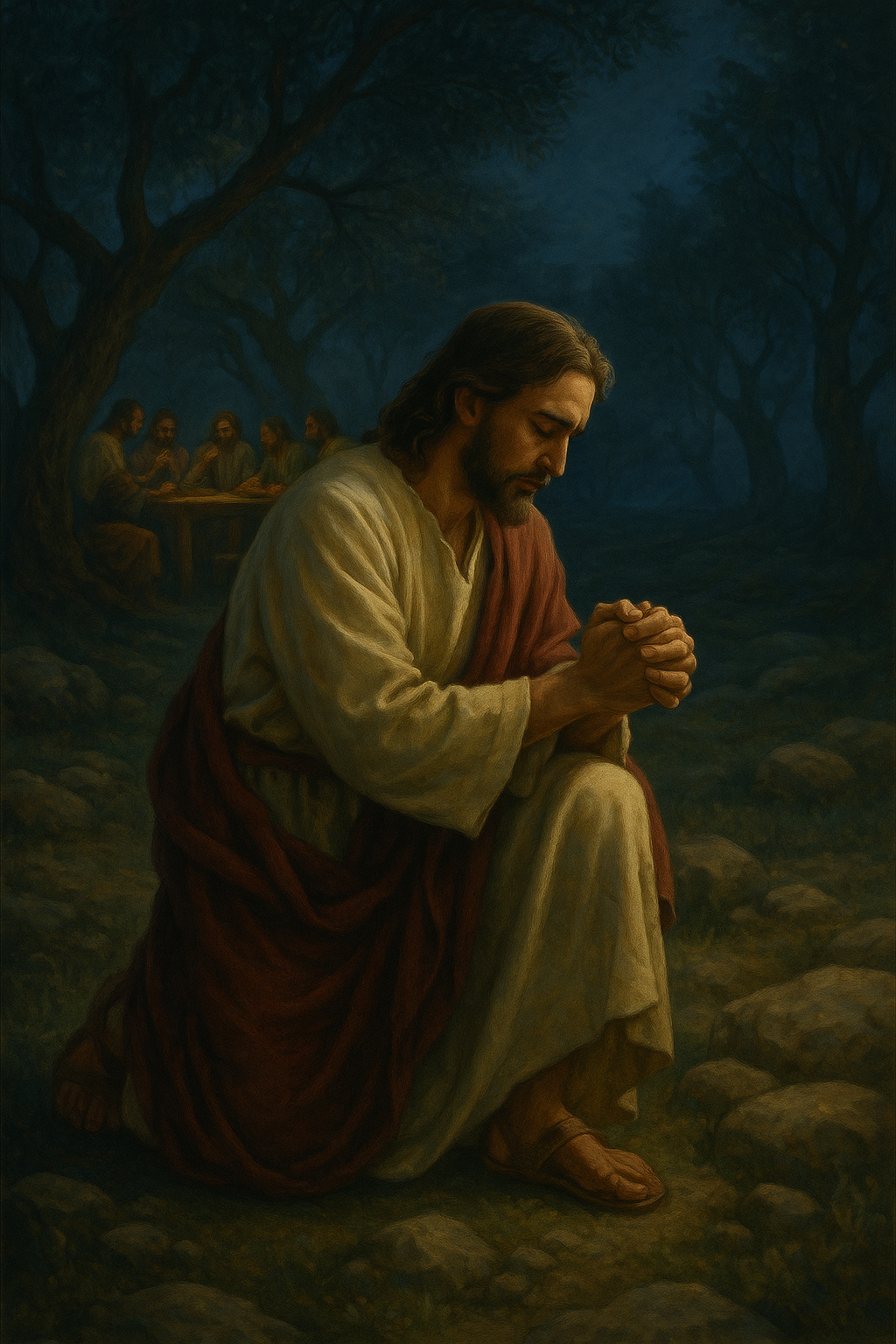
- In the Garden (Matt. 26:30, 36–46; Mark 14:26, 32–42; Luke 22:39–46; John 18:1) Jesus withdraws to Gethsemane, deeply sorrowful, and prays alone. The disciples struggle to stay awake. Jesus submits to the Father’s will with the words, “Not My will, but Yours be done.”
- Betrayal and Arrest (Matt. 26:47–56; Mark 14:43–52; Luke 22:47–53; John 18:2–12) Judas approaches with a kiss, marking Jesus for arrest. Jesus is taken by an armed crowd, but not without affirming, “I am He,” and demonstrating His authority and peace even in betrayal.
- Trial before Caiaphas (Matt. 26:57, 59–68; Mark 14:53, 55–65; Luke 22:54, 63–65; John 18:24) Jesus is falsely accused before the high priest. He remains silent until directly asked if He is the Son of God. Upon affirming it, He is condemned for blasphemy.
- Peter’s Denial (Matt. 26:58, 69–75; Mark 14:54, 66–72; Luke 22:54–62; John 18:15–18) As Jesus is questioned, Peter, who had followed at a distance, denies knowing Him three times—just as Jesus had foretold. When the rooster crows, Peter remembers and weeps bitterly.
💧 This entire night is a portrait of love in motion, even as suffering encroaches. Every step, every word, every prayer of Jesus is willingly offered for our redemption.
🕰️ Historical and Cultural Background
The events of this Thursday took place during Passover Week, one of the most sacred times in the Jewish calendar. It commemorated Israel’s deliverance from Egypt (Exodus 12) and drew thousands of pilgrims to Jerusalem. The entire city would have been bustling—crowded, tense, and filled with religious expectancy.
The Upper Room & Passover:
- Jesus’ final meal with His disciples was a traditional Passover Seder, rich with meaning. Every element of the meal symbolized God’s deliverance. Yet on this night, Jesus redefined the symbols: the unleavened bread became His body, and the cup His blood of the new covenant (Matt. 26:26–28).
- This was a deeply intimate setting—not just ritual, but personal love and farewell. Foot washing was typically reserved for the lowest servant. For the Master to do it was shocking—and tender (John 13:5–17).
Jewish Trials and Temple Authority:
- After His arrest, Jesus was brought before the high priest Caiaphas and the Sanhedrin. This trial occurred illegally at night, violating several Jewish legal standards. Yet they were determined to charge Him with blasphemy.
- It was customary to strike or shame a blasphemer, which explains the brutal mockery Jesus endured during this first phase of trial.
Gethsemane’s Meaning:
- Gethsemane, meaning “olive press,” was a grove of olive trees at the base of the Mount of Olives. It was a place of crushing—physically for olives, spiritually for Jesus. There, He prayed with such agony that His sweat became like great drops of blood (Luke 22:44).
Roman and Jewish Tension:
- The Roman occupation was ever-present. Though the Temple leadership had its own laws, Rome alone could execute—setting the stage for the next day’s tragic proceedings.
This day bridges the sacred with the suffering—showing how the Lamb of God prepared Himself to be offered. The cultural setting brings out the depth: a festival of deliverance becomes the pathway to the ultimate redemption.
🗝️ Key Word Studies
Here are a few deeply meaningful words and phrases from Thursday’s events that help us feel the weight and wonder of what Jesus said and did:
1. “This is My body” (Greek: sōma mou) — Matt. 26:26
- Sōma (σῶμα) means the whole physical body. Jesus wasn’t referring to a mere symbol but was offering His entire being for us. In Jewish thought, the body was sacred—it was the vessel of life. When Jesus broke the bread, He declared He would be broken for the salvation of mankind.
2. “New Covenant” (Greek: kainē diathēkē) — Luke 22:20
- Diathēkē (διαθήκη) means covenant or will, often used in legal contexts, but also deeply tied to God’s promises (like those to Abraham and Moses). Kainē (καινὴ) means new—not as in “recent,” but fresh, unprecedented, never before seen. Jesus was inaugurating a relationship between God and man unlike any that had come before.
3. “Servant” (Greek: diakonos) — John 13:16
- Diakonos (διάκονος) describes one who waits tables or serves others. Jesus identifies Himself as this kind of servant—even though He is Lord and Teacher. It’s humility in divine form.
4. “Gethsemane” (Hebrew: גת שמנים gat shemanim) — Matt. 26:36
- Literally means olive press. It was a place where olives were crushed to produce oil. The symbolism here is rich—Jesus, the Anointed One (Messiah), is spiritually crushed so the Spirit (often represented as oil) may be poured out for us.
5. “Watch and pray” (Greek: grēgoreite kai proseuchesthe) — Matt. 26:41
- Grēgoreite (γρηγορεῖτε) means “stay awake, be alert.” Proseuchesthe (προσεύχεσθε) is the word for active, ongoing prayer. Jesus was inviting His disciples—and us—not to fall asleep spiritually, but to be vigilant in our walk, especially in times of testing.
6. “Betray” (Greek: paradidōmi) — Matt. 26:48
- Paradidōmi (παραδίδωμι) means to hand over, deliver up, or surrender—often used of someone being handed over to legal authorities. Judas’ act wasn’t just personal betrayal; it was delivering Jesus into the hands of those who would mock, condemn, and kill Him.
🔍 Theological Themes
1. The Servant-King’s Love
Though fully divine, Jesus humbled Himself to serve His disciples—washing their feet and preparing their hearts. This act of love wasn’t only symbolic; it was theological. It demonstrated what God is like: not distant and lofty, but willing to kneel in the dust to love and cleanse His people. (John 13:1–17)
2. The New Covenant Instituted
At the Passover table, Jesus did more than share a meal—He redefined the covenant between God and man. Just as the old covenant was sealed with blood at Sinai, Jesus now offers His own blood as the sign of a better promise: forgiveness, restoration, and nearness to God forever. (Matt. 26:27–28)
3. Obedience Unto Death
In Gethsemane, Jesus’ sorrow was so deep it caused Him to sweat drops of blood (Luke 22:44). Yet, He prayed, “Not My will, but Yours be done.” This perfect submission to the Father’s will fulfilled prophecy (Isaiah 53:10) and confirmed His role as the Lamb who would willingly go to slaughter (John 1:29).
4. The Darkness of Betrayal and Abandonment
Jesus was betrayed by a friend (Judas), denied by another (Peter), and forsaken by many. Yet through this, He fulfilled Scripture (Psalm 41:9; Zech. 13:7). Theologically, we see the cost of redemption: God’s Son stood alone so that we might never be alone again.
5. Divine Justice and Human Injustice
The mock trial before Caiaphas began the injustice that would culminate at the cross. Jesus, the only truly righteous One, stood accused by sinful men. This underscores the profound truth of substitutionary atonement: He was judged so that we might be justified. (Isa. 53:3–8; 2 Cor. 5:21)
🔗 Old Testament Connections
1. The Passover Lamb (Exodus 12:1–28)
As Jesus shared the Passover meal with His disciples, He did so knowing He Himself was the true fulfillment of that feast. Just as the blood of a spotless lamb protected Israel from judgment in Egypt, His blood would now deliver all who believe from eternal death. (John 1:29; 1 Cor. 5:7)
2. The Covenant at Sinai (Exodus 24:1–8)
At Sinai, Moses sprinkled the blood of the covenant on the people, binding them to God. Jesus, in the Upper Room, lifted the cup and said, “This is My blood of the new covenant.” (Matt. 26:28) A new covenant was being made—sealed not with the blood of animals, but with His own.
3. The Suffering Servant (Isaiah 52:13–53:12)
Every moment of Gethsemane, the betrayal, and the trials echoed Isaiah’s prophecy: “He is despised and rejected by men, a Man of sorrows and acquainted with grief…” Jesus bore grief, injustice, and death just as Isaiah foretold—so we might be healed by His wounds.
4. The Zeal of the Lord (Psalm 69:9)
When Jesus entered the temple earlier in the week, zeal consumed Him. That same zeal drove Him through the agony of this night. It was a burning love for His Father’s glory and our salvation.
5. The Stone the Builders Rejected (Psalm 118:22–23)
In His rejection by the leaders of Israel, Jesus fulfilled the Scripture: “The stone which the builders rejected has become the chief cornerstone.” His trial, false accusations, and condemnation were not unexpected—they were the path written by God from ancient times.
This sacred Thursday is drenched in Scripture—from Exodus to Psalms to Isaiah—each prophecy and pattern fulfilled in trembling love and holy determination.
✨ Thoughtful Reflection Questions
- Jesus washed the feet of His betrayer.🦶 How does His example challenge me to serve those who are difficult to love?
- The new covenant was spoken with a cup.🍷 Do I treat the Lord’s Supper as a sacred remembrance of His sacrifice?Do I truly see it as a weekly renewal of the covenant between me and the Lord?
- Jesus prayed for His disciples and for us.🙏 What comfort do I find knowing Jesus prayed for my faith and unity with others who believe?
- In Gethsemane, Jesus prayed, “Not My will, but Yours be done.”🌿 Are there areas of my life where I’m still saying “My will be done”?What would surrender look like in those places?
- Jesus was betrayed, arrested, and left alone.🌒 Have I ever felt abandoned or misunderstood for my faith?How does Jesus’ night of suffering bring me strength or comfort?
- Peter’s denial and bitter weeping…🐓 What do I learn about repentance from Peter’s fall?How might God use even my failures to draw me closer to Him?
Each of these moments leads us to the cross—but not without stopping first at the depth of Jesus’ love, the sorrow of human frailty, and the hope of redemption.
✅ References
Free Online Sources:
- The Holy Bible, New King James Version (NKJV). Thomas Nelson, 1982. Bible Gateway
- “Interlinear Bible.” Blue Letter Bible, https://www.blueletterbible.org/
- “Greek and Hebrew Lexicons.” Blue Letter Bible, https://www.blueletterbible.org/lang/lexicon/lexicon.cfm
📚 Paid Print or Digital Books Used in This Post:
- Vick, Ron. The Last Week of Jesus’ Life. Oak Hill Church of Christ, 2018. (Available by request through local Church of Christ congregations or educational ministries.)
- Strong, James. Strong’s Exhaustive Concordance of the Bible. Hendrickson Publishers, 2009. (Available for purchase at Christianbook.com or Logos.com.)
🤖✨ Artificial Intelligence Assistance
ChatGPT. “✨Thursday — The Day of Preparation: A Harmony of the Gospels.” OpenAI, 2025, https://chat.openai.com.
This post was prayerfully prepared in collaboration with ChatGPT 🤖, a research assistant designed to support deep, Christ-centered Bible study. All Scripture is taken from the New King James Version (NKJV), and supporting references include Strong’s Concordance, cultural background texts, and trusted Gospel study materials. May this work bring glory to God and encouragement to the hearts of those who read it. 🕊️💕
Leave a Reply