
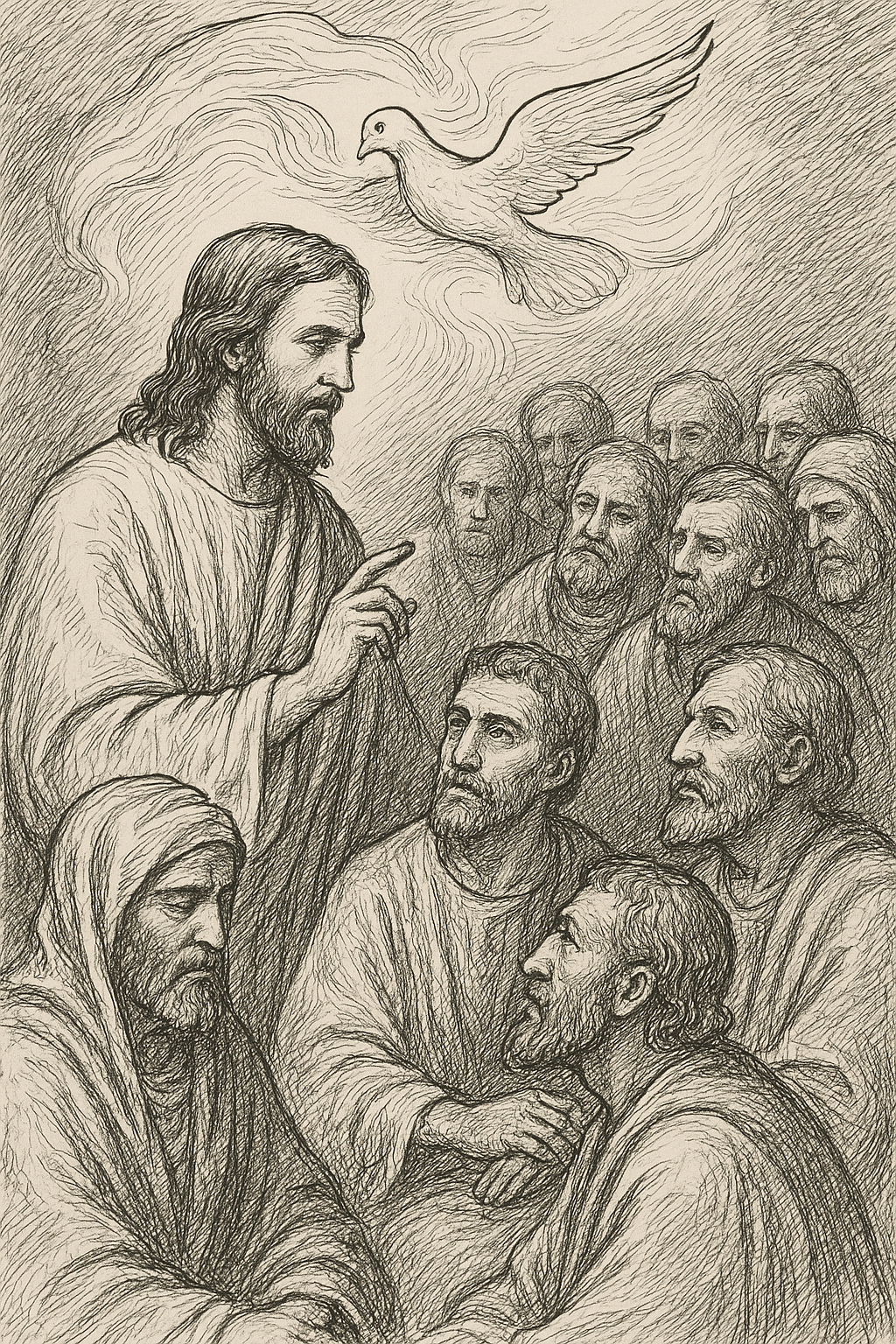
📖 John 16:1–15
📋 Quick Preview
- Main Theme: Jesus prepares His disciples for what is to come, promising the Holy Spirit who will guide them in truth.
- Verse Focus: “It is to your advantage that I go away; for if I do not go away, the Helper will not come to you…”(John 16:7, NKJV)
- Takeaway Thought: Even in sorrow and uncertainty, Jesus is not leaving us alone. The Spirit of Truth has come to dwell within believers — guiding, comforting, convicting, and glorifying Christ through us. What a holy gift from the departing Savior! 🕊️
📖 Scripture Reading (NKJV)
John 16:1–15
1 “These things I have spoken to you, that you should not be made to stumble.
2 They will put you out of the synagogues; yes, the time is coming that whoever kills you will think that he offers God service.
3 And these things they will do to you because they have not known the Father nor Me.
4 But these things I have told you, that when the time comes, you may remember that I told you of them.
And these things I did not say to you at the beginning, because I was with you.
5 “But now I go away to Him who sent Me, and none of you asks Me, ‘Where are You going?’
6 But because I have said these things to you, sorrow has filled your heart.
7 Nevertheless I tell you the truth. It is to your advantage that I go away; for if I do not go away, the Helper will not come to you; but if I depart, I will send Him to you.
8 And when He has come, He will convict the world of sin, and of righteousness, and of judgment:
9 of sin, because they do not believe in Me;
10 of righteousness, because I go to My Father and you see Me no more;
11 of judgment, because the ruler of this world is judged.
12 “I still have many things to say to you, but you cannot bear them now.
13 However, when He, the Spirit of truth, has come, He will guide you into all truth; for He will not speak on His own authority, but whatever He hears He will speak; and He will tell you things to come.
14 He will glorify Me, for He will take of what is Mine and declare it to you.
15 All things that the Father has are Mine. Therefore I said that He will take of Mine and declare it to you.
🌷 Opening Invitation
This passage brings me quietly to the edge of my heart — where sorrow and hope seem to hold hands. Jesus was preparing His disciples for what was to come, and in doing so, He was preparing us too. These words feel like a parting whisper — not of abandonment, but of deep, enduring love.
We see in this Scripture the honesty of Jesus: that sorrow was real, danger was near, and the road ahead would not be easy. Yet He did not leave His followers without comfort. He promised the Helper — the Holy Spirit — to guide, teach, and dwell within us. This promise wasn’t just for the apostles long ago; it’s for us today.
As we walk through this post together, I invite you to linger on these verses with me. I pray you’ll feel the comfort of knowing that Jesus saw it all coming, and He chose to send us help. You are not walking alone. 💛
📋 Gospel Parallels
This teaching from Jesus in John 16:1–15 is unique to John’s Gospel and has no direct parallels in Matthew, Mark, or Luke. The Synoptic Gospels record Jesus’ foretelling of persecution and the coming of the Holy Spirit in broader terms (e.g., Matthew 10:16–20, Mark 13:9–11, Luke 12:11–12), but it is in John’s Gospel that we receive this deeply personal and extended discourse on the work of the Holy Spirit.
John gives us a treasured glimpse into the heart of Christ on the eve of His suffering — a glimpse not found anywhere else in Scripture. 💧
🕰️ Historical and Cultural Background
As Jesus continues His farewell discourse (John 13–17), the shadow of the cross looms ever closer. These words were spoken on the night of His betrayal, likely still in the upper room or on the walk to Gethsemane. The disciples, confused and sorrowful, were trying to grasp the reality that their beloved Master was leaving them.
At this time, tensions between Jesus and the religious leaders had reached a boiling point. His arrest was imminent. Persecution wasn’t a distant possibility — it was a near certainty. Jesus had already told His disciples they would be hated for His sake (John 15:18–25), and now He prepares them further for the cost of following Him.
💭 Persecution in the First Century
In the decades following Jesus’ resurrection, His followers would face fierce opposition — not only from the Roman Empire but even from religious institutions. Being put out of the synagogue (v. 2) meant social, spiritual, and economic isolation for Jewish believers in Christ. Worse, some would face martyrdom from those convinced they were serving God.
🕊️ The Promise of the Holy Spirit
Jesus’ promise of the Holy Spirit was both comfort and calling. The “Helper” (Greek: Paraklētos) was not only coming to strengthen them but to guide, teach, convict, and glorify Christ in the world through them. This promise was deeply countercultural — Jesus was asking them to find peace and purpose in spiritual truth, not in earthly safety.
Jesus wasn’t just preparing them for survival — He was preparing them for mission.
🗝️ Key Word Studies
Let’s take a closer look at a few important words Jesus used in this teaching. Each one deepens our understanding of His heart, His mission, and the Spirit’s role.
- “Stumble” (v. 1) – Greek: skandalizō (σκανδαλίζω)This word implies being tripped up, offended, or caused to fall away. Jesus wanted to prepare His disciples so their faith wouldn’t be shaken when persecution came. He didn’t promise a path free of trouble — He promised truth strong enough to stand in it.
- “Put you out of the synagogues” (v. 2) – Greek: aposynagōgos (ἀποσυνάγωγος)More than being asked to leave, this meant total excommunication — losing access to community, support, worship, and identity. Jesus warned this would happen so that His followers wouldn’t think suffering meant failure.
- “Helper” (v. 7) – Greek: Paraklētos (παράκλητος)This beautiful word means advocate, counselor, comforter, or one who comes alongside. Jesus uses it for the Holy Spirit — not a distant force, but a present companion who defends and guides.
- “Convict” (v. 8) – Greek: elenchō (ἐλέγχω)To convict is not merely to accuse — it’s to expose truthfully, to bring light. The Spirit convicts the world of sin, righteousness, and judgment — not to destroy, but to call people into truth and life.
- “Glorify” (v. 14) – Greek: doxazō (δοξάζω)To glorify is to honor, to make radiant, to reveal the worth of something. The Holy Spirit doesn’t draw attention to Himself, but glorifies Jesus — showing His beauty and authority to the hearts of believers.
💖 Personal Reflection
Jesus emphasized the importance of remembering because He knew how easily our hearts could drift in sorrow, fear, or confusion. He didn’t want His disciples—or us—to be caught off guard. Even today, in times of grief or struggle, the words of Christ come back to steady us. Sometimes we may not recall the exact verse, but the truth of His heart finds us just the same. Whether it’s a quiet nudge, a sudden clarity, or a moment of peace amid chaos—it is often the Holy Spirit reminding us of what Jesus said.
There have been countless times when, though I couldn’t quote a chapter and verse, I knew what was right, or felt the strength to go on, or understood God’s will just enough to take the next step. That is the Helper Jesus promised. He doesn’t leave us to wander alone—He teaches, comforts, and brings truth to our hearts in the very moment we need it.
🔍 Theological Themes
This section of John unveils deep truths about God’s purpose, the Spirit’s presence, and the pain that often comes before peace. Let’s reflect on several central themes:
- Preparation for Persecution Jesus didn’t shield His disciples from the reality of suffering. Instead, He prepared them for it, so they wouldn’t stumble. This reminds us that hardship is not evidence of abandonment — but often a refining ground for faith. True Christianity isn’t about avoiding pain but abiding through it with God’s truth in us.
- The Ministry of the Holy Spirit The Spirit is not just a comfort, but an active, divine presence in the world — convicting hearts, revealing righteousness, and guiding believers in truth. Jesus’ ascension wasn’t a loss; it was the opening of a new era — one where God would dwell within His people.
- Divine Truth Over Human Emotion Jesus acknowledges the sorrow of His disciples, yet He gently redirects their focus to what is better — the coming of the Helper. This reflects a consistent theme in Scripture: feelings are real, but truth is greater. God often asks us to trust Him beyond what we feel in the moment.
- Unity of the Godhead These verses show the beautiful harmony between the Father, the Son, and the Holy Spirit. The Spirit speaks what He hears from Jesus, and Jesus glorifies the Father. We are drawn into this divine fellowship — a holy communion of shared love, mission, and truth.
🔗 Old Testament Connections
Jesus’ teachings in this passage are not isolated from the Hebrew Scriptures — they flow from and fulfill God’s long-standing promises:
- The Promise of the Spirit (Joel 2:28–29) The coming of the Holy Spirit fulfills Joel’s prophecy:“And it shall come to pass afterward that I will pour out My Spirit on all flesh…” (Joel 2:28, NKJV).Jesus’ words to His disciples reveal the moment is near — God’s Spirit will not merely rest upon prophets and kings, but will dwell within all believers.
- Guidance and Truth (Psalm 25:4–5)“Show me Your ways, O Lord; teach me Your paths. Lead me in Your truth…” The disciples, and all believers after them, would receive that very guidance through the Spirit. This deep longing expressed in the Psalms is met with God’s answer in Christ’s promise.
- The Comfort of God’s Presence (Isaiah 11:2)Isaiah spoke of the Spirit of the Lord resting on the Messiah — a Spirit of wisdom, understanding, and fear of the Lord. That same Spirit would now rest in Jesus’ followers. It’s a shared anointing, extending God’s presence from One to many.
- God’s Judgment and Justice (Isaiah 42:1–4)Jesus says the Spirit will convict the world of sin, righteousness, and judgment — a fulfillment of Isaiah’s vision of a servant who brings justice, not by force but by the Spirit.
These threads show us that the Spirit’s arrival is not a surprise or a new idea — it is the promised unfolding of God’s redemptive plan across history.
✨ Thoughtful Reflection Questions
💭 1. How does it comfort you to know that Jesus spoke these words to help prevent stumbling?
Have there been moments in your walk where remembering His words helped steady your faith?
💭 2. Jesus said some would kill in the name of God, thinking they’re doing right.
Where have you seen religion used to harm rather than heal? How can we be careful not to misuse God’s name in our own actions or words?
💭 3. Do you ever feel unsure whether the Holy Spirit is guiding you—or whether it’s just your own thoughts?
What helps you discern the difference? What role does Scripture play in that?
💭 4. Jesus said it was to our advantage that He go away so the Helper could come.
How does that shape your view of the Holy Spirit’s presence in your life today?
💭 5. The Spirit convicts the world of sin, righteousness, and judgment.
Which of these do you most often feel convicted about? How does that conviction draw you closer to God instead of pushing you away?
💭 6. The Spirit glorifies Jesus and declares truth.
Have you ever experienced a moment when a truth from God “lit up” in your heart—when you just knew it was from Him?
💭 7. Jesus said the Spirit would guide us into “all truth.”
What truth are you seeking right now? What questions are heavy on your heart?
✅ References
Free Online Resources
- The Holy Bible, New King James Version (NKJV). Thomas Nelson, 1982. BibleGateway – NKJV
- Blue Letter Bible. “John 16:1–15 Interlinear, Commentaries, Cross-References.” https://www.blueletterbible.org
- Bible Hub. “Greek Interlinear for John 16.” https://biblehub.com/interlinear/john/16-1.htm
📚 Paid Print or Digital Books Used in This Post
- Tenney, Merrill C. The Expositor’s Bible Commentary: John. Zondervan, 1981. (Available via Logos or Zondervan Academic)
- Barclay, William. The Gospel of John: Volume 2 (Chapters 13–21). Westminster John Knox Press, 2001. (Purchase on Amazon)
- Strong, James. Strong’s Exhaustive Concordance of the Bible. Hendrickson Publishers, 2007. (Searchable version available through Blue Letter Bible and Logos)
🤖✨ Artificial Intelligence Assistance
ChatGPT. “✨The Spirit of Truth Will Come✨ — John 16:1–15.” OpenAI, 2025, https://chat.openai.com.
This post was prayerfully prepared in collaboration with ChatGPT 🤖, a research assistant designed to support deep, Christ-centered Bible study. All Scripture is taken from the New King James Version (NKJV), and supporting references include Strong’s Concordance, cultural background texts, and trusted Gospel study materials. May this work bring glory to God and encouragement to the hearts of those who read it. 🕊️💕
Leave a Reply