
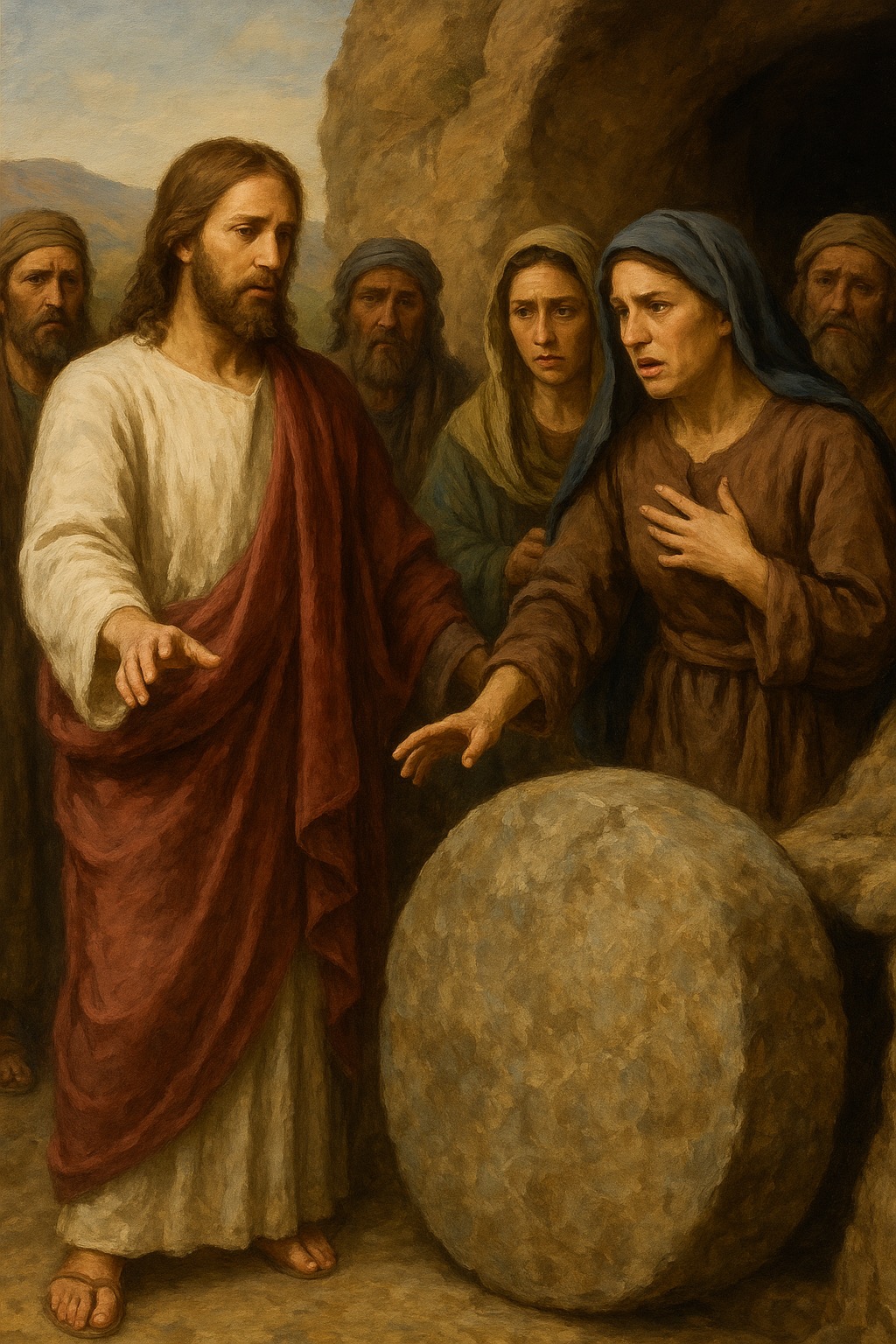
John 11:38-44
John 11:38-44 (NKJV)
38 Then Jesus, again groaning in Himself, came to the tomb. It was a cave, and a stone lay against it.
39 Jesus said, “Take away the stone.” Martha, the sister of him who was dead, said to Him, “Lord, by this time there is a stench, for he has been dead four days.”
40 Jesus said to her, “Did I not say to you that if you would believe you would see the glory of God?”
41 Then they took away the stone from the place where the dead man was lying. And Jesus lifted up His eyes and said, “Father, I thank You that You have heard Me.

42 And I know that You always hear Me, but because of the people who are standing by I said this, that they may believe that You sent Me.”
43 Now when He had said these things, He cried with a loud voice, “Lazarus, come forth!”
44 And he who had died came out bound hand and foot with graveclothes, and his face was wrapped with a cloth. Jesus said to them, “Loose him, and let him go.”
🧭 Observations
This passage is rich in movement, emotion, and meaning. Let’s look closely at what’s happening in the scene:
👥 Who is present?
- Jesus, standing near the tomb, deeply moved.
- Martha, Lazarus’s sister, speaking with Jesus.
- A crowd of people or mourners, standing by and watching.
- Lazarus, lying in the tomb, soon to rise.
- Possibly Mary and others who had followed.
📍 What is the setting?
- A tomb, described as a cave with a stone laid against it.
- Burial outside the city was common, and this stone tomb likely belonged to a family of some means.
🗣️ What is said and done?
- Jesus commands the stone be removed, but Martha hesitates, pointing out the stench—Lazarus has been dead four days.
- Jesus reminds her of His promise: belief leads to seeing the glory of God.
- He then prays publicly, thanking the Father—not for Himself—but for the crowd’s sake, so they might believe.
- With a loud voice, Jesus cries, “Lazarus, come forth!”
- Lazarus emerges from the tomb, bound in graveclothes—a visible proof of life returned.
- Jesus says, “Loose him, and let him go”—a command full of both physical and spiritual symbolism.
🔁 Repeated themes?
- The idea of hearing and believing runs through Jesus’ prayer and dialogue.
- The glory of God is central to the purpose of this miracle.
- Themes of death, resurrection, and release—literal and spiritual—shine through.
🕰️ Historical & Cultural Background
Understanding the cultural world of this scene brings even deeper meaning:
🪦 Tombs in the 1st Century
- Tombs were often caves carved into rock, sealed with a large round stone that could be rolled into place.
- This was typical for wealthier families, while the poor were buried in simple ground graves.
- The stone covering was essential to keep animals out and odors in.
🕊️ Four Days Dead
- In Jewish tradition, it was believed the soul lingered near the body for three days, hoping to re-enter.
- On the fourth day, all hope was lost—the soul was thought to depart, and decomposition had fully set in.
- Martha’s objection, “there is a stench,” confirms Lazarus was truly dead beyond question.
- Jesus chooses this moment to perform the miracle so that no one could deny its power. He raises someone whom all agreed was fully, irreversibly dead.
🧼 Burial Practices
- The dead were wrapped in linen strips with spices, a practice that slowed the odor and symbolized care.
- The face was wrapped separately with a cloth—this is mentioned when Lazarus comes forth.
- Lazarus emerging bound hand and foot is both vivid and real—he likely shuffled out, unable to move freely, until they unbound him at Jesus’ word.
🙏 Public Prayer
- Jesus didn’t need to speak aloud to be heard by God—but He prays openly so that the crowd might believe.
- This was common in Jewish custom: a public prayer was a way of testifying, bearing witness, and giving glory to God on behalf of others.
🧎 Mourning Practices
- The Jews practiced seven days of intense mourning called shivah.
- Friends, family, and even professional mourners would be present.
- This miracle wasn’t witnessed in private—it occurred in front of a crowd, adding to its impact.
🗝️ Key Word Studies — John 11:38–44
Here we’ll explore some of the most meaningful words in the passage, using Strong’s definitions to bring out the depth of what was written in Greek.
📌 “Groaning” (v. 38)
Greek word: ἐμβριμᾶσθαι (embrimaomai)
Strong’s #1690
- Meaning: To groan with deep emotion, to snort with anger or distress
- This word implies a powerful, inward storm of emotion—not casual sadness, but agitated grief, perhaps mixed with indignation.
- Jesus wasn’t untouched by the sorrow and disbelief around Him—He felt it deeply, possibly angered by death’s grip and people’s lack of faith. 😔
📌 “Take away the stone” (v. 39)
Greek verb: ἀρᾶτε (arate) from αἴρω (airō)
Strong’s #142
- To lift, remove, or bear away.
- It’s a command—and a step of faith. Jesus doesn’t remove the stone Himself, but calls others to do it. The miracle began with obedience to this instruction.
📌 “Glory” (v. 40)
Greek word: δόξα (doxa)
Strong’s #1391
- Means honor, splendor, brightness—but especially the revealed majesty of God.
- Jesus tells Martha she will see the glory of God—not just hear about it. Faith opens our eyes to divine beauty and power. ✨
📌 “Heard Me” (v. 41)
Greek word: ἤκουσάς (ēkousas)
Strong’s #191
- From akouō, to hear with the intent to respond.
- Jesus thanks the Father for already responding to Him—this is a prayer of confidence and union.
- He knows the Father always hears Him, but He speaks aloud for others to believe.
📌 “Come forth!” (v. 43)
Greek phrase: Δεῦρο ἔξω (Deuro exō)
Strong’s #1204 (Deuro) & #1854 (Exō)
- A direct and powerful call: “Here! Out!”
- There’s urgency and authority in Jesus’ words.
- With just a command, life returns. The voice of the Son of God pierces death itself. 🕊️
📌 “Loose him” (v. 44)
Greek word: Λύσατε (lysate) from λύω (lyō)
Strong’s #3089
- To release, untie, set free.
- Lazarus is alive, but still bound. Jesus commands others to help release him from the signs of death.
- A reminder: New life often still needs help being unbound. 💗
🔍 Theological Themes — John 11:38–44
This passage overflows with deep spiritual meaning. Here are the major theological themes that rise from the text like light through the tomb’s opening:
✨ 1. Jesus’ Power Over Death
- With just His voice, Jesus calls a dead man back to life.
- This miracle shows Jesus’ divine authority — not only over sickness, but over death itself.
- It foreshadows His own resurrection and teaches that death is not the end for those who believe (cf. John 11:25–26).
✨ 2. Faith Opens the Way to God’s Glory
- Jesus tells Martha, “Did I not say to you that if you would believe, you would see the glory of God?” (v. 40).
- Belief is not just mental agreement—it is trusting surrender that allows God to reveal His power in our lives.
- Faith removes the “stone” that hides God’s glory from our sight. ✨
✨ 3. Jesus as the Sent One
- Jesus prays aloud, saying, “that they may believe that You sent Me” (v. 42).
- This connects to the Gospel’s constant theme: Jesus is the one sent from the Father, the fulfillment of all the promises.
- Everything He does points back to the Father’s plan and authority (cf. John 5:30, John 6:29).
✨ 4. God’s Compassion and Grief
- Jesus is not detached. He groans deeply and is visibly moved (v. 38).
- God’s heart is not cold toward our sorrow—He is present with us in it.
- The cross wasn’t the only moment of Jesus’ suffering. He felt the weight of death and the brokenness of creation right here at the tomb.
✨ 5. New Life Still Needs Help
- When Lazarus comes forth, he is alive but still bound.
- Jesus says, “Loose him, and let him go.”
- This is a picture of what happens in spiritual rebirth—God gives life, but often others help unwrap the graveclothes of our old life.
- The church is called to participate in helping new believers walk in freedom. 💗
🔗 Old Testament Connections — John 11:38–44
📜 1. God as the Giver of Life
- Genesis 2:7 — “And the LORD God formed man of the dust of the ground, and breathed into his nostrils the breath of life; and man became a living being.”
➤ In Eden, God breathed life into man. In Bethany, Jesus speaks and life is restored to the dead.
➤ This mirrors God’s original act of creation—Jesus is showing that He holds the same life-giving power.
📜 2. Resurrection Promised
- Isaiah 26:19 — “Your dead shall live; Together with my dead body they shall arise. Awake and sing, you who dwell in dust!”
➤ The prophet Isaiah looked ahead to a time when the dead would rise in joy and victory.
➤ Lazarus’s rising gives a taste of this promise being fulfilled—not the final resurrection, but a signpost pointing toward it.
📜 3. The Stony Heart Removed
- Ezekiel 36:26 — “I will give you a new heart and put a new spirit within you; I will take the heart of stone out of your flesh…”
➤ The command to “Take away the stone” (John 11:39) is more than physical—it echoes the deeper truth that God removes barriers to life.
➤ Jesus not only opens tombs—He opens hearts.
📜 4. Valley of Dry Bones
- Ezekiel 37:5 — “Surely I will cause breath to enter into you, and you shall live.”
➤ In Ezekiel’s vision, God breathes life into lifeless bones, causing an entire valley of the dead to rise.
➤ Jesus’ voice calling “Lazarus, come forth!” is a real-world fulfillment of that prophetic vision—a preview of God’s resurrection power.
📜 5. The Glory of God Revealed
- Exodus 33:18–19 — Moses says, “Please, show me Your glory.” And God replies, “I will make all My goodness pass before you…”
➤ In raising Lazarus, Jesus answers the longing to see God’s glory.
➤ It is revealed not just in splendor, but in compassion, power, and life restored.
📜 6. Loosing the Captives
- Isaiah 61:1 — “The Spirit of the Lord GOD is upon Me… to proclaim liberty to the captives, and the opening of the prison to those who are bound.”
➤ Lazarus came out bound in graveclothes, and Jesus said, “Loose him, and let him go.”
➤ This mirrors the Messiah’s mission: to free people from the bonds of death, sin, and despair. 💔➡️💗
✨ Thoughtful Reflection Questions — John 11:38–44
These questions are meant to draw the story into your heart and help you reflect deeply on what God is showing through this moment:
💭 1. When Jesus groaned deeply at the tomb, what do you think He was feeling?
- Can you relate to that mix of grief, love, and even righteous anger?
💭 2. Jesus told Martha that if she believed, she would see the glory of God.
- Are there any “stones” in your life that He’s asking you to move so His glory can be revealed?
💭 3. Lazarus was raised from the dead, but still bound in graveclothes.
- What things from your “old life” still cling to you, even though you’re walking in new life?
💭 4. Jesus asked others to help unbind Lazarus.
- Who has helped you “unwrap” your spiritual graveclothes?
- Is there someone you know who needs help walking into freedom?
💭 5. Jesus thanked God out loud for the sake of the people standing by.
- When was the last time you prayed publicly—not for show, but so others might believe?
💭 6. Jesus called Lazarus by name.
- Do you believe He calls you by name, too?
- What might He be saying to you right now?
✅ References
📖 Scripture
- The Holy Bible, New King James Version. Thomas Nelson, 1982.
🔍 Strong’s Concordance
- Strong, James. Strong’s Exhaustive Concordance of the Bible. Hendrickson Publishers, 2007.
📚 Paid Print or Digital Books Used in This Post
- Tenney, Merrill C. John: The Gospel of Belief. Eerdmans Publishing, 1997. Available at Eerdmans.com or ChristianBook.com.
- Kostenberger, Andreas J. John (Baker Exegetical Commentary on the New Testament). Baker Academic, 2004. Available at BakerPublishingGroup.com or Logos.com.
🌐 Free Online Resources
- Blue Letter Bible. “John 11:38–44.” Accessed May 20, 2025. https://www.blueletterbible.org/nkjv/jhn/11/38.
- Bible Hub. “Greek Lexicon.” Accessed May 20, 2025. https://biblehub.com/lexicon.
🤖✨ Artificial Intelligence Assistance
ChatGPT. “✨Lazarus, Come Forth✨ — John 11:38–44.” OpenAI, 2025, https://chat.openai.com.
This post was prayerfully prepared in collaboration with ChatGPT 🤖, a research assistant designed to support deep, Christ-centered Bible study. All Scripture is taken from the New King James Version (NKJV), and supporting references include Strong’s Concordance, cultural background texts, and trusted Gospel study materials. May this work bring glory to God and encouragement to the hearts of those who read it. 🕊️💕
Leave a Reply