
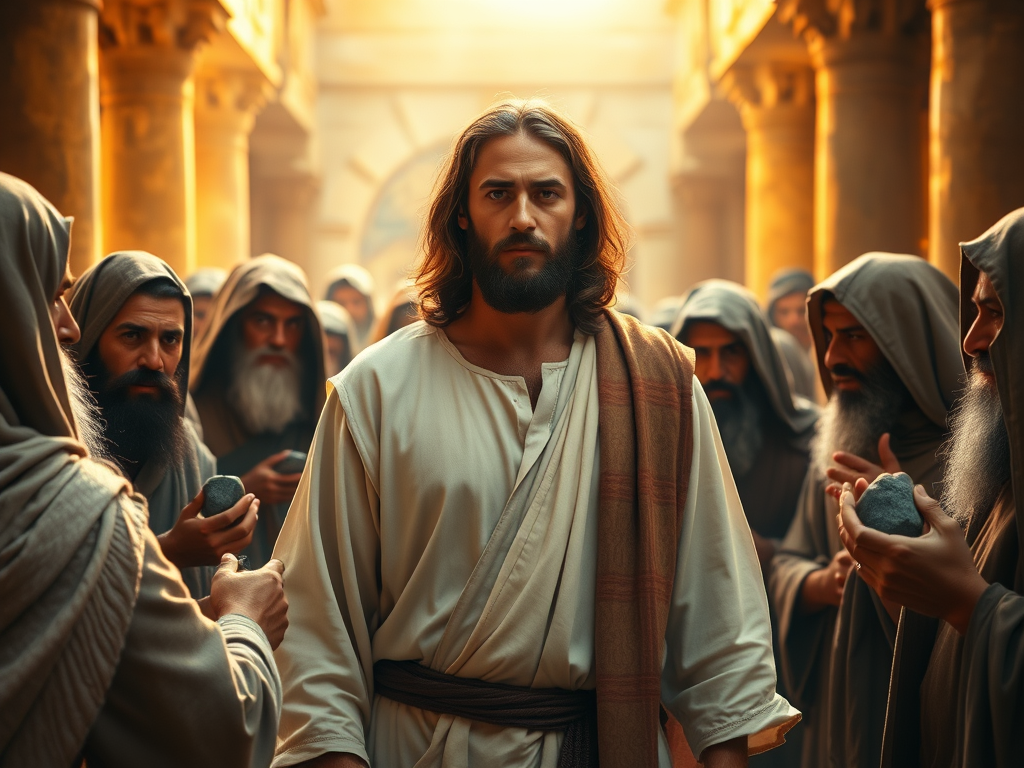
📖 John 10:22–42
This passage takes place during the Feast of Dedication (Hanukkah) in Jerusalem. It continues the confrontation between Jesus and the Jewish leaders—but now even more intense:
- The Jews demand a clear declaration: “If You are the Christ, tell us plainly.” (v. 24)
- Jesus reaffirms His unity with the Father: “I and My Father are one.” (v. 30)
- The response is immediate: they pick up stones to kill Him for blasphemy.
📚 Key Themes We Will Explore:
- Jesus as the consecrated Son sent by the Father
- The security of His sheep: “No one can snatch them out of My hand.” (v. 28)
- A direct claim to divine identity
- Quoting Psalm 82 as part of His defense
- A deep theological moment wrapped in historical and spiritual significance
📖 Scripture Reading (NKJV)
John 10:22-42 (NKJV) The Shepherd Knows His Sheep
22 Now it was the Feast of Dedication in Jerusalem, and it was winter.
23 And Jesus walked in the temple, in Solomon’s porch.
24 Then the Jews surrounded Him and said to Him, “How long do You keep us in doubt? If You are the Christ, tell us plainly.”
25 Jesus answered them, “I told you, and you do not believe. The works that I do in My Father’s name, they bear witness of Me.
26 But you do not believe, because you are not of My sheep, as I said to you.
27 My sheep hear My voice, and I know them, and they follow Me.
28 And I give them eternal life, and they shall never perish; neither shall anyone snatch them out of My hand.
29 My Father, who has given them to Me, is greater than all; and no one is able to snatch them out of My Father’s hand.
30 I and My Father are one.”
Renewed Efforts to Stone Jesus
31 Then the Jews took up stones again to stone Him.
32 Jesus answered them, “Many good works I have shown you from My Father. For which of those works do you stone Me?”
33 The Jews answered Him, saying, “For a good work we do not stone You, but for blasphemy, and because You, being a Man, make Yourself God.”
34 Jesus answered them, “Is it not written in your law, I said, “You are gods” ’?
35 If He called them gods, to whom the word of God came (and the Scripture cannot be broken),
36 do you say of Him whom the Father sanctified and sent into the world, ‘You are blaspheming,’ because I said, ‘I am the Son of God’?
37 If I do not do the works of My Father, do not believe Me;
38 but if I do, though you do not believe Me, believe the works, that you may know and believe that the Father is in Me, and I in Him.”
39 Therefore they sought again to seize Him, but He escaped out of their hand.
The Believers Beyond Jordan
40 And He went away again beyond the Jordan to the place where John was baptizing at first, and there He stayed.
41 Then many came to Him and said, “John performed no sign, but all the things that John spoke about this Man were true.”
42 And many believed in Him there.
🕰️ Historical and Cultural Background
When and Where Did This Take Place?
🕯️ This moment happens during the Feast of Dedication (Hanukkah)—a winter celebration that commemorated the rededication of the temple after it had been defiled by foreign powers (see 1 Maccabees for historical context). It was a time of national memory, spiritual identity, and renewed hope.

Jesus is walking in the temple at Solomon’s Porch—also known as the Portico of Solomon—a colonnaded walkway that lined the eastern side of the outer court. While this part of the temple complex had been rebuilt during Herod’s time, it still carried the symbolic weight of Solomon’s legacy and Israel’s history.
📚 “Solomon’s Porch” refers to the raised outermost part of Herod’s temple with columns all around the outer court. It was often a gathering place for teaching and public dialogue (cf. Acts 3:11).
(Holman Illustrated Bible Dictionary, p. 1516)
🌬️ It was winter, and the tone of this moment is cold—not just in season, but in spirit. The religious leaders surround Jesus, not with curiosity, but with hostility. Yet even in the chill, the light of the world is walking in the temple, offering eternal truth.
🧭 Observational Insights
🧍♂️ Who Is Present in This Passage?
- Jesus — teaching boldly in the temple
- The Jews (religious leaders) — surrounding Him with a challenging spirit
- People beyond the Jordan — who believed later (v. 40–42)
- Possibly the formerly blind man and his parents — still lingering from the prior interaction
🗣️ Who Speaks?
- Jesus
- The Jews (challenging and accusing)
👂 Who Listens?
While Jesus speaks, most of the religious leaders do not truly hear.
“You do not believe, because you are not of My sheep.” (v. 26)
Only those who later come to Him beyond the Jordan truly listen—and believe (v. 42).
🔄 Who Changes?
There’s no change in the hearts of the temple crowd. In fact, the hostility intensifies.
But those who had been present with John—they believe.
“Many came to Him… and many believed in Him there.” (v. 41–42)
These are the ones whose hearts were already stirred by truth – and now they believed.
🔁 What Words or Phrases Are Repeated or Emphasized?
- “Believe” – appears again and again
- “Works” – Jesus points to His actions as proof of His identity
- “Father” – a central theme of oneness and divine origin
- “Sheep” – connects this directly to the earlier Good Shepherd teaching
- “Stone/stoning” – echoes past rejection (see John 8:59)
🔥 What Conflict or Tension Is Unfolding?
The Jews surround Jesus in Solomon’s Porch—not with warmth, but with challenge:

“If You are the Christ, tell us plainly.” (v. 24)
Jesus responds clearly—but it leads not to belief, but accusation and attempted violence:
“For blasphemy… because You, being a Man, make Yourself God.” (v. 33)
This moment reveals a deep blindness in the very place where light should be understood.
💬 What Statement or Moment Stirred My Heart the Most?
“Can you not see My works?” (v. 25, paraphrased)
And especially:
“No one is able to snatch them out of My Father’s hand.” (v. 29)
These words remind us that belief is not built on argument—but on recognizing the works and heart of God in Jesus. They also give us great security and peace.
🔗 How Does This Section Connect to What Came Before?
This is a direct continuation of the Good Shepherd teaching. Jesus is still standing in the same temple court, and His words build on what He just said:
- “My sheep hear My voice…” (v. 27) repeats His earlier message (v. 14)
- He again speaks of knowing, giving life, and protection
- The rejection in chapter 10 parallels the stoning attempt in John 8:59
This is not a new moment—it is the crescendo of the story that began with the blind man’s healing in John 9.
📋 Gospel Harmony
🔎 Does This Scene Appear in the Other Gospels?
No direct parallel to this event is found in Matthew, Mark, or Luke. This moment—Jesus walking in the temple during the Feast of Dedication, and declaring His unity with the Father—is unique to John’s Gospel.
🔁 However, similar themes appear elsewhere:
| 📖 Reference | Summary | Shared Theme |
|---|---|---|
| Matthew 26:63–65 | At His trial, Jesus says He is the Son of God. The high priest tears his robes and accuses Him of blasphemy. | Divinity claimed → Blasphemy charged |
| Mark 14:61–64 | Jesus again claims divine identity before the Sanhedrin and is condemned for blasphemy. | Direct accusation like John 10:33 |
| Luke 22:67–71 | When asked if He is the Christ, Jesus affirms it, and the council says, “What further testimony do we need?” | Hostile questioning of Jesus’ identity |
✨ John’s Emphasis Compared to the Synoptics
While the Synoptics often highlight Jesus’ claims to divinity later, during His trial, John’s Gospel brings it front and center during His public ministry.
- John’s Gospel shows us that Jesus was not misunderstood—He knew exactly what He was saying, and so did His listeners:“You, being a Man, make Yourself God.” (v. 33)
- This confrontation happens not at Jesus’ trial, but in the open courts of the temple, during a feast that commemorated the rededication of the temple itself.
📜 The Temple is being rededicated, and the true Temple—Jesus—is being rejected.
🕰️ Historical and Scriptural Note — Psalm 82 in John 10:34
📖 What did Jesus say?
“Is it not written in your law, ‘I said, “You are gods”’?”
(John 10:34, quoting Psalm 82:6)
This is one of the most controversial and striking defenses Jesus gives in all of Scripture. Let’s understand what it means.
📜 What is Psalm 82?
Psalm 82 is a short but strong psalm where God rebukes unjust judges—called “gods” because they held earthly authority that reflected divine judgment.
Psalm 82:6–7 (NKJV):
“I said, ‘You are gods, and all of you are children of the Most High. But you shall die like men, and fall like one of the princes.’”
These were human rulers, possibly Israel’s judges or kings, who had been given authority from God, but had misused it. God calls them “gods” not because they were divine, but because they stood in a representative role.
✡️ How was this understood in Jewish thought?
- In Jewish tradition, leaders could sometimes be called “gods” (Hebrew: elohim) when acting on God’s behalf (cf. Exodus 21:6, Exodus 22:8–9).
- But they were always human, flawed, and held accountable.
So Jesus reminds the religious leaders that their own Scriptures used the term “gods” for lesser, mortal beings—and yet they now accuse Him of blasphemy for claiming to be the Son of God.
✨ Why does Jesus use this defense?
Jesus is not saying humans are divine. Rather, He’s:
- Refuting their charge of blasphemy using their own Scriptures
- Showing that if even fallen rulers were called “gods,” how much more can the One sanctified and sent by the Father rightfully call Himself the Son of God?
This is a masterful rabbinical argument:
If your own law gives that title to flawed men… why do you accuse Me of blasphemy for speaking the truth of who I am—One sent from heaven and doing the works of My Father?
🕊️ What does this teach us about Jesus?
It shows that:
- He knew the Scriptures perfectly
- He engaged hearts with truth and mercy—even when met with hardness
- And most of all… He was not afraid to claim His identity boldly, even under threat
He is not a god, like those earthly judges.
He is God’s Son, sanctified, sent, and One with the Father.
🗝️ Key Word Studies

✨ 1. Believe
(Greek: πιστεύω – pisteuō)
“You do not believe, because you are not of My sheep.” (v. 26)
“Believe the works, that you may know and believe…” (v. 38)
- Strong’s Number: G4100
- Meaning: To trust in, rely upon, to have faith
- Used in: John 3:16, John 11:25–26
🕯️ Insight:
This isn’t about intellectual agreement—it’s about placing your heart’s trust in Jesus. It’s active, personal faith that hears His voice and follows.
✨ 2. Blasphemy
(Greek: βλασφημία – blasphēmia)
“…for blasphemy, because You, being a Man, make Yourself God.” (v. 33)
- Strong’s Number: G988
- Meaning: Speech that slanders or mocks God’s holiness; claiming divine rights falsely
- Used in: Matthew 12:31, Revelation 13:6
🕯️ Insight:
They accuse Jesus of the highest offense possible—but ironically, the only one who has ever had the right to call Himself God is standing before them in humility and truth.
✨ 3. One (Greek: ἕν – hen)
“I and My Father are one.” (v. 30)
- Strong’s Number: G1520
- Meaning: One in essence or unity (not the same person, but same nature)
- Used in: John 17:21–23 (Jesus prays His followers would be one)
🕯️ Insight:
This is one of the clearest statements of divine unity in Scripture. Jesus isn’t saying He and the Father are the same person—but that they are united in nature, purpose, and power.
✨ 4. Works (Greek: ἔργα – erga)
“The works that I do in My Father’s name…” (v. 25)
“Believe the works…” (v. 38)
- Strong’s Number: G2041
- Meaning: Deeds, acts, miracles; visible signs of divine origin
- Used in: John 5:36, Matthew 5:16
🕯️ Insight:
Jesus invites belief not in empty words, but in living proof—His miracles, mercy, and divine power are all witnesses of who He is.
✨ 5. Sanctified (Greek: ἁγιάζω – hagiazō)
“…Him whom the Father sanctified and sent into the world…” (v. 36)
- Strong’s Number: G37
- Meaning: To set apart for holy purpose; to dedicate
- Used in: John 17:17, 1 Thessalonians 5:23
🕯️ Insight:
Jesus is not just any man—He was set apart, chosen, and anointed for the purpose of revealing the Father and redeeming the world.
🔍 Theological Themes
✨ 1. Jesus Boldly Declares His Divine Identity

Jesus doesn’t hint or whisper—He states clearly that He and the Father share unity. This is one of the strongest statements of divinity in the Gospels.
“I and My Father are one.” (v. 30)
🕯️ Theological Truth:
Jesus is not merely a prophet or good teacher—He is God in the flesh, one in essence with the Father. Belief in Him is belief in the very heart of God.
✨ 2. Unbelief Is Not About Evidence—It’s About the Heart
“I told you, and you do not believe.” (v. 25)
Despite His miracles and words, the religious leaders still reject Him—not because of lack of proof, but because of spiritual resistance.
🕯️ Theological Truth:
Faith is not just seeing signs—it’s hearing the Shepherd’s voice and responding with trust. Unbelief often stems from pride, fear, or refusal to surrender.
✨ 3. True Believers Are Held Securely by God

“No one is able to snatch them out of My Father’s hand.” (v. 29)
Jesus gives eternal life to His sheep, and no one—no circumstance, no enemy—can remove them from His care.
🕯️ Theological Truth:
Salvation is not fragile. It is upheld by the power and faithfulness of God. The Good Shepherd both calls and keeps His flock.
✨ 4. Jesus Is the Sanctified and Sent Son
“…whom the Father sanctified and sent into the world…” (v. 36)
Jesus was set apart by God and entered the world with a holy mission—to reveal the Father, to confront falsehood, and to save His sheep.
🕯️ Theological Truth:
Jesus is the Holy One, fully God and fully man, sent to bring light into the temple courts of human hearts.
✨ 5. The Word of God Cannot Be Broken
“…and the Scripture cannot be broken…” (v. 35)
Even in defense, Jesus appeals to the authority of the Scriptures—demonstrating their weight and permanence.
🕯️ Theological Truth:
Jesus honors the Word of God as unchangeable and binding. His teaching is not against the Law, but the fulfillment and clarification of it.
🔗 Old Testament Connections
🕎 1. The Feast of Dedication (Hanukkah)
“Now it was the Feast of Dedication in Jerusalem, and it was winter.” (v. 22)
🕯️ Background:
This feast commemorates the rededication of the temple after it was defiled by Antiochus IV Epiphanes during the second century BC. It’s not one of the original feasts from the Law of Moses, but it became deeply symbolic for Jewish identity, temple purity, and national hope.
✨ Connection to Jesus:
- He is walking in the temple during a feast about cleansing and consecration—yet He Himself is the true, holy Temple (cf. John 2:19).
- As the physical temple is remembered, the living Temple is being rejected by its own people.
📜 2. Psalm 82 — “You Are Gods”
“Is it not written in your law, ‘I said, “You are gods”’?” (v. 34)
🕯️ Background:
Psalm 82 rebukes Israel’s human judges—called “gods” (elohim) because they held delegated authority from God. Yet they were corrupt, and God declared they would “die like men.”
✨ Connection to Jesus:
- Jesus quotes this psalm to turn their accusation around.
- If flawed humans can be called “gods” when acting in God’s name, how much more rightly can He—who is truly sanctified and sent by the Father—call Himself the Son of God?
🐑 3. The Ongoing Shepherd Theme (Psalm 23, Ezekiel 34)
While not quoted directly in this section, the language of sheep, voice, and belonging continues the earlier theme from John 10:1–21.
🕯️ Psalm 23:
“The Lord is my Shepherd…”
🕯️ Ezekiel 34:
“I Myself will search for My sheep and seek them out… I will establish one Shepherd over them.”
✨ Connection to Jesus:
These prophecies paint the portrait Jesus now embodies:
- Divine care for the sheep
- Protection from enemies
- God’s own Shepherd coming to guide and gather
Jesus is the fulfillment of all the Shepherd imagery Israel knew—and yet He is being rejected as a stranger.
🌍 4. Messianic Expectation and Rejection (Isaiah 53, Zechariah 11)
“The Jews took up stones again to stone Him.” (v. 31)
“…You, being a Man, make Yourself God.” (v. 33)
🕯️ Isaiah 53:
“He was despised and rejected by men… we esteemed Him stricken.”
🕯️ Zechariah 11:12–13:
“They weighed out for my wages thirty pieces of silver.”
✨ Connection to Jesus:
The very Messiah they longed for is standing in their midst—and they do not know Him. Their reaction fulfills prophecy: rejection, false accusation, and eventual death by betrayal.
✨ Thoughtful Reflection Questions

💭 1. Do I believe because of what I’ve seen—or because I trust the Shepherd’s voice?
Jesus said, “You do not believe, because you are not of My sheep.”
Do I listen for His voice daily? Or do I wait for signs and proof instead of resting in trust?
💭 2. What keeps me from truly hearing Jesus when He speaks?
Is it pride? Fear? Distraction?
Are there areas in my life where I resist His voice because it calls me to surrender or change?
💭 3. When I feel afraid, do I remember that I cannot be snatched from His hand?
Jesus promised, “No one is able to snatch them out of My Father’s hand.”
How might my anxiety or grief shift if I remembered that I am held, always?
💭 4. Have I ever misunderstood Jesus—like the religious leaders did?
Have I ever limited who I thought He was, or tried to fit Him into my expectations?
Am I willing to let Scripture reshape what I think I know?
💭 5. What does it mean to me that Jesus and the Father are one?
Does that truth move my heart to worship?
Do I trust that everything Jesus does flows from the Father’s perfect love?
✅ References
📖 Scripture
The Holy Bible, New King James Version. Thomas Nelson, 1982.
🌐 Free Online Resources Used in This Post
- Bible Gateway. “John 10:22–42 NKJV.” https://www.biblegateway.com/passage/?search=John+10%3A22-42&version=NKJV
- Blue Letter Bible. “Greek Lexicon Tools and Interlinear for John 10.” https://www.blueletterbible.org
- Bible Hub. “Commentaries on John 10.” https://biblehub.com/commentaries/john/10-22.htm
- OpenBible.info. “Topical Bible: Blasphemy.” https://www.openbible.info/topics/blasphemy
- Biblical Archaeology Society. “Hanukkah and the Feast of Dedication.” https://www.biblicalarchaeology.org
📚 Paid Print or Digital Books Used in This Post
- Strong, James. Strong’s Exhaustive Concordance of the Bible. Hendrickson Publishers, 2007.Available at Christianbook.com and Amazon.com
- Barclay, William. The Gospel of John. Westminster John Knox Press, 2001.Available at WestminsterJohnKnoxPress.com and Amazon.com
- Dods, Marcus. The Gospel of St. John: The Expositor’s Greek Testament. Vol. 1. London: Hodder and Stoughton, 1897.Reprint editions available at Logos.com, Amazon.com, and Archive.org (free public domain edition)
- Brand, Chad, ed. Holman Illustrated Bible Dictionary. B&H Publishing Group, 2003.Available at Lifeway.com and Amazon.com
🤖 Artificial Intelligence Assistance
ChatGPT. “Teach Me, Lord — John 10:22–42.” OpenAI, 2025, https://chat.openai.com.
This post was prayerfully prepared in collaboration with ChatGPT, a research assistant designed to support deep, Christ-centered Bible study. All Scripture is taken from the New King James Version (NKJV), and supporting references include Strong’s Concordance, cultural background texts, and trusted theological sources. May this work bring glory to God and clarity to every reader. 🕊️
Leave a Reply