
John 9:35–41
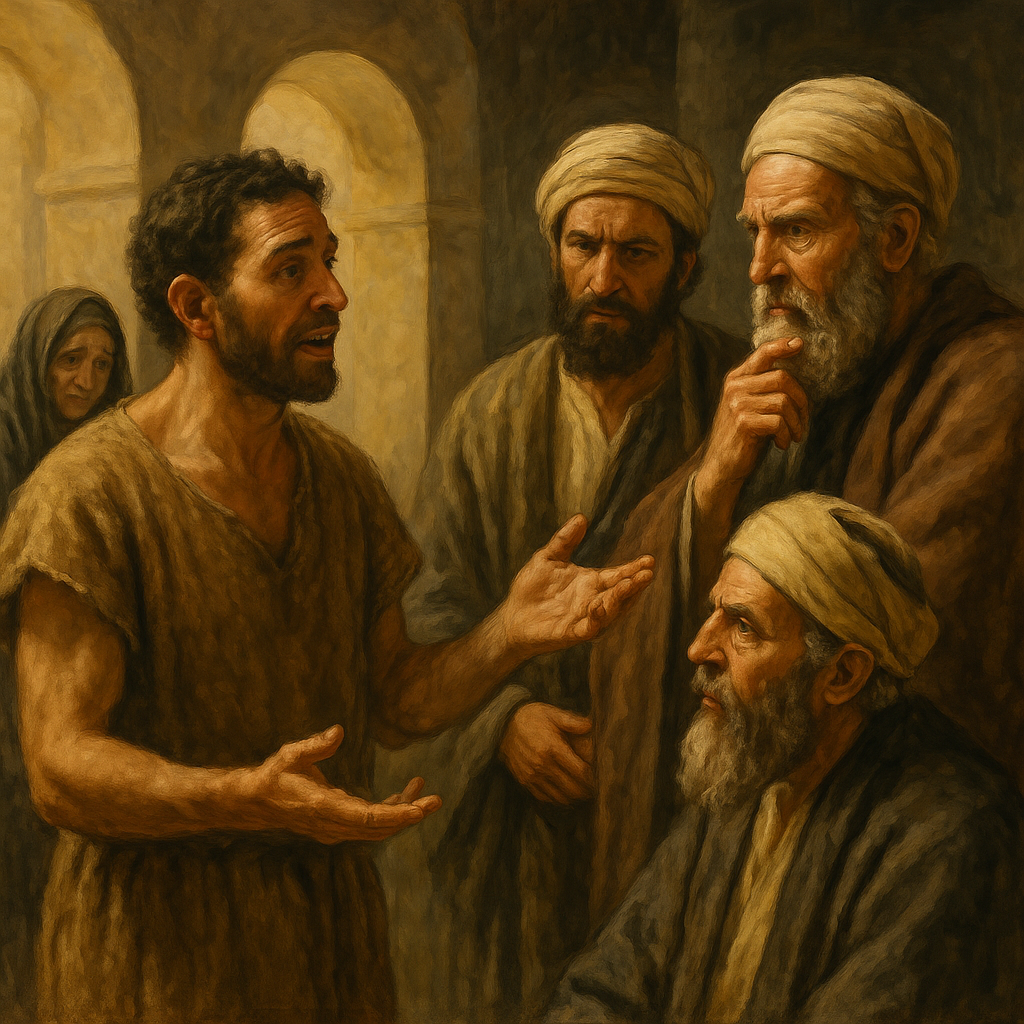
This passage is the climax of the entire healing narrative. The man who was once blind not only receives his sight, but now comes face to face with the One who healed him—and he responds with worship. Meanwhile, the Pharisees are confronted with their own blindness.
35 Jesus heard that they had cast him out; and when He had found him, He said to him,
“Do you believe in the Son of God?”
36 He answered and said,
“Who is He, Lord, that I may believe in Him?”
37 And Jesus said to him,
“You have both seen Him and it is He who is talking with you.”
38 Then he said,
“Lord, I believe!”
And he worshiped Him.
39 And Jesus said,
“For judgment I have come into this world, that those who do not see may see, and that those who see may be made blind.”
40 Then some of the Pharisees who were with Him heard these words, and said to Him,
“Are we blind also?”
41 Jesus said to them,
“If you were blind, you would have no sin; but now you say, ‘We see.’ Therefore your sin remains.”
This passage moves from physical healing to spiritual worship—and from bold faith to a direct confrontation with hardened hearts.
🧍♂️ Who Is Present in This Passage?
This final portion of the chapter centers on Jesus, the formerly blind man, and a few listening Pharisees.
Jesus and the man speak.
The man listens—and he changes.
This man, who began the day blind and rejected, now ends it worshiping the Son of God. His heart has been opened not just to healing, but to faith.
🗣️ What Words or Phrases Stand Out?
- “May see”
- “Made blind”
Jesus uses the language of sight and blindness to reveal spiritual truth. These are not just physical descriptions—they describe the heart’s condition.
Turning Point:
“But now you say, ‘We see.’ Therefore your sin remains.” (v. 41)
This line pierces. It reveals that pride in one’s own understanding can blind a person more than physical darkness ever could.
👁️ What Spiritual Contrast Is Being Drawn?
Sight vs. blindness becomes a symbol for humility vs. rejection.
Those who humbly admit their need are given sight.
Those who say “We see”—as if they need nothing—are left in judgment.
Jesus uses this metaphor to show that the real blindness is spiritual pride.
💬 What Stirred My Heart Most?
“Lord, I believe.” (v. 38)
This moment moved me deeply—
Just because Jesus said so.
There were no long explanations or arguments. Just a moment of holy recognition.
The man didn’t need more signs—he believed simply because he had heard Jesus.
Faith doesn’t always need proof. Sometimes, it just needs a voice.
🔦 How This Passage Resolves the Story
In John 9:1, we met a man born blind.
By John 9:38, that same man is bowed in worship before the Son of God.
His sight has gone from:
- Physical
- To relational
- To spiritual
Jesus, the One who gives light, becomes his Lord.
And for those who insist they already “see,” Jesus speaks a warning:
“Your sin remains.”
He is both Judge and Savior—and in this story, both roles are revealed with gentleness, clarity, and holy purpose.
🔍 Theological Themes
🌟 1. True Faith Responds to the Voice of Jesus
“Lord, I believe.” (v. 38)
The man didn’t need a miracle this time. He simply heard Jesus’ voice and responded in faith.
His journey through suffering led to something far greater than sight—worship.
👁️ 2. Physical Sight Is a Gift—But Spiritual Sight Is Salvation
Jesus opened the man’s eyes twice:
- First to the world around him
- Then to the truth before him
Seeing Jesus clearly meant more than having good eyes. It meant recognizing Him as Lord.
⚖️ 3. Pride in Our Own Understanding Leads to Judgment
“But now you say, ‘We see.’ Therefore your sin remains.” (v. 41)
The Pharisees refused to see their need.
Spiritual blindness isn’t always about ignorance—it’s often about refusing to be taught.
Jesus warns that self-righteousness keeps the heart blind, even while the eyes seem open.
🕊️ 4. Jesus Seeks Out the Rejected
“When He had found him…” (v. 35)
Jesus went looking for the man after he was cast out.
Our Lord is not passive—He pursues those pushed aside by the world.
He is both the Light and the Shepherd, seeking the one who was once in darkness.
🔗 Old Testament Connections
“You have both seen Him, and it is He who is talking with you.”
📜 1. The Messiah Would Give Sight to the Blind
“That those who do not see may see…” (v. 39)
➡️ Isaiah 42:6–7
“I… will give You as a covenant to the people… to open blind eyes.”
➡️ Isaiah 35:5–6
“Then the eyes of the blind shall be opened, and the ears of the deaf shall be unstopped.”
Jesus is fulfilling this prophetic mission: He is the Servant of the Lord, opening both physical and spiritual eyes.
🕯️ 2. Worship Is Reserved for God Alone
“And he worshiped Him.” (v. 38)
➡️ Exodus 34:14
“You shall worship no other god, for the LORD, whose name is Jealous, is a jealous God.”
➡️ Psalm 95:6
“Oh come, let us worship and bow down; let us kneel before the LORD our Maker.”
The man’s act of worship is no small gesture—this is proof of Jesus’ divinity.
Jesus receives worship, not just honor. He doesn’t correct the man, as angels or prophets always did—because He is worthy.
🪨 3. Moses Prophesied of a Greater Prophet
“We are Moses’ disciples.” (v. 28)
➡️ Deuteronomy 18:15
“The LORD your God will raise up for you a Prophet like me… Him you shall hear.”
The Pharisees claim Moses, but Moses pointed to One greater—Jesus.
By rejecting Jesus, they reveal they never truly followed Moses at all.
🧠 4. Blindness as a Metaphor for Spiritual Hardness
“Are we blind also?” (v. 40)
➡️ Isaiah 6:9–10
“Hearing you will hear and not understand… make the heart of this people dull.”
➡️ Deuteronomy 29:4
“Yet the LORD has not given you a heart to perceive and eyes to see…”
The blindness Jesus refers to is spiritual refusal—those who could see, but won’t.
It’s not about lack of knowledge—it’s about lack of humility.
✨ Thoughtful Reflection Questions
💭 1. Has Jesus ever found me in a moment when I felt cast out?
Jesus sought the man after he was rejected.
Can I recall a time when the Lord came close after others pushed me away?
💭 2. Am I ready to believe simply because He says so?
The man believed without needing another sign.
Do I trust Jesus’ voice even when I don’t have all the answers?
💭 3. In what ways might I be spiritually blind?
Jesus warned that those who think they see may be the most blind.
Is there an area of my life where I’m relying on my own understanding instead of seeking God’s?
💭 4. When was the last time I worshiped Jesus in response to what He’s done?
The man worshiped Jesus the moment he realized who He truly was.
How can I return to a posture of awe and gratitude in worship today?
💭 5. Do I welcome truth—even when it confronts me?
Jesus didn’t shy away from speaking hard truth to the Pharisees.
Am I soft-hearted enough to receive correction, or do I close my eyes to the light?
✅ References — John 9:35–41
📖 Scripture
The Holy Bible, New King James Version. Thomas Nelson, 1982.
🌐 Free Online Resources Used in this Post
- Bible Gateway. “John 9:35–41 NKJV.” https://www.biblegateway.com
- Blue Letter Bible. “Greek Lexicon Tools and Interlinear for John 9.” https://www.blueletterbible.org
- Bible Hub. “Commentaries on John 9.” https://biblehub.com/commentaries/john/9-35.htm
- OpenBible.info. “Topical Bible: Blindness.” https://www.openbible.info/topics/blindness
- Biblical Archaeology Society. “Worship Practices in First Century Judaism.” https://www.biblicalarchaeology.org
📚 Paid Print or Digital Books Used in this Post
- Strong, James. Strong’s Exhaustive Concordance of the Bible. Hendrickson Publishers, 2007.
- Barclay, William. The Gospel of John. Westminster John Knox Press, 2001.
- Dods, Marcus. The Gospel of St. John: The Expositor’s Greek Testament. Vol. 1. London: Hodder and Stoughton, 1897.
🤖 Artificial Intelligence Assistance
ChatGPT. “Teach Me, Lord — John 9:35–41.” OpenAI, 2025, https://chat.openai.com.
This post was prayerfully prepared in collaboration with ChatGPT, a research assistant designed to support deep, Christ-centered Bible study. All Scripture is taken from the New King James Version (NKJV), and supporting references include Strong’s Concordance, cultural background texts, and trusted theological sources. May this work bring glory to God and clarity to every reader. 🕊️
Leave a Reply