
🕊️ Let’s step into study with gentle hearts and open scrolls.
John 9:1-12 (NKJV)
1 Now as Jesus passed by, He saw a man who was blind from birth,
2 And His disciples asked Him, saying, “Rabbi, who sinned, this man or his parents, that he was born blind?”
3 Jesus answered, “Neither this man nor his parents sinned, but that the works of God should be revealed in him.
4 I must work the works of Him who sent Me while it is day; the night is coming when no one can work.
5 As long as I am in the world, I am the light of the world.”
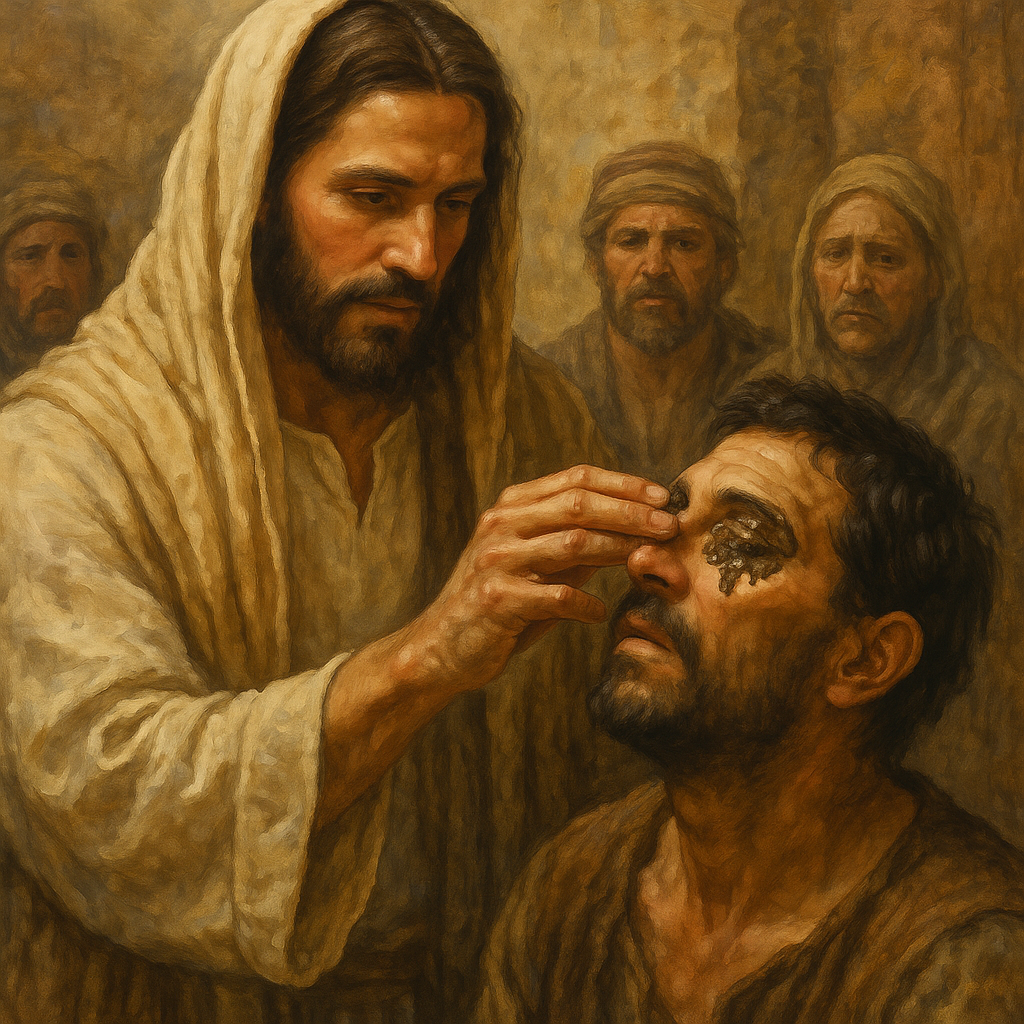
6 When He had said these things, He spat on the ground and made clay with the saliva; and He anointed the eyes of the blind man with the clay.
7 And He said to him, “Go, wash in the pool of Siloam” (which is translated, Sent). So he went and washed, and came back seeing.
8 Therefore the neighbors and those who previously had seen that he was blind said, “Is not this he who sat and begged?”
9 Some said, “This is he.” Others said, “He is like him.”
10 Therefore they said to him, “How were your eyes opened?”
11 He answered and said, “A Man called Jesus made clay and anointed my eyes and said to me, ‘Go to the pool of Siloam and wash.’ So I went and washed, and I received my sight.”
12 Then they said to him, “Where is He?” He said, “I do not know.”
📚 Gospel Parallel Table for John 9:1–12
| Gospel | Passage | Summary |
|---|---|---|
| John | 9:1–12 | Jesus heals a man born blind using clay and sends him to wash in the Pool of Siloam. The miracle sparks wonder and debate. |
| Matthew | 9:27–31 | Jesus heals two blind men by touching their eyes after they cry out, “Son of David.” |
| Mark | 8:22–26 | Jesus heals a blind man in Bethsaida in stages—first partial sight, then full. |
| Luke | 18:35–43 | Jesus heals a blind beggar near Jericho who cries out persistently for mercy. |
🌟 What This Tells Us:
- John is the only Gospel to record a healing of a man born blind (emphasizing creation and light themes)
- John often records miracles that are signs pointing to who Jesus is (John 20:31)
- The mud and washing imagery reflects deep symbolism and obedience unique to John’s style
🕰️ Historical and Cultural Background
📌 Blindness and the Assumption of Sin (v. 2)
“Who sinned, this man or his parents?”
💡 Background Insight:
- In first-century Jewish culture, physical suffering (like blindness) was often believed to be the result of personal or inherited sin.
- This belief likely stemmed from misapplied readings of passages like Exodus 20:5 (“visiting the iniquity of the fathers upon the children”).
- But Ezekiel 18:20 and Job strongly refute this idea—teaching that individuals are responsible for their own sin.
Five insightful possibilities that reflect actual beliefs held in first-century Judaism, drawn from Marcus Dods, The Gospel of St. John (1897):
- Belief in the Pre-existence of Souls: Some Jews thought that souls existed before birth and could sin in that preexistent state. This belief may have had roots in early mystical or Greek-influenced Jewish thought.
- Reincarnation Beliefs: While not mainstream in Jewish doctrine, some fringe groups (possibly influenced by pagan ideas) entertained the thought that a person might return in another life—and suffer for past sins.
- Sin in the Womb: Based on verses like Genesis 25:22 and Psalm 51:5, some rabbis believed a fetus could sin in utero.
- Punishment for Future Sins: There was a view that God might strike someone now for sins they were destined to commit—though this idea borders on fatalism and lacks strong Scriptural support.
- An Unthinking Question from Confusion: Sometimes people ask questions that reveal more about their confusion than their theology. The disciples might have just been trying to make sense of suffering in a broken world.
🕊️ Reflection:
This rich background helps us understand that the disciples’ question was not random—it came from real-world theological assumptions, even if they were flawed.
And Jesus responds not with condemnation, but by redirecting their attention to God’s purpose:
“…that the works of God should be revealed in him.” (John 9:3)
🗝️ Key Word Studies
🌑 1. “Blind” — Greek: τυφλός (typhlos)
- Strong’s #5185
- Meaning: blind (physically or spiritually); unable to see
- Often used metaphorically in the NT to describe spiritual blindness (e.g., Matthew 15:14, Revelation 3:17)
💡 Insight: John always uses physical healing to teach spiritual truth. The man’s physical blindness mirrors the spiritual blindness of others in the chapter.
🌊 2. “Sent” — Greek (Siloam): Σιλωάμ / from ἀποστέλλω (apostellō)
- Strong’s #649
- Meaning: to send on a mission, to commission, to send forth with authority
- Root of “apostle”
💡 Insight: Jesus sends the man to Siloam, which means “Sent”. Symbolically, Jesus (the One Sent from the Father) sends the man to a place called Sent, showing that healing and obedience go together—and that the man’s faith is active.
🧼 3. “Wash” — Greek: νίπτω (niptō)
- Strong’s #3538
- Meaning: to wash part of the body (hands, feet, or face)
- Different than louō, which means full-body cleansing
💡 Insight: This word appears again in John 13:5 when Jesus washes the disciples’ feet. Both stories show humble acts of obedience leading to cleansing and revelation.
💡 4. “Light” – Greek: φῶς (phōs) / φωστήρ (phōstēr)
- Strong’s Number: G5457 (phōs) and G5458 (phōstēr)
- Meaning: light, brightness; metaphorically: truth, understanding, or divine presence
- Related Verbs: phaneróō (to bring to light), photízō (to enlighten), lampō (to shine)
🔍 Scriptural Usage of “Light” (Beyond the Physical)
| Verse | Reference | Theme |
|---|---|---|
| 1 Timothy 6:16 | God dwells in unapproachable light | God’s glory and holiness |
| 1 John 1:5 | God is light, and in Him is no darkness | Nature of God as morally pure |
| James 1:17 | Father of lights, with no variation | God’s goodness and constancy |
| Psalm 4:6 | “LORD, lift up the light of Your countenance” | Favor and blessing from God |
| Job 29:24 | Light from the face of a respected leader | Influence and encouragement |
🌿 Spiritual Insight
- Light isn’t just physical brightness in the Bible—it represents:
- Truth that overcomes confusion
- Hope that dispels despair
- Divine purpose that gives meaning to existence
- In John 9, Jesus says:“As long as I am in the world, I am the light of the world.” (v. 5)
This is more than metaphor—it’s a statement of identity. He is the source of understanding, the one who makes sense of suffering, and the one who restores what has never worked before (as in the man born blind).
💡 “Light” is about **more than illumination—it’s about meaning.
🔍 Theological Themes
✨ 1. God works through suffering—not in spite of it, but through it
“…that the works of God should be revealed in him.” (v. 3)
God does not waste our suffering. Even affliction from birth can be used as a stage for His glory. This teaches us about God’s sovereign purpose and redemptive power.
🌞 2. Jesus is the Light of the World—both physically and spiritually
“I am the light of the world.” (v. 5)
Jesus illuminates more than the man’s vision—He brings meaning, clarity, and hope. His light gives sight to the soul, not just the eyes.
🧎♂️ 3. Obedience is part of the healing process
“Go, wash… so he went and washed, and came back seeing.” (v. 7)
Jesus could have healed the man instantly—but He involved the man in the process. Faith and obedience often work hand in hand in experiencing God’s blessings.
🕊️ 4. Faith often leads to confusion in others
“Is this not he who sat and begged?” (v. 8)
When God transforms someone, the people around them may doubt, question, or even dismiss the change. Spiritual transformation is undeniable, yet it causes a stir.
✉️ 5. Being “Sent” Is About Trust, Not Just Tasks
“Go, wash in the pool of Siloam” (which is translated, Sent). So he went and washed, and came back seeing.” (v. 7)
The pool’s name—Siloam (Sent)—reminds us that God’s commands are never random.
Jesus doesn’t just send the man to wash as a ritual—He sends him to act in faith, even when the act seems simple or strange.
🕊️ When we are “sent” by God, He is inviting us into a process of trust, not just the completion of a task. The miracle follows obedient faith, not perfect understanding.
Here we uncovered a theme that runs throughout all of Scripture:
- Abraham: “Go to a land I will show you…”
- Naaman: “Dip seven times…”
- Disciples: “Follow Me…”
They all had to walk before they saw.
🔗 Old Testament Connections
🌞 1. Light in the Darkness
“I am the light of the world.” (John 9:5)
➡️ Isaiah 9:2
“The people who walked in darkness have seen a great light…”
Jesus fulfills Isaiah’s prophecy of a light dawning in darkness. Healing the blind man is not only a miracle—it is a sign that Jesus is the Messianic Light who brings both truth and sight.
🧖♂️ 2. Washing and Cleansing as Obedience
“Go, wash in the pool of Siloam…” (John 9:7)
➡️ 2 Kings 5:10–14 — Naaman washing in the Jordan
Like Naaman, the man must obey a command that may seem odd—but obedience leads to healing. God often uses physical actions to reveal spiritual realities.
✍️ 3. The Works of God Made Visible

“…that the works of God should be revealed in him.” (John 9:3)
➡️ Psalm 92:4
“For You, LORD, have made me glad through Your work…”
➡️ Exodus 34:10
“I will do marvels… such as have not been done in all the earth.”
God’s “works” in the Old Testament were wonders, signs, and covenant acts—now Jesus performs those same works, revealing Himself as the One sent from the Father.
👁️ 4. God Opens Eyes
➡️ Psalm 146:8
“The LORD opens the eyes of the blind…”
➡️ Isaiah 42:6–7
“I… will keep You… to open blind eyes, to bring out prisoners from the prison…”
These are Messianic prophecies—and Jesus fulfills them not just physically but spiritually. He is the Servant of the Lord who opens eyes and hearts alike.
💧 Obedience Opens the Way for Sight
In the story of Naaman (2 Kings 5), and again in the healing at the Pool of Siloam (John 9), we see that God often requires an act of trust before revelation comes. He doesn’t heal and then ask for obedience—He asks for obedience, and then reveals healing, purpose, and truth.
This teaches us something powerful:
🕯️ When we obey what God has already spoken, our spiritual sight sharpens. The more we follow, the more we understand.
This aligns perfectly with Psalm 119:18:
“Open my eyes, that I may see wondrous things from Your law.”
And Isaiah 42:7, where the Messiah is described as the One who comes:
“To open blind eyes, to bring out prisoners from the prison…”
Sometimes we don’t realize we’re blind until after the washing.
Jesus teaches us that healing and understanding often come after faith-filled obedience—not before.
✨ Thoughtful Reflection Questions
🕊️ 1. What assumptions about suffering have I carried that might not be true?
Jesus challenged the idea that suffering must be punishment.
Have I ever thought of someone’s hardship—or my own—as a result of sin, instead of seeing it as an opportunity for God’s glory?
🌿 2. What is God asking me to do in obedience today, even if it doesn’t yet make sense?
The blind man obeyed Jesus without fully understanding the result.
Is there a “pool of Siloam” in your life—something you’re being asked to walk toward in trust?
💧
3. Am I willing to follow the small directions of God to discover the greater revelation?
Are there areas where I’ve delayed obedience, hoping to “understand first”?
How might God be asking me to step forward before the full picture is revealed?
👁️
4. How has God opened my eyes—physically, emotionally, or spiritually—in ways I didn’t expect?
What are some things I now see more clearly than I once did?
How has the Lord shown me light through my journey with Him?
🌟
5. What does it mean for me that Jesus is “the Light of the world”?
How can I live each day in a way that reflects His light to others who are still stumbling in darkness?
✅ References
📖 Scripture
The Holy Bible, New King James Version. Thomas Nelson, 1982.
🌐 Free Online Resources Used in this Post
- Bible Gateway. “John 9:1–12 NKJV.” https://www.biblegateway.com
- Blue Letter Bible. “John 9 Interlinear & Lexicon Tools.” https://www.blueletterbible.org
- Bible Hub. “Commentaries on John 9.” https://biblehub.com/commentaries/john/9-1.htm
- Biblical Archaeology Society. “Pool of Siloam Discovery.” https://www.biblicalarchaeology.org
- Open Bible. “Topical Bible Search: Blindness.” https://www.openbible.info
📚 Paid Print or Digital Books Used in this Post
- Dods, Marcus. The Gospel of St. John: The Expositor’s Greek Testament. Vol. 1, Section 2 (John), London: Hodder and Stoughton, 1897.
- Strong, James. Strong’s Exhaustive Concordance of the Bible. Hendrickson Publishers, 2007.
- Barclay, William. The Gospel of John. Westminster John Knox Press, 2001.
🤖 Artificial Intelligence Assistance
ChatGPT. “Teach Me, Lord — John 9:1–12.” OpenAI, 2025, https://chat.openai.com.
This post was prayerfully prepared in collaboration with ChatGPT, a research assistant designed to support deep, Christ-centered Bible study. All Scripture is taken from the New King James Version (NKJV), and supporting references include Strong’s Concordance, cultural background texts, and trusted theological sources. May this work bring glory to God and light to the eyes of all who seek Him. 🕊️
Leave a Reply