
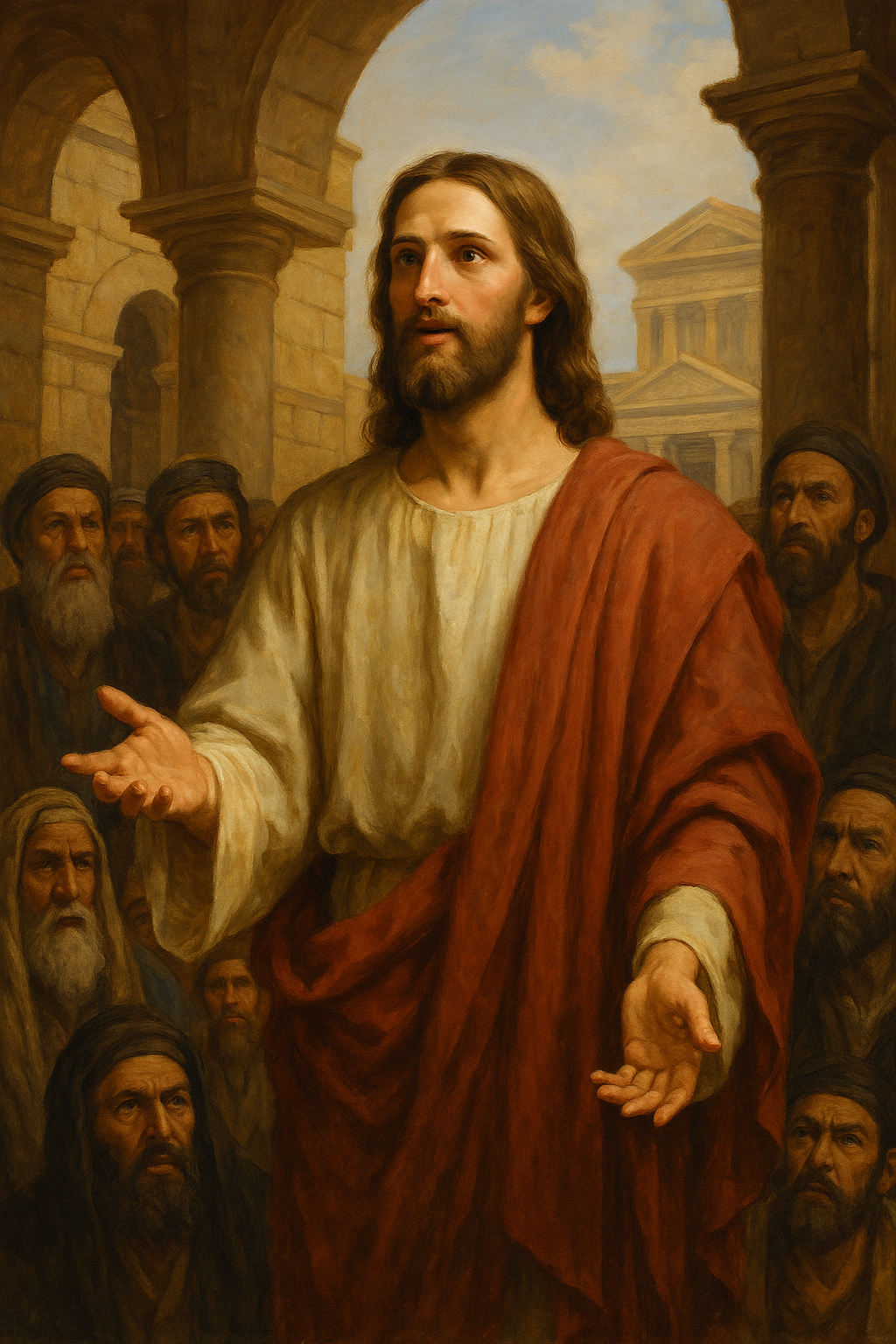
John 7:25–53 — Division and Unbelief Among the People
Theme: Jesus’ identity causes confusion, division, and fear—but His words pierce through appearances and reveal the heart.
Could This Be the Christ?
25 Now some of them from Jerusalem said, “Is this not He whom they seek to kill?
26 But look! He speaks boldly, and they say nothing to Him. Do the rulers know indeed that this is truly the Christ?
27 However, we know where this Man is from; but when the Christ comes, no one knows where He is from.”
28 Then Jesus cried out, as He taught in the temple, saying, “You both know Me, and you know where I am from; and I have not come of Myself, but He who sent Me is true, whom you do not know.
29 But I know Him, for I am from Him, and He sent Me.”
30 Therefore they sought to take Him; but no one laid a hand on Him, because His hour had not yet come.
31 And many of the people believed in Him, and said, “When the Christ comes, will He do more signs than these which this Man has done?”
Jesus and the Religious Leaders
32 The Pharisees heard the crowd murmuring these things concerning Him, and the Pharisees and the chief priests sent officers to take Him.
33 Then Jesus said to them, “I shall be with you a little while longer, and then I go to Him who sent Me.
34 You will seek Me and not find Me, and where I am you cannot come.”
35 Then the Jews said among themselves, “Where does He intend to go that we shall not find Him? Does He intend to go to the Dispersion among the Greeks and teach the Greeks?
36 What is this thing that He said, ‘You will seek Me and not find Me, and where I am you cannot come’?”
The Promise of the Holy Spirit
37 On the last day, that great day of the feast, Jesus stood and cried out, saying, “If anyone thirsts, let him come to Me and drink.
38 He who believes in Me, as the Scripture has said, out of his heart will flow rivers of living water.”
39 But this He spoke concerning the Spirit, whom those believing in Him would receive; for the Holy Spirit was not yet given, because Jesus was not yet glorified.
Who Is He?
40 Therefore many from the crowd, when they heard this saying, said, “Truly this is the Prophet.”
41 Others said, “This is the Christ.” But some said, “Will the Christ come out of Galilee?
42 Has not the Scripture said that the Christ comes from the seed of David and from the town of Bethlehem, where David was?”
43 So there was a division among the people because of Him.
44 Now some of them wanted to take Him, but no one laid hands on Him.
Rejected by the Authorities
45 Then the officers came to the chief priests and Pharisees, who said to them, “Why have you not brought Him?”
46 The officers answered, “No man ever spoke like this Man!”
47 Then the Pharisees answered them, “Are you also deceived?
48 Have any of the rulers or the Pharisees believed in Him?
49 But this crowd that does not know the law is accursed.”
50 Nicodemus (he who came to Jesus by night, being one of them) said to them,
51 “Does our law judge a man before it hears him and knows what he is doing?”
52 They answered and said to him, “Are you also from Galilee? Search and look, for no prophet has arisen out of Galilee.”
53 And everyone went to his own house.
📋 Gospel Parallel Table
John 7:25–53 is unique to the Gospel of John, but the themes of division, debate, and Jesus’ identity appear across the Gospels. Here’s how this passage harmonizes with similar moments elsewhere:
| Theme or Event | Matthew | Mark | Luke | John |
|---|---|---|---|---|
| Confusion about Jesus’ identity | Matt. 13:54–57 | Mark 6:2–3 | Luke 4:22–30 | John 7:25–27, 40–43 |
| Attempts to arrest Jesus | Matt. 26:3–5 | Mark 14:1 | Luke 22:2 | John 7:30, 32, 44–46 |
| Jesus teaches publicly despite danger | Matt. 26:55 | — | — | John 7:26, 28 |
| Divided public opinion | Matt. 16:13–14 | Mark 8:27–28 | Luke 9:18–19 | John 7:12, 43 |
| Nicodemus defends fairness | — | — | — | John 7:50–52 |
🔍 Parallel Highlights
- Public division about Jesus—whether He is the Prophet, the Christ, or a deceiver—is seen in all four Gospels. His identity challenges everyone.
- Fear of the authorities also appears frequently. People hesitate to speak openly (John 7:13), just like Joseph of Arimathea later fears the Jews (John 19:38).
- The officers’ comment—“No man ever spoke like this Man!”—shows Jesus’ unique authority, echoed in the Synoptics where the crowds are often astonished at His teaching (e.g., Matt. 7:28–29).
🧭 Harmony with the Gospels
🔍 1. Confusion About the Messiah’s Origin
“We know where this Man is from… But when the Christ comes, no one knows where He is from.” (v. 27)
- This echoes the confusion in Matthew 13:55–57, when the people ask:“Is this not the carpenter’s son?… Where then did this Man get all these things?”
- In Luke 4:22, they marvel: “Is this not Joseph’s son?”
- Across the Gospels, Jesus’ humble background becomes a stumbling block to many.
🕊️ 2. Attempts to Arrest Jesus
“They sought to take Him… but no one laid a hand on Him.” (v. 30, 44)
- This theme runs throughout the Synoptics:
- Matthew 26:3–5 — The leaders plot to kill Jesus.
- Luke 22:2 — “They sought how they might kill Him…”
- Yet again and again, we’re told: His hour had not yet come. God’s timing rules over every attempt.
💬 3. Jesus Teaches Boldly Despite Threats
“He speaks boldly, and they say nothing to Him.” (v. 26)
- Compare:
- Matthew 26:55 — “I sat daily with you, teaching in the temple, and you did not seize Me.”
- Jesus’ fearless proclamation in public reveals His divine confidence and clarity—He speaks not to avoid danger, but to fulfill His mission.
🧑🤝🧑 4. Divided Crowds and Conflicting Opinions
“There was a division among the people because of Him.” (v. 43)
- In all Gospels, some say He’s the Christ, others say He has a demon, others are undecided.
- Matthew 16:13–14 — “Some say John the Baptist… Elijah… Jeremiah…”
- This mixture of belief and skepticism is always present.
🌘 5. Nicodemus Begins to Step Forward
“Does our law judge a man before it hears him?” (v. 51)
- Nicodemus had first come secretly by night (John 3). Now he speaks—gently but publicly—in Jesus’ defense.
- His growing courage is not yet full, but it’s clearly maturing.
- He will appear again at the burial (John 19:39) to honor Jesus openly.
This section shows the dividing line Jesus creates—not by hostility, but by truth. He speaks with grace and clarity, and the responses reveal the hearts of those listening. 💔💛
🕰️ Historical and Cultural Background
🎉 1. The Last Day of the Feast of Tabernacles
“On the last day, that great day of the feast…” (v. 37)
- This is the eighth day of Sukkot, also called Hoshana Rabbah (“The Great Salvation”).
- Each day, priests would carry water in a golden pitcher from the Pool of Siloam and pour it at the base of the altar while Psalms were sung—a symbol of God’s provision and hope for future rain and salvation (Isaiah 12:3).
- When Jesus says, “If anyone thirsts, let him come to Me and drink…”, He is directly connecting Himself to that ceremony.
- He is saying: “I am the fulfillment of this promise. Come to Me, and you’ll never thirst again.”
- This declaration would have been stunning and provocative to those present.
🧍 2. Identity Debates Rooted in Misunderstanding of Scripture
“Will the Christ come out of Galilee?” (v. 41)
- Many assumed the Messiah would come from Bethlehem, of David’s lineage (Micah 5:2).
- Ironically, Jesus was born in Bethlehem (Luke 2:4–7), but the people didn’t know His background fully.
- Their judgment is based on incomplete information and shallow assumptions—a repeated theme in Jesus’ ministry.
🕵️♂️ 3. Fear of the Authorities
“No one spoke openly of Him for fear of the Jews.” (v. 13)
“Are you also deceived?” (v. 47)
- The religious leaders had such strong influence and intimidation over the people that even the temple officers feared speaking favorably about Jesus.
- The ruling class held immense sway, both religiously and socially. To side with Jesus could mean social rejection, religious punishment, or worse.
🗣️ 4. The Remarkable Words of Jesus
“No man ever spoke like this Man!” (v. 46)
- In Jewish tradition, rabbis always taught by quoting others. Jesus, by contrast, spoke with original authority (cf. Matt. 7:28–29).
- His words were not just eloquent—they were alive. His teaching was so powerful that even officers sent to arrest Him were stopped in their tracks.
🌘 5. Nicodemus’ Boldness in a Tense Council
- Nicodemus speaks up during an intense debate, questioning whether their actions align with the Law (v. 50–51).
- While subtle, his question shows he is willing to stand for justice, even in a hostile crowd.
- This sets the stage for his later open support at Jesus’ burial.
In a time of loud celebration and whispered plots, Jesus stands and cries out truth. And once again, the people are divided—not by politics or tradition, but by the Word Himself.
🗝️ Key Word Studies
🗣️ 1. “Cried out” — Greek: krazō (κράζω)
- Used in: v. 28, 37 — “Then Jesus cried out…”
- Meaning: To shout, proclaim loudly with emotion or urgency.
- Insight: Jesus doesn’t speak softly here—He raises His voice. It’s a passionate, public cry, like a herald or prophet.He longs for people to understand, to come and live.
💧 2. “Thirsts” — Greek: dipsaō (διψάω)
- Used in: v. 37 — “If anyone thirsts, let him come to Me and drink.”
- Meaning: To be dry, to long for refreshment.
- Insight: Jesus is speaking spiritually. Thirst here refers to a deep soul-need, a longing that only He can satisfy—like in John 4 at the well.
🌊 3. “Living water” — Greek: hydōr zōn (ὕδωρ ζῶν)
- Used in: v. 38 — “Out of his heart will flow rivers of living water.”
- Meaning: Zōn means alive, flowing—not stagnant water.
- Insight: Living water was a term for fresh, running spring water—also a symbol in Scripture for the Holy Spirit, as explained in v. 39.This is the Spirit’s indwelling life, flowing outward.
⏰ 4. “His hour had not yet come” — Greek: hōra (ὥρα)
- Used in: v. 30 — “No one laid a hand on Him…”
- Meaning: A set time, divinely appointed moment.
- Insight: Jesus was not arrested because God’s sovereign timetable had not arrived. Every moment of His mission was precisely planned.
✋ 5. “Take” — Greek: piazō (πιάζω)
- Used in: v. 30, 32, 44 — “They sought to take Him…”
- Meaning: To seize, arrest, or lay hold of by force.
- Insight: Multiple times they attempt to seize Him, but it never succeeds—not because of hesitation, but because God’s will overruled human effort.
These words show the beauty of Jesus’ control, the Spirit’s promise, and the people’s confusion. It’s a dramatic scene—but through it, living water is offered to all who will come. 🕊️💧
🔍 Theological Themes
💧 1. Jesus Is the Source of Living Water (The Holy Spirit)
“If anyone thirsts, let him come to Me and drink… out of his heart will flow rivers of living water.” (vv. 37–38)
- Jesus boldly invites all to come—not just Jews, not just the learned, but “anyone.”
- This living water represents the Holy Spirit (v. 39), promised to believers after Jesus’ glorification (His death, resurrection, and ascension).
- It’s not only a gift to receive, but a gift that flows outward—the believer becomes a vessel of blessing to others.
⏰ 2. God’s Timing Is Sovereign
“No one laid a hand on Him, because His hour had not yet come.” (v. 30)
- God’s plan unfolds exactly on schedule—not too early, not too late.
- Even when opposition grows fierce, Jesus walks in peace, knowing He is under the Father’s protection until the appointed hour.
🕊️ 3. The Spirit Will Come After the Glorification of Christ
“The Holy Spirit was not yet given, because Jesus was not yet glorified.” (v. 39)
- This passage teaches that the Spirit’s full outpouring is tied to Jesus’ completed mission.
- After the cross and resurrection, the Spirit will come to indwell every believer, just as promised in Joel 2 and fulfilled in Acts 2.
🧍♂️ 4. Jesus Divides People with Truth
“So there was a division among the people because of Him.” (v. 43)
- Jesus doesn’t create division through conflict—He speaks pure truth, and it reveals the hearts of those who hear.
- Some believe, some question, some reject—but the division isn’t in Him. It’s in how He is received.
🕯️ 5. Nicodemus Begins to Shine in the Darkness
“Does our law judge a man before it hears him?” (v. 51)
- Nicodemus, once silent and secret, now defends Jesus before his peers.
- He is a picture of a heart slowly coming into the light, reminding us that faith can grow even in the shadows.
This portion of John’s Gospel is like a deep well—at the surface, confusion and tension swirl. But at the center is Jesus, crying out with hope, offering eternal life to every thirsty soul. 💛
🔗 Old Testament Connections
💧 1. Living Water and the Feast of Tabernacles — Isaiah 12:3; Zechariah 14:8, 16–17
“If anyone thirsts, let him come to Me and drink.” (v. 37)
- 📖 Isaiah 12:3 — “With joy you will draw water from the wells of salvation.”
- 📖 Zechariah 14:8 — “Living waters shall flow from Jerusalem…”
- During the Feast of Tabernacles, water-drawing rituals symbolized these very prophecies.
- Jesus steps into this imagery and declares Himself to be the fulfillment: not just bringing living water—but being it.
🕊️ 2. The Spirit as a Promised Gift — Joel 2:28–29
“This He spoke concerning the Spirit…” (v. 39)
- 📖 Joel 2:28 — “I will pour out My Spirit on all flesh…”
- Jesus’ promise looks forward to the day when the Spirit will dwell in all believers, a promise fulfilled at Pentecost (Acts 2).
- The outpouring will not be limited by tribe or status—but given to all who believe.
🌾 3. The Messiah’s Origin — Micah 5:2
*“Does the Christ come out of Galilee?”… “The Christ comes from Bethlehem…” (vv. 41–42)
- 📖 Micah 5:2 — “Out of you, Bethlehem… shall come forth to Me the One to be Ruler in Israel.”
- They knew the prophecy, but did not know Jesus’ birth story.
- The irony is sharp—they are correct about the Scripture but wrong about the Man standing in front of them.
⚖️ 4. Judging Justly — Deuteronomy 1:16–17
“Does our law judge a man before it hears him?” (v. 51)
- 📖 Deut. 1:17 — “You shall not show partiality in judgment… you shall hear the small as well as the great.”
- Nicodemus appeals to Mosaic justice—a law these leaders claimed to uphold. His voice quietly exposes their hypocrisy.
🕊️ 5. Division Among the People — Isaiah 8:14–15
“There was a division among the people because of Him.” (v. 43)
- 📖 Isaiah 8:14 — “He will be as a sanctuary, but a stone of stumbling… and a rock of offense…”
- Jesus fulfills Isaiah’s prophecy: the Messiah would both gather and divide, revealing the hearts of men.
Through every moment in this passage, Jesus stands as the fulfillment of ancient hope—but also the stone of stumbling for those unwilling to see. And still, He cries out: “If anyone thirsts…” 💧
✨
Thoughtful Reflection Questions
1. 💧 Am I still thirsty for more of Jesus—or have I tried to quench my thirst elsewhere?
“If anyone thirsts, let him come to Me and drink.” (v. 37)
- Where in my life do I feel spiritually dry or weary?
- What does it look like for me to truly come to Him and drink?
2. 🔍 Do I judge based on assumptions or seek to understand before forming conclusions?
“We know where this Man is from…” (v. 27)
- How often do I miss truth because I cling to surface-level understanding?
- Am I open to hearing what God is really saying—even when it challenges my expectations?
3. 🔥 Do I speak boldly like Nicodemus—even when surrounded by doubt or opposition?
“Does our law judge a man before it hears him?” (v. 51)
- Where might God be calling me to stand gently for truth, even when it’s unpopular?
- What step of courage can I take in my faith this week?
4. ⏳ Do I rest in the Father’s timing—or try to rush His plans?
“His hour had not yet come.” (v. 30)
- What is one area of my life I need to entrust again to God’s perfect timing?
- How can I grow in peaceful confidence that He is always on schedule?
5. 💛 What do I most desire to overflow from my life—words of fear or rivers of living water?
“Out of his heart will flow rivers of living water.” (v. 38)
- Is my life marked more by anxiety or refreshment?
- How can I stay filled so that I may overflow with grace to others?
✅ References
📖 Bible Translation
- The Holy Bible, New King James Version (NKJV).Nashville: Thomas Nelson, 1982.
- Purchase: Thomas Nelson NKJV or Amazon
🆓 Free Online Resources
- Strong, James.Strong’s Exhaustive Concordance of the Bible. Abingdon Press, 1890.
- Free access: Blue Letter Bible
- Greek words studied in this post:
- krazō (G2896) – cried out
- dipsaō (G1372) – thirsts
- hydōr zōn (G5204 + G2198) – living water
- hōra (G5610) – hour/time
- piazō (G4084) – to seize or arrest
- BibleHub Commentary on John 7:25–53.
- Cross-referenced passages available free at BibleGateway:
- Isaiah 12:3
- Zechariah 14:8, 16–17
- Joel 2:28–29
- Micah 5:2
- Deuteronomy 1:16–17
- Isaiah 8:14–15
💵 Paid Print or Digital Books used in this Post
- Carson, D.A. The Gospel According to John.Grand Rapids: Eerdmans, 1991.
- Tenney, Merrill C. John: The Gospel of Belief.Grand Rapids: Eerdmans, 1948.
- Purchase: Christianbook.com or Amazon
- Robertson, A.T. A Harmony of the Gospels.Grand Rapids: Harper & Row, 1922.
- Purchase: Christianbook.com or Amazon
Artificial Intelligence Assistance
ChatGPT. “Day 28 — The Study of Jesus, with Bonnie Moore: John 7:25–53 – Division and Unbelief Among the People.” OpenAI, 2025, https://chat.openai.com.
This post was prayerfully prepared in collaboration with ChatGPT. All Scripture is from the New King James Version (NKJV). Supporting references include Strong’s Concordance, historical sources, and harmony of the Gospels commentaries. May it refresh and equip every reader. 🕊️
Leave a Reply