
📖 John 5:24–30 (NKJV)
This passage is very uniquely John — full of deep theological richness and claims of divine authority that unfold Jesus’ identity as both Life-Giver and Judge.
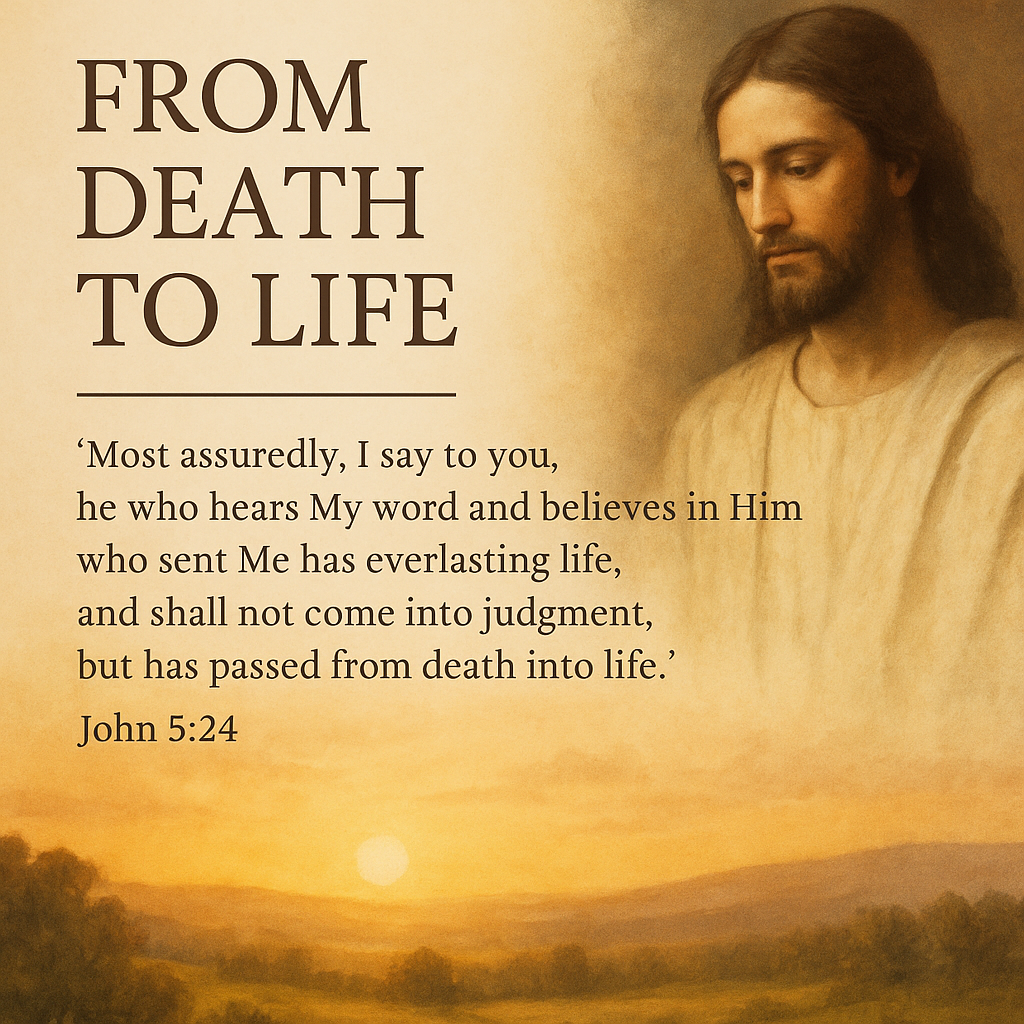
24 “Most assuredly, I say to you, he who hears My word and believes in Him who sent Me has everlasting life, and shall not come into judgment, but has passed from death into life.
25 Most assuredly, I say to you, the hour is coming, and now is, when the dead will hear the voice of the Son of God; and those who hear will live.
26 For as the Father has life in Himself, so He has granted the Son to have life in Himself,
27 and has given Him authority to execute judgment also, because He is the Son of Man.
28 Do not marvel at this; for the hour is coming in which all who are in the graves will hear His voice
29 and come forth—those who have done good, to the resurrection of life, and those who have done evil, to the resurrection of condemnation.
30 I can of Myself do nothing. As I hear, I judge; and My judgment is righteous, because I do not seek My own will but the will of the Father who sent Me.
🧭 Harmony with the Gospels
✨ Theme 1: Resurrection and Judgment
Jesus speaks of a time when “all who are in the graves will hear His voice” (v. 28). While this specific teaching is unique in clarity to John, echoes of resurrection and judgment are found elsewhere:
- Matthew 25:31–46 – The Son of Man separates the righteous from the wicked at the final judgment.
- Luke 14:14 – Jesus speaks of “the resurrection of the just.”
- Luke 20:35–36 – Those who are counted worthy attain the resurrection and “can die no more.”
✨ Theme 2: Jesus’ Authority from the Father
John 5:26–27 shows Jesus declaring His power to give life and to judge. This reflects the same divine authority seen when:
- Matthew 28:18 – “All authority has been given to Me in heaven and on earth.”
- Luke 10:22 – “All things have been delivered to Me by My Father…”
✨ Theme 3: Passing from Death to Life
Only John phrases it this way, but the Synoptics reflect it in different images:
- Luke 15:24 – “For this my son was dead and is alive again…” (Prodigal Son)
- Mark 12:27 – “He is not the God of the dead, but the God of the living.”
Summary:
Though the exact content of John 5:24–30 isn’t duplicated word-for-word in the other Gospels, the truths Jesus teaches — eternal life, judgment, resurrection, and His authority from the Father — are deeply harmonized in theme and doctrine.
🕰️ Historical and Cultural Background
🕎 1. Jewish Understanding of Resurrection and Judgment
At the time of Jesus, belief in a final resurrection was present among many Jews — particularly the Pharisees. However, it was often thought of as a distant, future event tied to the coming of the Messiah and the Day of the Lord.
- The Sadducees, on the other hand, rejected the resurrection entirely (Acts 23:8).
- The Pharisees believed in a bodily resurrection of the righteous — but not in the radical, present-tense authority Jesus claimed here.
🔍 Jesus saying “the hour is coming, and now is…” (v. 25) would have been shocking — He was claiming that resurrection power had already arrived through Himself.
👑 2. “Son of Man” — A Title with Deep Prophetic Meaning
In verse 27, Jesus says the Father has given Him authority because He is the “Son of Man.” This title:
- Is drawn from Daniel 7:13–14, where “One like the Son of Man” is given everlasting dominion by God.
- Was understood as a Messianic figure with divine authority — a ruler and judge.
By calling Himself the Son of Man here, Jesus was directly claiming that Daniel 7 prophecy — placing Himself as both Resurrector and Judge of all mankind. This was bold, divine, and unmistakably confrontational in the ears of His Jewish audience.
⚖️ 3. The Right to Judge
In Jewish thought, only God could judge the hearts of men (Genesis 18:25, Psalm 75:7). By claiming to execute judgment (v. 27), Jesus was again declaring Himself equal in authority with God — a major point of contention that leads into the growing opposition against Him.
✨ 4. Life in Himself (v. 26)
This phrase points to self-existence, a divine attribute. All other life comes from something or someone else — but God alone is the source of life.
For Jesus to say, “the Father has granted the Son to have life in Himself,” was a declaration that:
- He shares in God’s eternal nature
- He is the source of resurrection life
- He holds the keys to eternal destiny

✨ “Already, But Not Yet” — What Does It Mean?
The phrase “already, but not yet” describes the tension between what God has done in Christ and what will be completed at His final return.
It helps explain verses like John 5:24:
“…has everlasting life, and shall not come into judgment, but has passed from death into life.”
In other words — eternal life is already yours, but the fullness of it is still to come.
📖 Here’s How It Shows Up in Scripture
🕊️ Already:
- Believers are already forgiven (Colossians 2:13)
- Already seated with Christ in the heavenly places (Ephesians 2:6)
- Already made alive in Christ (John 5:25, Romans 6:11)
- Already have eternal life (John 3:36; 1 John 5:11)
⏳ Not Yet:
- But we still await the resurrection of the body (Romans 8:23)
- Still await the full redemption of creation (Romans 8:19–22)
- Still wait for the return of Christ and the final judgment (Revelation 20)
- We still experience suffering, sin, and death in this world.
📚 Where Did the Phrase Come From?
The term “already, but not yet” was popularized in modern theology by a scholar named George Eldon Ladd in the mid-20th century. He was a biblical scholar who studied the Kingdom of God and explained how:
The Kingdom has already come in Jesus’ ministry (Luke 17:21)
But the Kingdom is also not yet fully revealed until Jesus returns (Revelation 11:15)
It’s a way of helping believers live in the hope of what is promised, while trusting in what is already secured through Christ.
🌼 Why It Matters
This concept helps us:
- Understand why we still suffer, even though we are saved
- Trust that we are truly alive in Christ, even while we wait for glorification
- Rest in the security of God’s promises, even when the world looks broken
So when Jesus says in John 5:24 that we have “passed from death into life,” He means:
- 🕊️ Spiritually — already true
- 🌅 Bodily resurrection — not yet, but absolutely certain.
🔗 Old Testament Connections
✨ 1. Daniel 12:2 — Resurrection of the Righteous and the Wicked
“And many of those who sleep in the dust of the earth shall awake,
Some to everlasting life,
Some to shame and everlasting contempt.”
This passage directly parallels what Jesus says in John 5:28–29. He affirms the coming resurrection of all people — with two clear outcomes. The Jews who heard Him would have recognized this reference immediately, and likely understood it as a claim that Jesus Himself was the fulfiller and executor of Daniel’s prophecy.
✨ 2. Isaiah 26:19 — “Your Dead Shall Live”
“Your dead shall live;
Together with my dead body they shall arise.
Awake and sing, you who dwell in dust;
For your dew is like the dew of herbs,
And the earth shall cast out the dead.”
Isaiah spoke of a future time of resurrection, giving hope to the faithful in Israel. Jesus now says that this time is both coming and now is (v. 25) — because He is the One with the voice that calls the dead to life.
✨ 3. Psalm 103:17–18 — The Righteous Live by Covenant Faithfulness
“But the mercy of the Lord is from everlasting to everlasting
On those who fear Him…
To such as keep His covenant…”
While eternal life is a New Testament term, the roots of reward for the righteous and God’s mercy extending beyond death are deeply embedded in the Hebrew Scriptures. Jesus declares that this promise now finds its fulfillment in Him.
✨ 4. Genesis 18:25 — “Shall not the Judge of all the earth do right?”
Abraham’s question before the destruction of Sodom introduces the idea that God is Judge of all.
In John 5:27, Jesus claims that He has been given the authority to judge — not just Israel, but all of humanity. This was a radical claim of divine identity.
✨ Thoughtful Reflection Questions
- Jesus says that those who hear and believe “have passed from death into life.”
- 🌾 Do I live each day aware that I am already walking in eternal life — not just waiting for heaven, but living as one raised from the dead now?
- Christ has been given authority to execute judgment.
- 👑 How does knowing that Jesus — not anyone else — will be my final Judge affect how I live, how I love, and how I prioritize my time?
- Jesus describes a resurrection of both the righteous and the wicked.
- 🔥 Am I preparing my heart, not just to avoid condemnation, but to meet my Savior with joy and assurance, knowing I have walked in His will?
- He says, “the hour is coming, and now is…”
- 🌅 What does it mean to live in that “now”? How can I better live in awareness of the Kingdom that is already breaking into the present through Christ?
- Jesus said He seeks not His own will, but the will of the Father.
- 💛 Do I humbly seek the will of my Father above my own, even when it costs me my comfort or control?
✅ References
Scripture
All Scripture is taken from the New King James Version (NKJV) unless otherwise noted.
Word Studies & Language
Strong, James. Strong’s Exhaustive Concordance of the Bible. Nashville: Thomas Nelson, 1990.
Greek terms referenced via Strong’s numbers:
- akouō (ἀκούω) – G191
- pisteuō (πιστεύω) – G4100
- zōē aiōnios (ζωὴ αἰώνιος) – G2222, G166
- metabainō (μεταβαίνω) – G3327
- krisis (κρίσις) – G2920
Cultural and Historical Background
- Walton, John H., et al. The IVP Bible Background Commentary: New Testament. InterVarsity Press, 2014.
- Wright, N. T. Surprised by Hope: Rethinking Heaven, the Resurrection, and the Mission of the Church. HarperOne, 2008.
- Ladd, George Eldon. The Presence of the Future: The Eschatology of Biblical Realism. Eerdmans, 1974.
Old Testament References
- Daniel 12:2 – The resurrection of the just and unjust
- Isaiah 26:19 – A promise of bodily resurrection
- Psalm 103:17–18 – God’s everlasting mercy toward the faithful
- Genesis 18:25 – God’s just judgment
Artificial Intelligence Assistance
ChatGPT. “Day 20 — The Study of Jesus, with Bonnie Moore: John 5:24–30 – ‘From Death to Life.’” OpenAI, 2025, https://chat.openai.com.
This post was prayerfully prepared in collaboration with ChatGPT, a research assistant designed to support deep, Christ-centered Bible study. All Scripture is taken from the New King James Version (NKJV), and supporting references include Strong’s Concordance, cultural background texts, and trusted harmony of the Gospels materials. May this work bring glory to God and encouragement to the hearts of those who read it. 🕊️
Leave a Reply